
%201.svg)
Workforce planning becomes difficult when an organization has many records about employees but limited confidence in what those records say about current capability. A profile may list a skill because someone selected it, completed a course, earned a credential, used it in a previous role, or demonstrated it recently. Those signals are useful, but they are not equivalent.
Skills intelligence is an approach for organizing and interpreting skills data so HR, L&D, and workforce-planning teams can make better-informed decisions about capability, development, staffing, and future needs. The goal is not to create a perfect database of every skill. It is to create enough reliable context to answer practical questions such as which capabilities are available, where evidence is weak, which gaps matter, and what response is appropriate.
Quick answer: Skills intelligence combines skills taxonomies, inventories, assessments, workforce data, and analysis to build a more useful view of employee capabilities. It can support skills-based workforce planning, but the quality of the output depends on the quality, recency, validation, and governance of the underlying data.
For a broader public-sector definition, Cedefop describes skills intelligence as the outcome of identifying, analyzing, synthesizing, and presenting quantitative or qualitative skills and labor-market information. Organizations can adapt that principle to internal workforce decisions.
Why Job Titles Alone Are Not Enough for Workforce Planning
Job titles remain useful for organizational structure, compensation, reporting lines, and workforce administration. They are less reliable when used as a complete description of capability. Two employees with the same title can work with different systems, customers, products, markets, or levels of complexity. A skill label can also mean different things across teams.
Skills data adds another layer by describing capabilities more directly. It should not replace role architecture or manager judgment. Instead, it can help teams compare role requirements with available evidence and identify where further validation is needed.
Three questions are especially useful when reviewing a skills record:
- How recent is the evidence? A recently demonstrated capability may be more relevant to a current staffing decision than an old course completion.
- What does proficiency mean in this context? Basic familiarity, independent performance, and the ability to coach others are different levels.
- Where did the evidence come from? Self-report, manager observation, assessment results, credentials, and work evidence each have strengths and limitations.
What Skills Intelligence Should Measure
Skills should be treated as evidence-based judgments rather than permanent facts. Proficiency can change with practice, role changes, new tools, and periods of disuse. The same label can also carry different expectations in different jobs.
| Dimension | What to Review | Why It Matters |
|---|---|---|
| Proficiency | What level of performance is required and what level is supported by evidence? | Workforce decisions should distinguish awareness from independent performance or advanced expertise. |
| Recency | When was the capability last assessed or demonstrated? | Older evidence may need revalidation when tools, processes, or role requirements have changed. |
| Context | Where and how was the skill applied? | The same skill name may represent different work in different functions or industries. |
| Evidence source | Was the skill self-reported, manager-observed, assessed, credentialed, or demonstrated in work? | Different sources provide different levels and types of evidence. |
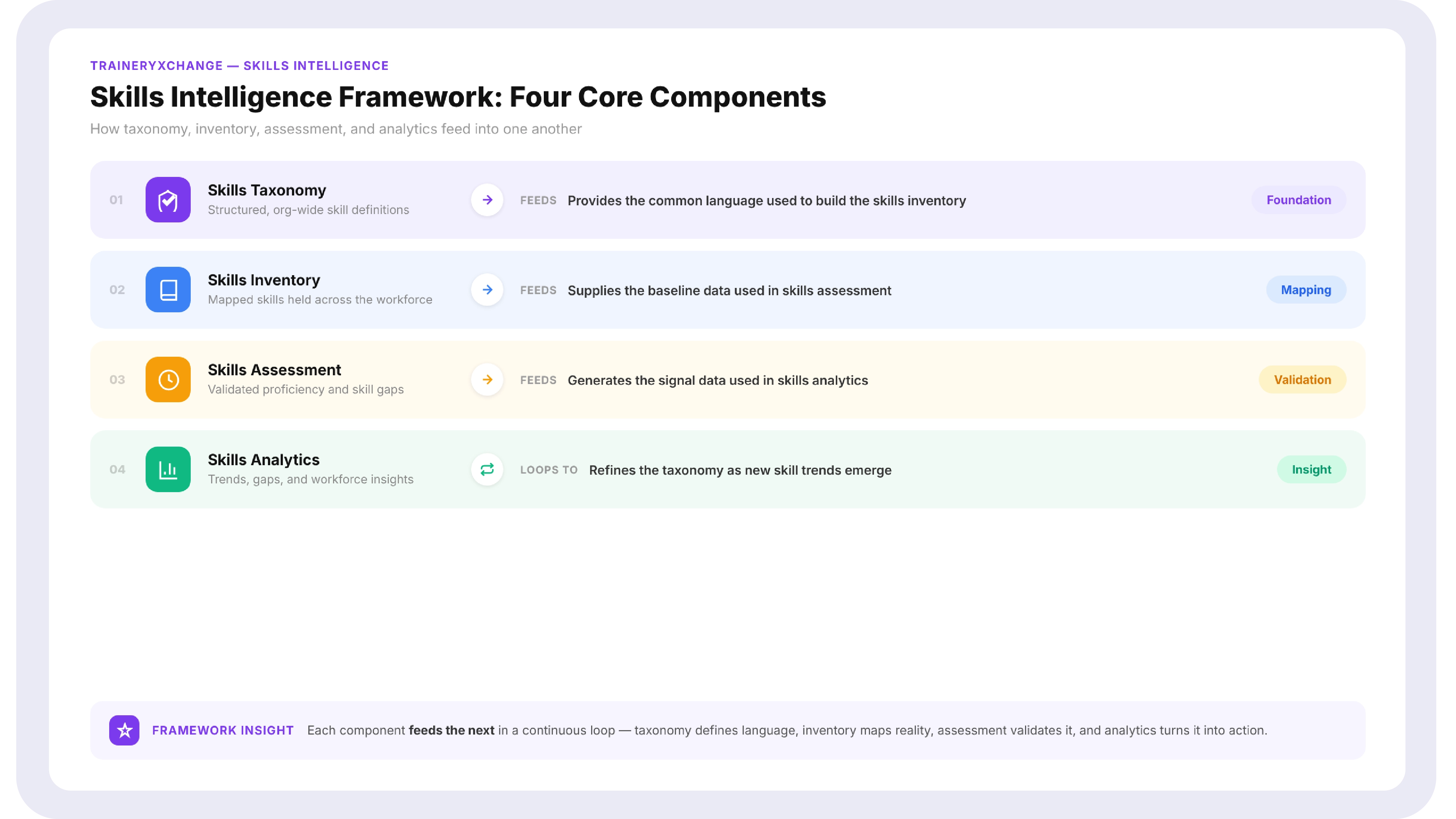
Four Components of a Practical Skills Intelligence Framework
1. Skills taxonomy
A skills taxonomy is a controlled vocabulary that defines the capabilities an organization wants to track and how those capabilities relate to roles, work, and development. A useful taxonomy is specific enough to support decisions without becoming so granular that teams cannot maintain it.
Taxonomy work should begin with decisions, not with a desire to catalog everything. If the purpose is workforce planning, define the roles and capabilities that materially affect staffing, succession, internal mobility, or development. Then document the proficiency language and evidence expected for those capabilities.
2. Skills inventory
A skills inventory records the capabilities associated with employees, teams, or roles. Inputs can include self-assessment, manager review, previous work, credentials, learning records, structured assessments, and other evidence that the organization is permitted to use.
Self-report can be a useful starting point because employees know about experience that may not appear in HR systems. It should be interpreted alongside other evidence when a decision is consequential. The right validation level depends on the use case.
3. Skills assessment
Assessment can add evidence to a skills inventory. Depending on the capability, this may involve a knowledge test, scenario, work sample, demonstration, manager observation, peer review, or credential verification. No single assessment format is appropriate for every skill.
Assessment should be designed around the decision it needs to support. A lightweight self-check may be sufficient for learning recommendations, while staffing a high-risk role may require stronger evidence.
4. Skills analytics
Skills analytics turns records into questions and comparisons. Useful outputs might include the difference between required and current capability for a role, the number of employees with recently validated evidence for a critical skill, or the distribution of proficiency across a team.
Analytics should communicate uncertainty where appropriate. A dashboard should not imply that an inferred or self-reported skill is equivalent to a validated performance measure.
Connect Priority Skills to Relevant Learning Resources
TraineryXchange can help L&D teams review curated training content for common leadership, compliance, and professional-development needs. Content availability, licensing, delivery options, and LMS compatibility should be confirmed for the selected courses and environment.
From Skills Data to Workforce Planning Decisions
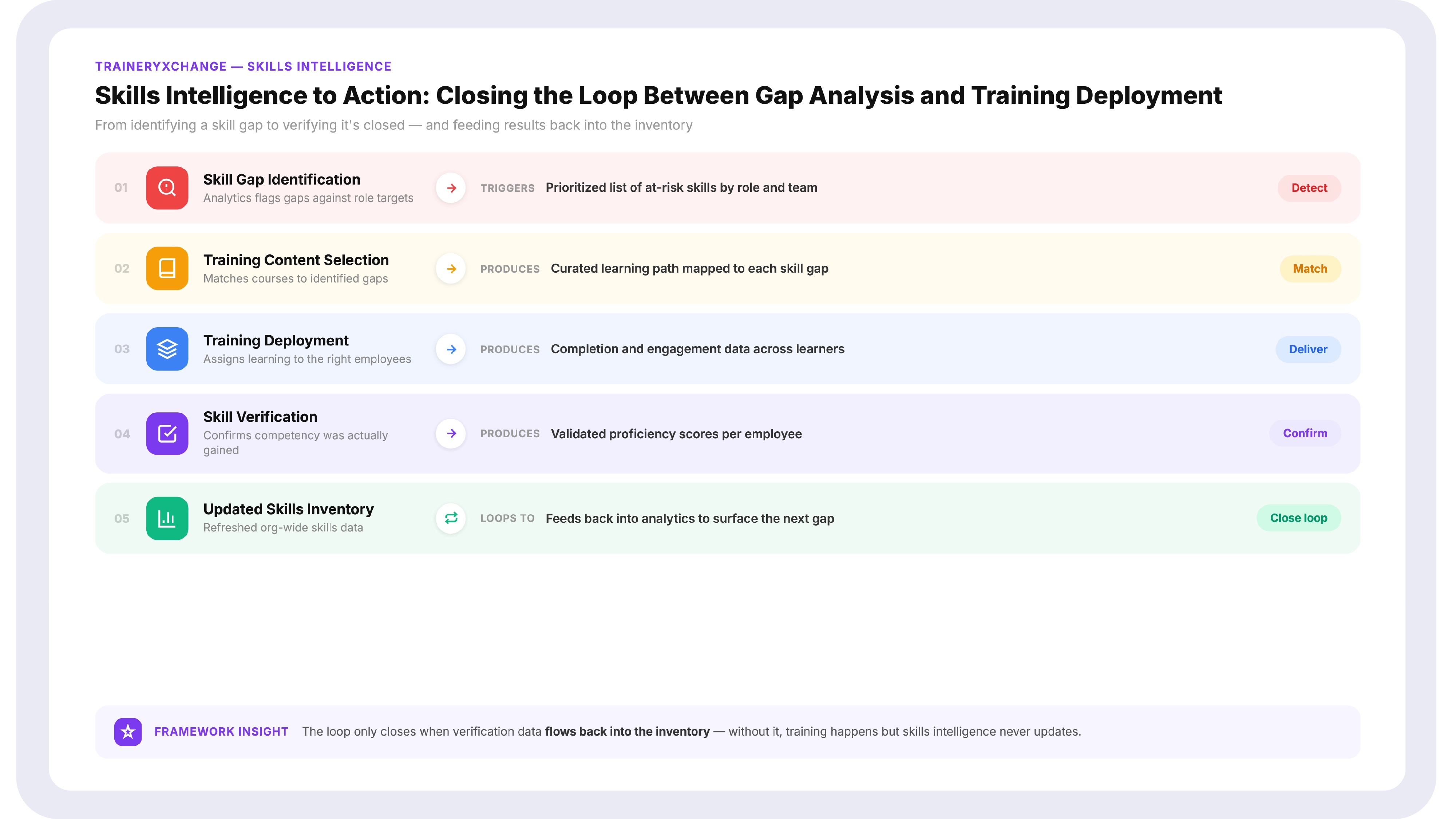
A useful skills-intelligence process connects data to a defined decision. Examples include deciding whether a project can be staffed internally, identifying development priorities for a role family, reviewing succession exposure, or deciding whether a capability should be developed, hired, contracted, or addressed through a process change.
Prioritize gaps by consequence and urgency
The largest numerical gap is not automatically the most important gap. A capability affecting a small number of safety-critical roles may deserve more attention than a broader, lower-consequence development need. Consider business relevance, timing, risk, available alternatives, and the feasibility of development.
Separate training gaps from non-training gaps
Training is appropriate when the problem is substantially related to knowledge or skill and learners have a realistic opportunity to apply the capability. A gap caused by missing tools, unclear process ownership, workload, incentives, access, or conflicting policies may require a different intervention.
Decide what to build and what to source
Organization-specific systems, products, procedures, and policy interpretation often require internally developed material. Common management, professional, software, safety, or compliance topics may be candidates for licensed or curated external content when the selected material fits the role, jurisdiction, standard, and delivery environment.
There is no universal percentage of skills gaps that should be sourced externally. The mix depends on the organization's work, risk profile, internal expertise, content budget, maintenance requirements, and available providers.
Map skills to development resources carefully
Connecting taxonomy terms to learning resources can reduce manual search effort, but a tag should not be treated as proof that a course develops a skill to the required level. L&D teams should review learning objectives, audience, prerequisites, practice opportunities, assessment, and content currency before assignment.
Common Skills Intelligence Implementation Risks
| Risk | What It Looks Like | Practical Response |
|---|---|---|
| Taxonomy without a decision model | Teams define many skills but cannot explain which workforce decisions the taxonomy supports. | Start with priority use cases and define only the detail required to support them. |
| Unvalidated evidence | High-stakes decisions rely on a single source such as self-report or old learning records. | Match the strength of validation to the consequence of the decision. |
| Dashboards without action | Skills data is reported but not connected to staffing, development, mobility, or hiring decisions. | Assign an owner and a next action for each priority finding. |
| Stale records | Skills remain on profiles long after roles, tools, or responsibilities change. | Use review dates and event triggers appropriate to the capability and use case. |
| Technology before governance | A platform is selected before data definitions, validation standards, privacy rules, or decision rights are clear. | Document the operating model before automating it. |
Evaluating Training Infrastructure for Skills-Based Development
When skills data identifies a development need, the training infrastructure should help administrators locate suitable resources, assign them to the appropriate audience, and review learning activity. Requirements vary, so buyers should verify the capabilities that matter in their environment.
- Taxonomy alignment: Can the organization map or tag content using its own skill language?
- Content fit: Does the available catalog cover the required topic, audience, proficiency level, jurisdiction, language, and format?
- Administration: Can assignments, groups, reminders, and reporting support the intended rollout?
- Delivery compatibility: Will the selected content work in the required LMS or delivery method?
- Content maintenance: Who is responsible for updates, and how are revised versions communicated or delivered?
SCORM, LTI, xAPI, hosted delivery, and other methods solve different technical problems. Compatibility and update behavior should be confirmed for the selected publisher, course, license, LMS, and configuration rather than assumed across an entire catalog.
Practical Next Steps for HR and L&D Teams
- Choose one workforce-planning question that matters to the business.
- Define the roles and skills required to answer that question.
- Document proficiency levels and acceptable evidence sources.
- Review the available skills data and mark where confidence is low.
- Validate only the capabilities that materially affect the decision.
- Classify each gap as training, hiring, process, tool, access, or another intervention.
- For training gaps, map appropriate learning resources and define how application will be checked.
- Set a review cadence so the skills record can change when new evidence appears.
Skills intelligence is most useful when it reduces uncertainty in a real workforce decision. It should not be treated as a promise that software can discover every capability automatically or predict future workforce needs with certainty. The value comes from combining better data, explicit definitions, appropriate validation, and disciplined follow-through.
Review Skills-Based Training Options with TraineryXchange
Discuss content discovery, curation, licensing, delivery, and TraineryLMS options for the development priorities identified through your skills-planning process. Available capabilities depend on the selected content and configuration.
Book a Demo



%5B1%5D.svg)
