
Key Principles of Cognitive Learning Theory in Online Education

Updated On:
June 25, 2026

Mahesh Kumar

Founder, TraineryHCM.com
Key Principles of Cognitive Learning

Table of Contents

What Is Cognitive Learning Theory?

Cognitive learning theory is a framework in educational psychology that explains how the mind actively processes and organizes new information. Rather than treating learners as passive recipients of knowledge, it focuses on the internal mental processes involved in understanding, memory, and problem-solving. In corporate training, this means designing programs that work with how the brain learns, not against it, by reducing unnecessary complexity, reinforcing key concepts over time, and connecting new skills to existing knowledge structures.

Why Cognitive Learning Theory Matters for Online Education and Corporate Training

Most corporate training programs are designed around delivery, not learning. Content is created, pushed to employees, and completion rates are tracked. But completion is not comprehension, and seat time is not skill transfer.

This gap between training activity and actual learning outcomes is where cognitive learning theory becomes directly relevant to HR leaders, L&D practitioners, and the enterprise learning platforms they rely on. Understanding how people actually process new information and what causes that information to stick or disappear is the foundation of effective instructional design.

In online education and digital corporate training, where learners are distributed, distracted, and often time-constrained, applying cognitive learning principles is not optional. It is the difference between training that drives measurable performance improvement and training that generates completion data with little real-world impact.
Align Workforce Capability with Cognitive Learning Principles

Explore how TraineryXchange's role-based learning paths align with cognitive learning principles. Browse the content marketplace.

Book a Demo
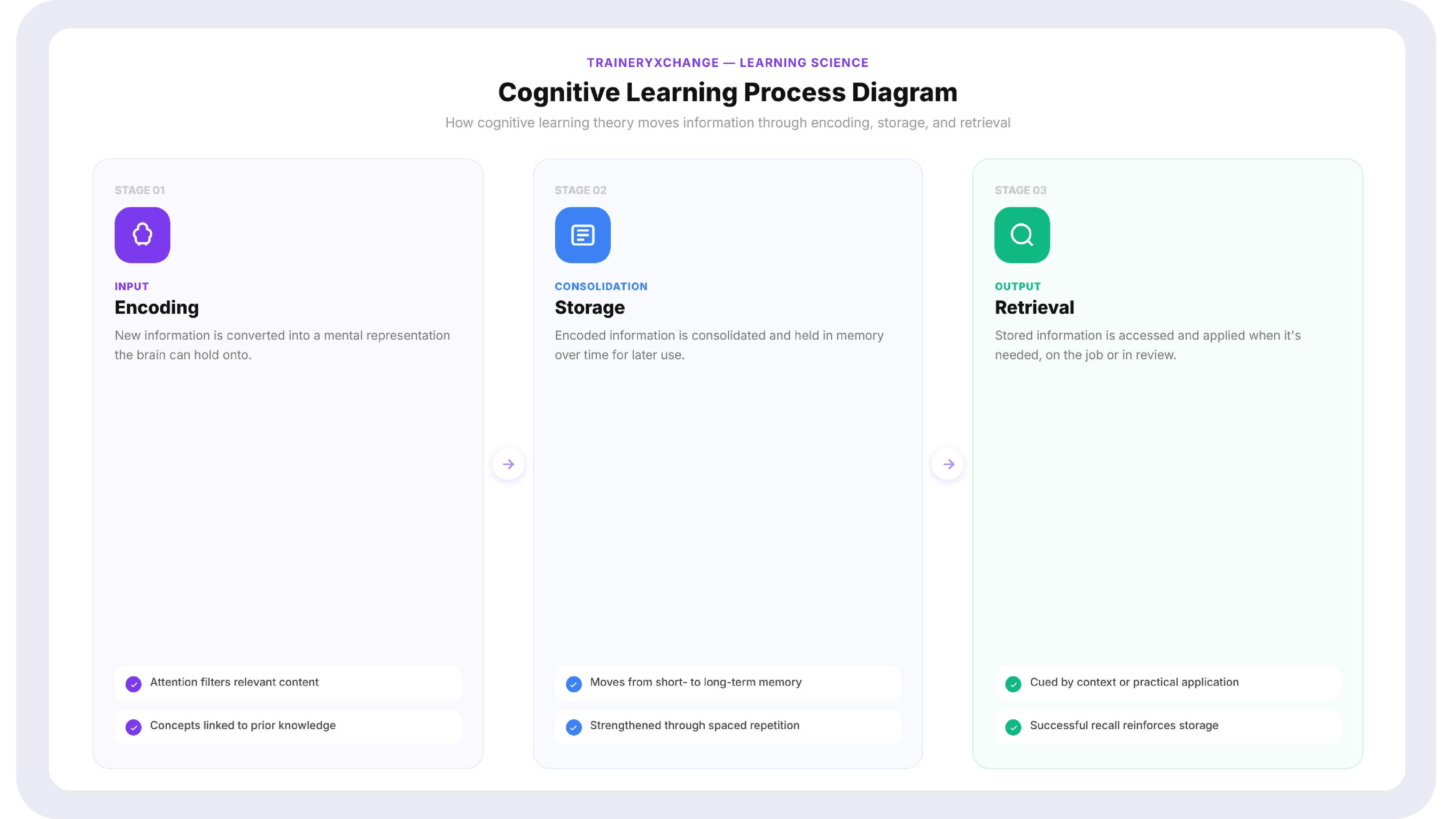
Diagram showing how cognitive learning theory processes information through encoding, storage, and retrieval

The Core Principles of Cognitive Learning Theory

Cognitive learning theory is not a single model but a collection of frameworks developed by researchers, including Jean Piaget, Lev Vygotsky, and later Sweller, Mayer, and others. The principles most relevant to online education and corporate training are:

1. Active Processing

Learners do not simply absorb information. They interpret, organize, and connect new content to what they already know. Effective eLearning design prompts learners to engage actively with material through reflection questions, decision scenarios, and applied exercises rather than passive video consumption.

In corporate training, this principle argues against long lecture-style courses and in favor of scenario-based learning, branching simulations, and real-world case studies that require learners to apply knowledge rather than recall it.

2. Schema Theory and Prior Knowledge

The brain organizes information into mental frameworks called schemas. When new information connects to an existing schema, it is encoded more effectively and retrieved more reliably. When it has no connection to prior knowledge, it is more likely to be forgotten.

Practical application: onboarding programs should begin by establishing a conceptual foundation before introducing complex policy or procedural content. Compliance training is more effective when it connects regulations to real situations employees already recognize from their roles.

3. Cognitive Load Theory

Developed by John Sweller, cognitive load theory identifies the limits of working memory and the importance of managing how much new information a learner is asked to process simultaneously. There are three types of cognitive load:

Load Type Definition Training Design Implication
Intrinsic Complexity inherent in the subject matter. Sequence content from simple to complex; use scaffolding.
Extraneous The load created by poor instructional design. Remove unnecessary visuals, redundant narration, and cluttered slides.
Germane Mental effort applied to building new schemas. Use worked examples, spaced practice, and reflection prompts to reinforce schema formation.

Reducing extraneous cognitive load is one of the most actionable improvements L&D teams can make to existing courses. Common mistakes include overloading slides with text, using unrelated imagery, and delivering audio and on-screen text simultaneously.

4. Spaced Repetition

The spacing effect, first identified by Hermann Ebbinghaus, demonstrates that information retained across multiple spaced learning sessions is remembered far more reliably than the same content delivered in a single session. In corporate training, this supports breaking programs into shorter modules delivered over time rather than marathon full-day sessions.

Spaced repetition is one of the strongest arguments for microlearning as a format. Delivering focused, 5-to-10-minute modules at intervals aligned with the learner's workflow produces measurably better retention than equivalent content delivered in a single course.

5. Retrieval Practice

Testing is not just an assessment tool. The act of retrieving information from memory strengthens the neural pathways associated with that information, making future retrieval faster and more reliable. This is known as the testing effect.

In eLearning design, this means incorporating low-stakes knowledge checks, scenario-based questions, and periodic review activities throughout a learning program, not just at the end. Enterprise learning platforms that support adaptive assessments can automate this process at scale.

6. Metacognition

Metacognition refers to a learner's awareness of their own thinking and learning processes. Learners who can reflect on how they understand and retain information are better equipped to self-direct their development. In corporate training, metacognitive activities include reflective journaling, self-assessment, and structured goal-setting before and after learning experiences.

7. Meaningful Learning and Transfer

Ausubel's meaningful learning theory emphasizes that information must be connected to a relevant context for it to transfer from short-term to long-term memory and ultimately to on-the-job behavior. This is why training that uses generic scenarios or fictional examples often fails to produce behavior change. The closer the training experience mirrors the actual work environment, the more effectively cognitive transfer occurs.

Cognitive Learning vs Behaviorism vs Constructivism

Understanding how cognitive learning theory relates to other dominant frameworks helps L&D teams make intentional design decisions rather than defaulting to familiar formats.

Framework Core Premise Learner Role Training Design Approach Best Used For
Behaviorism Learning is a change in observable behavior driven by stimuli and reinforcement. Passive recipient Repetition, reward, and immediate feedback. Compliance, safety procedures, basic skill drills.
Cognitive Learning Learning involves internal mental processing, memory, and schema formation. Active processor Spaced repetition, retrieval practice, and reduced cognitive load. Complex skills, leadership, analytical thinking.
Constructivism Learners build knowledge through experience and social interaction. Active co-creator Project-based learning, collaborative tasks, and real-world application. Problem-solving, innovation, and cross-functional collaboration.

Most enterprise training programs benefit from a hybrid approach. Compliance training may rely on behaviorist reinforcement. Leadership development calls for constructivist collaboration. Technical upskilling often benefits most from cognitive approaches centered on schema-building and retrieval practice.

How Microlearning Supports Cognitive Learning Theory

Microlearning has become one of the most widely discussed formats in corporate L&D, but it is most effective when its design is deliberately grounded in cognitive principles rather than simply shortened in length.

A five-minute video that dumps information without retrieval prompts, spacing, or schema connection is not cognitive microlearning. It is a short information transfer activity with limited learning impact.

Effective cognitive microlearning shares several characteristics:

  • Focuses on a single learning objective per module, reducing intrinsic and extraneous cognitive load.
  • Uses scenario-based questions or knowledge checks to activate retrieval practice immediately after content delivery.
  • Is designed to be repeated or revisited at intervals, supporting the spacing effect.
  • Connects explicitly to the learner's role and existing knowledge, enabling schema formation.
  • Is delivered in the flow of work, so cognitive transfer happens in the environment where the skill will be applied.

Enterprise learning platforms that support role-based content delivery and adaptive learning paths are the infrastructure that makes cognitive microlearning scalable across a distributed workforce.

Applying Cognitive Learning Theory in Corporate Training Programs

The distance between cognitive learning theory and corporate training practice is where most L&D programs lose effectiveness. The following applications represent the highest-impact areas for L&D teams looking to close that gap.

Onboarding Programs

Onboarding is one of the highest-stakes learning experiences in the employee lifecycle. Information is dense, time is compressed, and schema formation is starting from close to zero for most new hires.

Applying cognitive principles to onboarding means sequencing content from foundational to complex, using spaced delivery over the first 30 to 90 days rather than front-loading information in week one, and building in retrieval activities that reinforce critical policies, processes, and cultural norms over time.

Compliance Training

Compliance training is historically among the most poorly designed content in corporate L&D. Most compliance courses are built around information delivery and completion tracking, not learning.

Cognitive redesign of compliance training involves reducing extraneous load by removing unnecessary slides and legal text, using scenario-based questions that require learners to apply regulations to real situations, spacing compliance modules across the year rather than completing all requirements in a single annual session, and using retrieval practice to test application rather than recall of definitions.

Leadership Development

Leadership capability is complex, contextual, and difficult to develop through information transfer alone. Cognitive learning theory supports leadership programs that build schemas through case study analysis, reflection exercises, and coaching conversations that connect new frameworks to the leader's existing experience and challenges.

Technical Upskilling and Reskilling

Technical learning benefits strongly from cognitive sequencing: foundational concepts before advanced application, worked examples before independent practice, and spaced retrieval to build fluency over time. Role-based learning paths that connect technical skills to the specific tools and workflows a learner uses daily produce faster transfer and higher competency than general technical libraries.

Deploy Scalable Enterprise Workforce Development

See how TraineryXchange delivers role-based, compliance-ready training across your workforce. Request a demo to explore the platform.

Book a Demo
Enterprise learning platform showing role-based training paths, compliance tracking, and learner analytics

Common Instructional Design Mistakes That Increase Cognitive Load

Even well-intentioned training programs routinely violate cognitive learning principles. Identifying and correcting these mistakes is among the highest-ROI activities available to L&D teams.

Mistake Why It Increases Cognitive Load Cognitive Learning Fix
Text-heavy slides with narration that reads the same text aloud Redundancy effect: processing identical information through two channels simultaneously increases extraneous load. Separate visual and audio channels. Use images or diagrams on screen while narration adds context, not duplicated text.
Courses that cover all topics in a single long session Overloads working memory; spacing effect is lost. Break content into modules delivered over multiple sessions with retrieval activities between them.
Generic scenarios disconnected from the learner's actual role Prevents schema activation and reduces transfer. Use role-specific scenarios that mirror actual job situations learners encounter.
No assessment or knowledge check until the final quiz No retrieval practice during learning; the testing effect is not leveraged. Insert low-stakes checks after every major concept to activate retrieval throughout the course.
Visually complex course designs with decorative elements Decorative images and animations create extraneous cognitive load without supporting learning. Use visuals only when they clarify or extend the instructional content.
Front-loading all onboarding content in week one Working memory is saturated; new hires cannot form schemas when overwhelmed by volume. Distribute onboarding content across the first 90 days with intentional spacing and reinforcement.

How Enterprise Learning Platforms Apply Cognitive Learning Principles

The infrastructure of learning matters as much as the instructional design. An enterprise learning platform built around cognitive principles enables L&D teams to apply these concepts systematically and at scale, rather than relying on individual course designers to implement them inconsistently.

Key capabilities that reflect cognitive learning design in modern enterprise learning platforms include:

Role-Based and Personalized Learning Paths

Personalization is not a luxury feature. From a cognitive standpoint, connecting learning content to the specific schema a learner already holds based on their role, experience level, and prior training is the mechanism through which new information is most effectively encoded. Platforms that support role-based path creation allow L&D teams to deliver the right schema-building content at the right time, rather than assigning all learners identical curricula regardless of their starting point.

Spaced Content Delivery and Automated Reminders

Spacing requires scheduling. Platforms that automate the delivery of follow-up modules, review activities, and reinforcement nudges at appropriate intervals remove the administrative burden of implementing spacing manually while ensuring the cognitive benefit is realized consistently across the workforce.

Integrated Assessments and Adaptive Learning

Retrieval practice requires assessment capability embedded in the learning experience, not bolted on as a standalone evaluation. Platforms that support adaptive questioning, adjusting difficulty based on learner performance, deliver personalized retrieval practice that is calibrated to each learner's demonstrated knowledge gaps.

Compliance Tracking and Audit-Ready Reporting

Compliance training that applies cognitive principles still requires governance. Enterprise platforms that automate tracking, generate audit-ready reports, and manage role-based compliance assignments allow L&D and compliance teams to implement cognitively sound training programs without sacrificing regulatory accountability.

Content Quality and Instructional Design Standards

Cognitive learning principles only translate to outcomes when the content itself is well-designed. Access to a curated library of professionally developed courses built by instructional designers who understand cognitive load, retrieval, and schema formation reduces the risk of deploying content that violates the principles it is meant to apply.

Cognitive learning theory is not an academic concept reserved for educational psychologists. It is a practical framework that explains why some corporate training programs produce measurable behavior change, and others produce completion certificates.

The core principles active processing, schema formation, cognitive load management, spaced repetition, retrieval practice, and meaningful transfer provide L&D teams with a concrete design vocabulary and a set of actionable standards for evaluating and improving training programs.

Applied consistently, cognitive learning principles improve knowledge retention, accelerate skill transfer, reduce the volume of training required to produce outcomes, and increase learner engagement because the learning experience feels relevant and appropriately challenging.

The enterprise learning platforms that support these principles at scale through role-based personalization, spaced delivery, integrated assessment, and curated content libraries are the infrastructure through which cognitive learning theory moves from concept to measurable workforce impact.


Cognitively Aligned Learning

Shift Your Training Focus From Completion to Real Capability

TraineryXchange gives your L&D team a 10,000+ course library, built-in or integrated LMS, role-based learning paths, and compliance tracking, all deployable in less than 24 hours. If your training programs are producing completions but not capability, request a demo and see how cognitively aligned learning design at enterprise scale actually works.

Book a Demo

Key Takeaways

  • Cognitive learning theory focuses on how people process, store, and retrieve information, not just what they do after training.
  • Applying cognitive principles such as spaced repetition, retrieval practice, and reduced cognitive load significantly improves knowledge retention in corporate training.
  • Microlearning is one of the most effective formats for supporting cognitive learning in enterprise environments.
  • Modern enterprise learning platforms like TraineryXchange are built around these principles, enabling role-based, personalized learning journeys at scale.
  • L&D teams that align their training programs with cognitive learning theory see measurably higher learner engagement and skill transfer to the job.

What Is Cognitive Learning Theory?

Cognitive learning theory is a framework in educational psychology that explains how the mind actively processes and organizes new information. Rather than treating learners as passive recipients of knowledge, it focuses on the internal mental processes involved in understanding, memory, and problem-solving. In corporate training, this means designing programs that work with how the brain learns, not against it, by reducing unnecessary complexity, reinforcing key concepts over time, and connecting new skills to existing knowledge structures.

Why Cognitive Learning Theory Matters for Online Education and Corporate Training

Most corporate training programs are designed around delivery, not learning. Content is created, pushed to employees, and completion rates are tracked. But completion is not comprehension, and seat time is not skill transfer.

This gap between training activity and actual learning outcomes is where cognitive learning theory becomes directly relevant to HR leaders, L&D practitioners, and the enterprise learning platforms they rely on. Understanding how people actually process new information and what causes that information to stick or disappear is the foundation of effective instructional design.

In online education and digital corporate training, where learners are distributed, distracted, and often time-constrained, applying cognitive learning principles is not optional. It is the difference between training that drives measurable performance improvement and training that generates completion data with little real-world impact.

Align Workforce Capability with Cognitive Learning Principles

Explore how TraineryXchange's role-based learning paths align with cognitive learning principles. Browse the content marketplace.

Book a Demo
Diagram showing how cognitive learning theory processes information through encoding, storage, and retrieval

The Core Principles of Cognitive Learning Theory

Cognitive learning theory is not a single model but a collection of frameworks developed by researchers, including Jean Piaget, Lev Vygotsky, and later Sweller, Mayer, and others. The principles most relevant to online education and corporate training are:

1. Active Processing

Learners do not simply absorb information. They interpret, organize, and connect new content to what they already know. Effective eLearning design prompts learners to engage actively with material through reflection questions, decision scenarios, and applied exercises rather than passive video consumption.

In corporate training, this principle argues against long lecture-style courses and in favor of scenario-based learning, branching simulations, and real-world case studies that require learners to apply knowledge rather than recall it.

2. Schema Theory and Prior Knowledge

The brain organizes information into mental frameworks called schemas. When new information connects to an existing schema, it is encoded more effectively and retrieved more reliably. When it has no connection to prior knowledge, it is more likely to be forgotten.

Practical application: onboarding programs should begin by establishing a conceptual foundation before introducing complex policy or procedural content. Compliance training is more effective when it connects regulations to real situations employees already recognize from their roles.

3. Cognitive Load Theory

Developed by John Sweller, cognitive load theory identifies the limits of working memory and the importance of managing how much new information a learner is asked to process simultaneously. There are three types of cognitive load:

Load Type Definition Training Design Implication
Intrinsic Complexity inherent in the subject matter. Sequence content from simple to complex; use scaffolding.
Extraneous The load created by poor instructional design. Remove unnecessary visuals, redundant narration, and cluttered slides.
Germane Mental effort applied to building new schemas. Use worked examples, spaced practice, and reflection prompts to reinforce schema formation.

Reducing extraneous cognitive load is one of the most actionable improvements L&D teams can make to existing courses. Common mistakes include overloading slides with text, using unrelated imagery, and delivering audio and on-screen text simultaneously.

4. Spaced Repetition

The spacing effect, first identified by Hermann Ebbinghaus, demonstrates that information retained across multiple spaced learning sessions is remembered far more reliably than the same content delivered in a single session. In corporate training, this supports breaking programs into shorter modules delivered over time rather than marathon full-day sessions.

Spaced repetition is one of the strongest arguments for microlearning as a format. Delivering focused, 5-to-10-minute modules at intervals aligned with the learner's workflow produces measurably better retention than equivalent content delivered in a single course.

5. Retrieval Practice

Testing is not just an assessment tool. The act of retrieving information from memory strengthens the neural pathways associated with that information, making future retrieval faster and more reliable. This is known as the testing effect.

In eLearning design, this means incorporating low-stakes knowledge checks, scenario-based questions, and periodic review activities throughout a learning program, not just at the end. Enterprise learning platforms that support adaptive assessments can automate this process at scale.

6. Metacognition

Metacognition refers to a learner's awareness of their own thinking and learning processes. Learners who can reflect on how they understand and retain information are better equipped to self-direct their development. In corporate training, metacognitive activities include reflective journaling, self-assessment, and structured goal-setting before and after learning experiences.

7. Meaningful Learning and Transfer

Ausubel's meaningful learning theory emphasizes that information must be connected to a relevant context for it to transfer from short-term to long-term memory and ultimately to on-the-job behavior. This is why training that uses generic scenarios or fictional examples often fails to produce behavior change. The closer the training experience mirrors the actual work environment, the more effectively cognitive transfer occurs.

Cognitive Learning vs Behaviorism vs Constructivism

Understanding how cognitive learning theory relates to other dominant frameworks helps L&D teams make intentional design decisions rather than defaulting to familiar formats.

Framework Core Premise Learner Role Training Design Approach Best Used For
Behaviorism Learning is a change in observable behavior driven by stimuli and reinforcement. Passive recipient Repetition, reward, and immediate feedback. Compliance, safety procedures, basic skill drills.
Cognitive Learning Learning involves internal mental processing, memory, and schema formation. Active processor Spaced repetition, retrieval practice, and reduced cognitive load. Complex skills, leadership, analytical thinking.
Constructivism Learners build knowledge through experience and social interaction. Active co-creator Project-based learning, collaborative tasks, and real-world application. Problem-solving, innovation, and cross-functional collaboration.

Most enterprise training programs benefit from a hybrid approach. Compliance training may rely on behaviorist reinforcement. Leadership development calls for constructivist collaboration. Technical upskilling often benefits most from cognitive approaches centered on schema-building and retrieval practice.

How Microlearning Supports Cognitive Learning Theory

Microlearning has become one of the most widely discussed formats in corporate L&D, but it is most effective when its design is deliberately grounded in cognitive principles rather than simply shortened in length.

A five-minute video that dumps information without retrieval prompts, spacing, or schema connection is not cognitive microlearning. It is a short information transfer activity with limited learning impact.

Effective cognitive microlearning shares several characteristics:

  • Focuses on a single learning objective per module, reducing intrinsic and extraneous cognitive load.
  • Uses scenario-based questions or knowledge checks to activate retrieval practice immediately after content delivery.
  • Is designed to be repeated or revisited at intervals, supporting the spacing effect.
  • Connects explicitly to the learner's role and existing knowledge, enabling schema formation.
  • Is delivered in the flow of work, so cognitive transfer happens in the environment where the skill will be applied.

Enterprise learning platforms that support role-based content delivery and adaptive learning paths are the infrastructure that makes cognitive microlearning scalable across a distributed workforce.

Applying Cognitive Learning Theory in Corporate Training Programs

The distance between cognitive learning theory and corporate training practice is where most L&D programs lose effectiveness. The following applications represent the highest-impact areas for L&D teams looking to close that gap.

Onboarding Programs

Onboarding is one of the highest-stakes learning experiences in the employee lifecycle. Information is dense, time is compressed, and schema formation is starting from close to zero for most new hires.

Applying cognitive principles to onboarding means sequencing content from foundational to complex, using spaced delivery over the first 30 to 90 days rather than front-loading information in week one, and building in retrieval activities that reinforce critical policies, processes, and cultural norms over time.

Compliance Training

Compliance training is historically among the most poorly designed content in corporate L&D. Most compliance courses are built around information delivery and completion tracking, not learning.

Cognitive redesign of compliance training involves reducing extraneous load by removing unnecessary slides and legal text, using scenario-based questions that require learners to apply regulations to real situations, spacing compliance modules across the year rather than completing all requirements in a single annual session, and using retrieval practice to test application rather than recall of definitions.

Leadership Development

Leadership capability is complex, contextual, and difficult to develop through information transfer alone. Cognitive learning theory supports leadership programs that build schemas through case study analysis, reflection exercises, and coaching conversations that connect new frameworks to the leader's existing experience and challenges.

Technical Upskilling and Reskilling

Technical learning benefits strongly from cognitive sequencing: foundational concepts before advanced application, worked examples before independent practice, and spaced retrieval to build fluency over time. Role-based learning paths that connect technical skills to the specific tools and workflows a learner uses daily produce faster transfer and higher competency than general technical libraries.

Deploy Scalable Enterprise Workforce Development

See how TraineryXchange delivers role-based, compliance-ready training across your workforce. Request a demo to explore the platform.

Book a Demo
Enterprise learning platform showing role-based training paths, compliance tracking, and learner analytics

Common Instructional Design Mistakes That Increase Cognitive Load

Even well-intentioned training programs routinely violate cognitive learning principles. Identifying and correcting these mistakes is among the highest-ROI activities available to L&D teams.

Mistake Why It Increases Cognitive Load Cognitive Learning Fix
Text-heavy slides with narration that reads the same text aloud Redundancy effect: processing identical information through two channels simultaneously increases extraneous load. Separate visual and audio channels. Use images or diagrams on screen while narration adds context, not duplicated text.
Courses that cover all topics in a single long session Overloads working memory; spacing effect is lost. Break content into modules delivered over multiple sessions with retrieval activities between them.
Generic scenarios disconnected from the learner's actual role Prevents schema activation and reduces transfer. Use role-specific scenarios that mirror actual job situations learners encounter.
No assessment or knowledge check until the final quiz No retrieval practice during learning; the testing effect is not leveraged. Insert low-stakes checks after every major concept to activate retrieval throughout the course.
Visually complex course designs with decorative elements Decorative images and animations create extraneous cognitive load without supporting learning. Use visuals only when they clarify or extend the instructional content.
Front-loading all onboarding content in week one Working memory is saturated; new hires cannot form schemas when overwhelmed by volume. Distribute onboarding content across the first 90 days with intentional spacing and reinforcement.

How Enterprise Learning Platforms Apply Cognitive Learning Principles

The infrastructure of learning matters as much as the instructional design. An enterprise learning platform built around cognitive principles enables L&D teams to apply these concepts systematically and at scale, rather than relying on individual course designers to implement them inconsistently.

Key capabilities that reflect cognitive learning design in modern enterprise learning platforms include:

Role-Based and Personalized Learning Paths

Personalization is not a luxury feature. From a cognitive standpoint, connecting learning content to the specific schema a learner already holds based on their role, experience level, and prior training is the mechanism through which new information is most effectively encoded. Platforms that support role-based path creation allow L&D teams to deliver the right schema-building content at the right time, rather than assigning all learners identical curricula regardless of their starting point.

Spaced Content Delivery and Automated Reminders

Spacing requires scheduling. Platforms that automate the delivery of follow-up modules, review activities, and reinforcement nudges at appropriate intervals remove the administrative burden of implementing spacing manually while ensuring the cognitive benefit is realized consistently across the workforce.

Integrated Assessments and Adaptive Learning

Retrieval practice requires assessment capability embedded in the learning experience, not bolted on as a standalone evaluation. Platforms that support adaptive questioning, adjusting difficulty based on learner performance, deliver personalized retrieval practice that is calibrated to each learner's demonstrated knowledge gaps.

Compliance Tracking and Audit-Ready Reporting

Compliance training that applies cognitive principles still requires governance. Enterprise platforms that automate tracking, generate audit-ready reports, and manage role-based compliance assignments allow L&D and compliance teams to implement cognitively sound training programs without sacrificing regulatory accountability.

Content Quality and Instructional Design Standards

Cognitive learning principles only translate to outcomes when the content itself is well-designed. Access to a curated library of professionally developed courses built by instructional designers who understand cognitive load, retrieval, and schema formation reduces the risk of deploying content that violates the principles it is meant to apply.

Cognitive learning theory is not an academic concept reserved for educational psychologists. It is a practical framework that explains why some corporate training programs produce measurable behavior change, and others produce completion certificates.

The core principles active processing, schema formation, cognitive load management, spaced repetition, retrieval practice, and meaningful transfer provide L&D teams with a concrete design vocabulary and a set of actionable standards for evaluating and improving training programs.

Applied consistently, cognitive learning principles improve knowledge retention, accelerate skill transfer, reduce the volume of training required to produce outcomes, and increase learner engagement because the learning experience feels relevant and appropriately challenging.

The enterprise learning platforms that support these principles at scale through role-based personalization, spaced delivery, integrated assessment, and curated content libraries are the infrastructure through which cognitive learning theory moves from concept to measurable workforce impact.

Cognitively Aligned Learning

Shift Your Training Focus From Completion to Real Capability

TraineryXchange gives your L&D team a 10,000+ course library, built-in or integrated LMS, role-based learning paths, and compliance tracking, all deployable in less than 24 hours. If your training programs are producing completions but not capability, request a demo and see how cognitively aligned learning design at enterprise scale actually works.

Book a Demo

Frequently Asked Questions

How can cognitive learning theory improve compliance training outcomes?
What should L&D teams look for in an enterprise learning platform that supports cognitive learning design?
How does microlearning support cognitive learning principles?
What is the difference between cognitive learning and behaviorist learning in workplace training?
How does cognitive load theory apply to eLearning course design?
What is cognitive learning theory, and why does it matter for corporate training?