Essential Soft Skills Training for Managers in 2026: Skills, Strategies, and Delivery at Scale

Updated On:
June 29, 2026

Mahesh Kumar

Founder, TraineryHCM.com
Essential Soft Skills Training for Managers in 2026

Table of Contents

What Is Soft Skills Training for Managers?

Soft skills training for managers is a structured learning program designed to develop the interpersonal, communication, and leadership capabilities that drive team performance, employee engagement, and organizational effectiveness. Unlike technical or hard skills training, soft skills development focuses on behaviors that are harder to quantify but more consequential for management outcomes: how a manager communicates expectations, handles conflict, coaches performance, responds to change, and makes decisions under pressure. In 2026, soft skills training for managers has become a strategic priority for organizations navigating hybrid work, multi-generational teams, and accelerating organizational change.

Why Soft Skills Training for Managers Is a Strategic Priority in 2026

The manager's role has fundamentally changed. In the past, management authority was derived primarily from technical expertise and hierarchical position. A manager knew more than their team, directed work clearly, and evaluated performance against defined standards.

That model no longer holds across most industries and organizational structures. In 2026, managers operate in hybrid environments where influence matters more than physical presence. They lead multi-generational teams with different communication preferences, motivational drivers, and expectations of leadership. They are expected to coach performance, not just evaluate it, and to facilitate development conversations that employees now consider a prerequisite for retention.

The skills required to do this effectively are not technical. They are relational, behavioral, and communicative. And for most managers at every level, they are the skills least systematically developed by organizations.

This gap has measurable consequences. Managers who lack soft skills produce disengaged teams, higher attrition, lower productivity, and elevated conflict. Managers who have developed these capabilities produce the opposite outcomes. The business case for soft skills training is not abstract. It is visible in retention rates, engagement scores, team performance data, and the frequency of escalated HR issues.
Empower Your Next Generation of Leaders

TraineryXchange offers a curated library of management and leadership courses ready to deploy across your organization today. Explore the corporate training marketplace.

Book a Demo
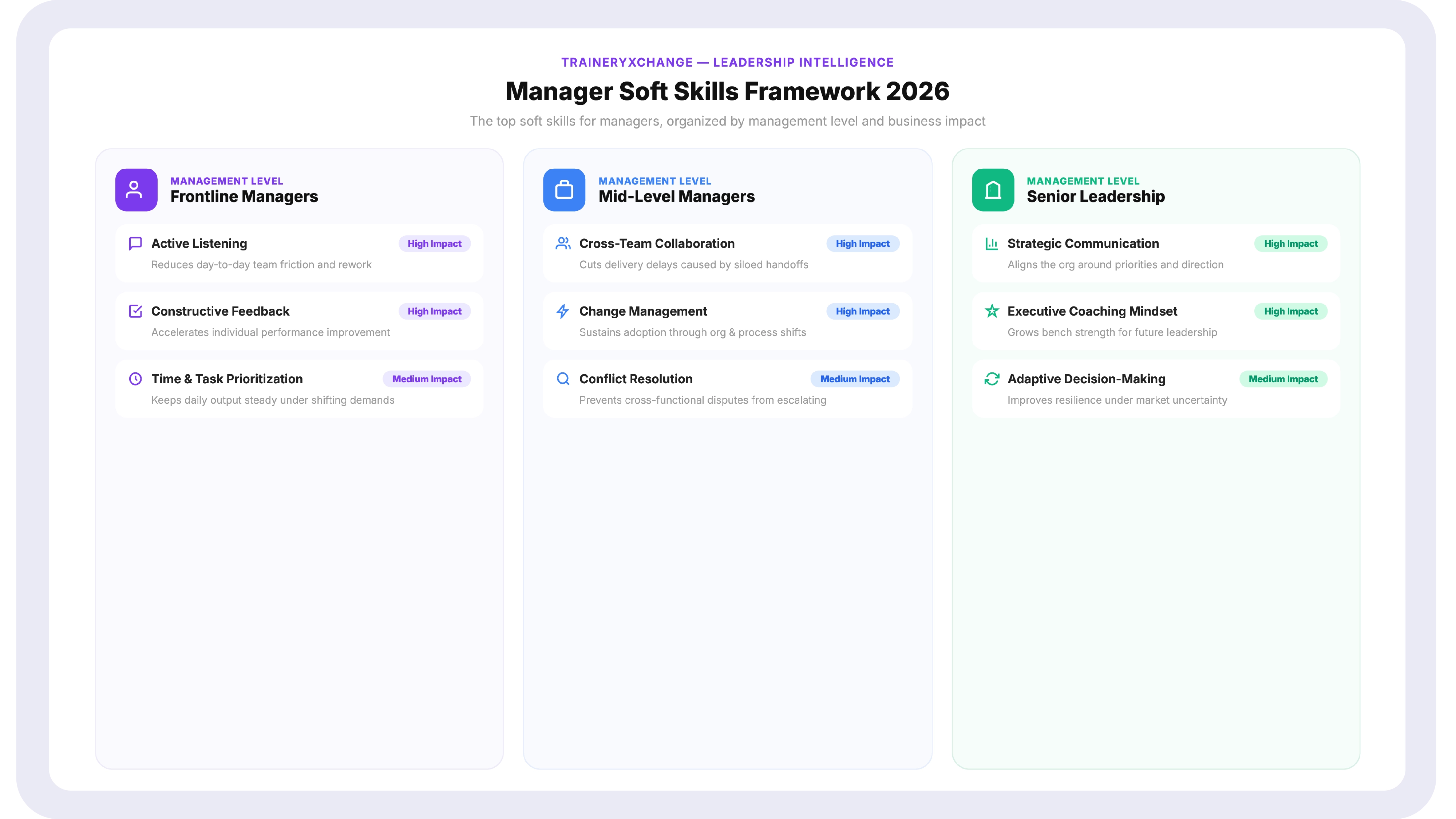
Diagram showing the top soft skills for managers in 2026, organized by management level and business impact

The Top 10 Soft Skills Every Manager Needs in 2026

The following skills are ranked by their organizational impact across industries and management levels, based on L&D priorities, workforce research, and the shifting demands of hybrid, multi-generational work environments.

1. Communication Across Channels and Audiences

Effective managerial communication in 2026 extends well beyond clarity in meetings. Managers must communicate precisely in writing for asynchronous teams, adapt their style for different generational preferences, deliver difficult feedback constructively, and align their messaging with organizational strategy. Communication failures at the manager level are the leading cause of team misalignment, performance gaps, and retention problems.

Training focus: written communication for distributed teams, delivering feedback, active listening, and audience-aware messaging.

2. Emotional Intelligence

Emotional intelligence, the ability to recognize, understand, and manage one's own emotions and respond appropriately to the emotions of others, is the soft skill most consistently correlated with manager effectiveness across research and organizational data. Managers with high emotional intelligence navigate conflict with less escalation, coach performance more effectively, retain high performers at higher rates, and build psychologically safe team environments that produce better results.

Training focus: self-awareness, empathy, emotional regulation, and social awareness in management interactions.

3. Coaching and Developing Others

The transition from individual contributor to manager is fundamentally a transition from doing to enabling. Managers who can identify development opportunities, ask questions that build capability rather than just directing outcomes, and hold structured development conversations are the managers whose teams grow fastest and stay longest. Coaching is no longer a skill reserved for senior leaders or executive development programs. It is a baseline expectation for managers at every level.

Training focus: coaching conversations, performance development planning, strengths-based feedback, and structured 1:1 frameworks.

4. Conflict Resolution and Difficult Conversations

Unresolved conflict is one of the highest-cost management failures in any organization. When managers lack the skills to address performance issues directly, mediate team disputes constructively, or navigate disagreements between stakeholders, conflict either escalates to HR or persists as a low-level drag on team performance and engagement.

Training focus: interest-based conflict resolution, managing performance conversations, de-escalation techniques, and navigating disagreement with senior stakeholders.

5. Decision-Making Under Uncertainty

Managers in 2026 are making consequential decisions faster, with less complete information, and with more organizational dependencies than their counterparts a decade ago. Structured decision-making frameworks, the ability to distinguish high-stakes from low-stakes decisions, and the confidence to act under ambiguity are critical differentiators between managers who accelerate organizational momentum and those who become bottlenecks.

Training focus: decision frameworks, bias recognition in judgment, risk assessment, and escalation criteria.

6. Delegation and Accountability

Managers who cannot delegate effectively create two simultaneous problems: they become overloaded and reactive, and their team members remain underdeveloped and under-challenged. Effective delegation is not task assignment. It is a skill that requires clarity about expected outcomes, appropriate authority transfer, follow-through without micromanagement, and accountability conversations when expectations are not met.

Training focus: delegation frameworks, outcome-based accountability conversations, follow-up without micromanaging, and escalation management.

7. Adaptability and Change Leadership

Organizational change is now a permanent condition rather than a periodic event. Managers are the primary translation layer between strategic change and team-level execution. Their ability to process change with stability, communicate it with transparency, address team resistance constructively, and maintain productivity through transitions directly determines how effectively organizations implement strategic initiatives.

Training focus: change communication frameworks, managing team resistance, maintaining performance continuity through transitions, and modeling adaptive behavior.

8. Time Management and Prioritization

Management roles generate more competing demands than almost any other position in an organization. Managers who have not developed structured prioritization skills default to reactive task management, which produces low-value output, missed deadlines on strategic priorities, and chronic overload. Effective time and priority management at the manager level has compounding effects on team planning, resource allocation, and organizational throughput.

Training focus: prioritization frameworks, calendar discipline, managing competing stakeholder demands, and recognizing and reducing reactive work patterns.

9. Inclusion and Cross-Cultural Communication

Workforce diversity has increased across virtually every industry and organizational level. Managers who cannot lead inclusively, who communicate primarily in one style, make assumptions about motivation or performance based on cultural background, or fail to create environments where diverse perspectives are heard, produce team dynamics that constrain performance and increase attrition. Inclusion is not a compliance topic in 2026. It is a core management effectiveness skill.

Training focus: inclusive communication, bias recognition in performance management, cultural competence, and equitable recognition practices.

10. Resilience and Wellbeing Leadership

Manager well-being has direct effects on team well-being, engagement, and performance. Managers who model resilience, manage stress visibly and productively, and actively support their team's wellbeing create environments with lower burnout rates and higher sustained performance. Conversely, managers in chronic overload or poor emotional regulation create team cultures characterized by anxiety, disengagement, and attrition.

Training focus: resilience practices, recognizing burnout signals in teams, wellbeing conversations, and boundary-setting as a leadership behavior.

Role-Based Learning Paths: Soft Skills Training by Management Level

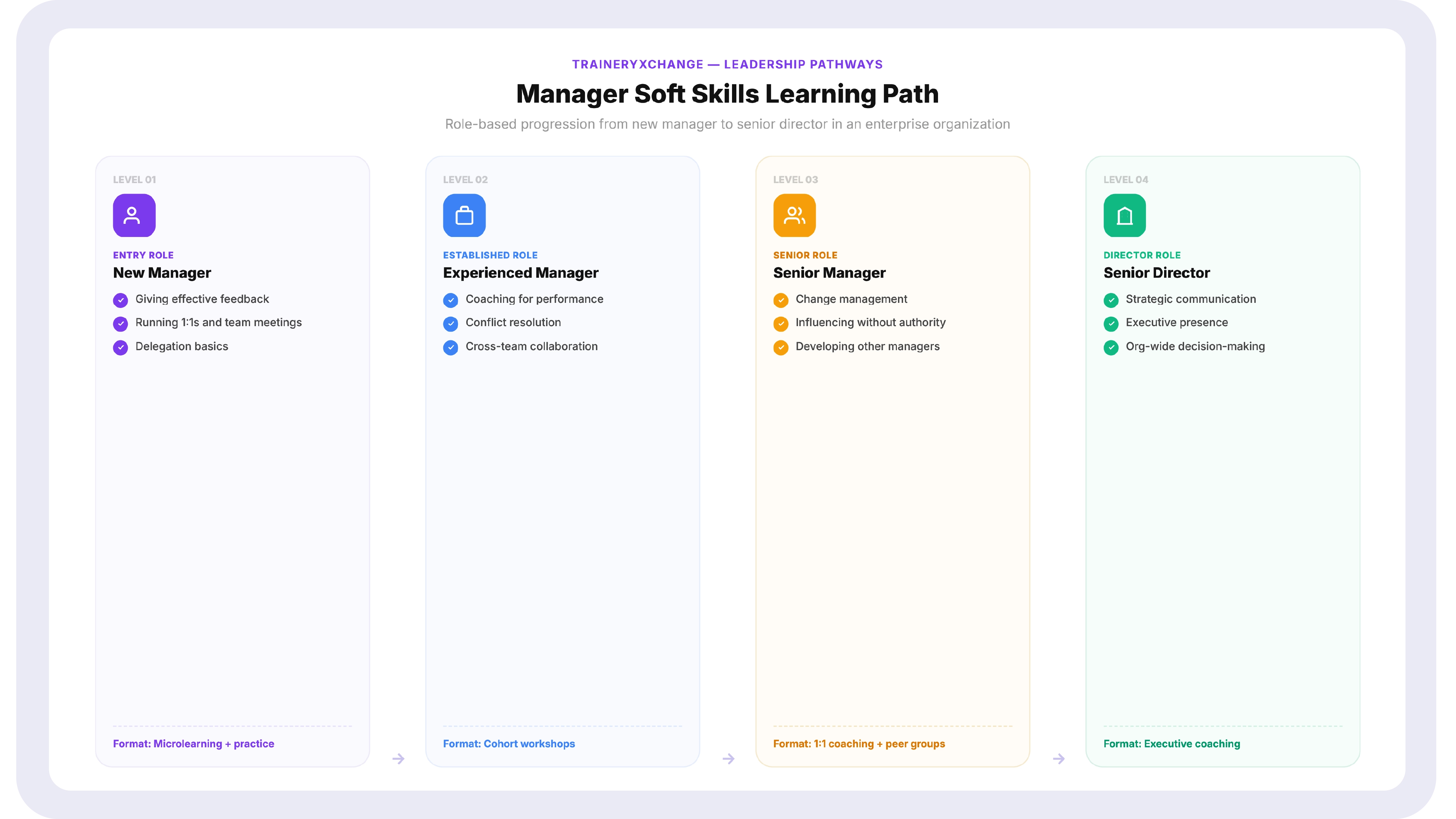
Generic management training programs attempt to serve every manager simultaneously and end up developing none of them effectively. The soft skills that matter most to a first-time manager leading a team of four are fundamentally different from those required by a senior director leading multiple teams through organizational change. Role-based learning paths address this by matching training priorities to the actual development needs of each management stage.

Management Level Primary Development Gap Priority Soft Skills Recommended Training Formats Success Indicator
New and First-Time Managers (0–18 Months) Transitioning from an individual contributor to a people leader by building authority through relationships rather than technical expertise. Communication, emotional intelligence, delegation, coaching conversations, feedback delivery, and conflict management. Structured onboarding learning paths, microlearning modules, scenario-based practice, manager cohort learning, and peer coaching. Reduced time to management proficiency, lower first-year team turnover, stronger upward feedback scores, and improved employee engagement.
Mid-Level Managers (Managing Managers or Larger Teams) Scaling influence beyond direct reports while managing performance through cross-functional collaboration and stakeholder alignment. Coaching other managers, strategic decision-making, cross-functional communication, leadership influence, stakeholder management, and prioritization. Self-paced learning libraries, facilitated leadership workshops, action learning projects, and complex scenario-based simulations. Higher employee engagement, fewer conflict escalations, improved performance review quality, and stronger cross-functional outcomes.
Senior Managers and Directors (Strategic Leadership) Leading through ambiguity, shaping organizational culture, influencing without direct authority, and building executive stakeholder credibility. Adaptability, executive communication, strategic influence, resilience, organizational leadership, and executive presence. Executive coaching, peer learning groups, strategic workshops, stretch assignments, and supported content from leadership programs. Leadership pipeline readiness, higher retention of high-potential talent, stronger executive alignment, and successful cross-functional initiatives.

Best Learning Formats for Soft Skills Training in Enterprise Settings

Soft skills are behavioral skills. They are developed through practice, reflection, feedback, and repetition, not through information consumption. This has direct implications for which learning formats produce results and which produce completion rates without capability change.

Format How It Supports Soft Skills Development Best Used For Limitation
Microlearning Modules (5–10 Minutes) Focus on a single skill or competency, reduce cognitive load, and reinforce learning through spaced repetition and retrieval practice. Introducing communication frameworks, decision-making tools, coaching techniques, and other manager skills that can be applied immediately. Does not build true skill fluency on its own and must be paired with practice opportunities.
Scenario-Based eLearning Places managers in realistic situations requiring judgment, communication, and people decisions to strengthen transfer of learning. Conflict resolution, difficult conversations, feedback delivery, coaching, and other situations requiring nuanced judgment. Effectiveness depends heavily on realistic scenarios and role relevance; generic scenarios reduce learning transfer.
Instructor-Led Training (ILT) Provides live practice, peer interaction, facilitated reflection, and relationship building that digital learning alone cannot replicate. Executive presence, negotiation, leadership development, team dynamics, and other high-stakes interpersonal skills. Resource-intensive and difficult to scale consistently across distributed organizations.
Blended Learning Paths Combines self-paced learning with live practice and reflection to accommodate different learning preferences while reinforcing skill development. Comprehensive leadership and management development programs delivered over several weeks or months. Requires greater instructional design effort to sequence, coordinate, and measure learning effectively.
Coaching Integration Applies learning directly to each manager's real work through structured one-to-one coaching conversations, providing the highest level of transfer. Senior leadership development, executive coaching, performance improvement, succession planning, and leadership transitions. Higher cost per learner and difficult to scale without a robust coaching infrastructure.

The most effective enterprise soft skills programs combine microlearning for skill introduction, scenario-based practice for application, and either cohort learning or coaching for reflection and accountability. Organizations that rely on a single format of self-paced eLearning alone consistently report lower behavioral transfer and weaker management development outcomes.
Scale Your Management Development Strategy

TraineryXchange's enterprise learning platform supports blended delivery, role-based learning paths, and a curated library of pre-built management and leadership courses. Request a demo to build your manager training program.

Book a Demo
Role-based learning path diagram showing soft skills training progression from new manager to senior director level in an enterprise organization

Measuring the ROI of Soft Skills Training for Managers

Soft skills training ROI is measurable, but the measurement framework must connect training activity to organizational outcomes rather than relying on completion rates and learner satisfaction surveys. Both metrics are useful for program management, but they tell organizations almost nothing about whether manager behavior has changed or whether team performance has improved as a result.

Metric What It Actually Measures How to Track Timeframe
Manager Net Promoter Score (mNPS) How likely employees are to recommend their manager, serving as a leading indicator of team engagement, retention risk, and overall management effectiveness. Conduct pulse surveys sent directly to employees at regular 90-day intervals. 90 days after training and then on an ongoing basis.
Employee Engagement Delta Changes in team engagement scores for managers who completed training compared with a control group or pre-training baseline. Analyze engagement survey results segmented by manager and training completion status. Approximately 6 months after training.
Voluntary Attrition Within Managed Teams Whether employees leave trained managers at higher or lower rates, providing a high-cost indicator of management quality. Review HR attrition data segmented by direct manager. Rolling 12-month measurement window.
Performance Review Quality Score Whether manager-authored performance reviews demonstrate stronger coaching, communication, and feedback skills. Evaluate reviews using HR calibration sessions or structured rubric scoring. During the next performance review cycle.
Conflict Escalation Frequency How often employee issues escalate to HR, serving as a measurable indicator of conflict resolution and communication effectiveness. Track HR case records by manager and team. Quarterly comparison before and after training.
360-Degree Feedback Scores Behavioral self-assessment combined with peer and direct-report feedback on targeted leadership and soft skills. Conduct structured 360-degree assessments before training and again six months afterward. Pre-training and 6 months post-training.

Organizations with access to an enterprise learning platform that integrates training completion data with HR performance metrics can automate much of this measurement, connecting program participation to the business outcomes that justify continued investment in management development.

Recommended Off-the-Shelf Soft Skills Courses for Managers

Building custom soft skills content from scratch is expensive, time-intensive, and often unnecessary. A well-curated training marketplace gives L&D teams immediate access to professionally designed courses across every major management soft skill, deployable directly into an existing LMS or through a built-in platform.

When evaluating off-the-shelf soft skills courses for managers, prioritize:

  • Role relevance: Does the course use realistic management scenarios rather than generic workplace examples?
  • Skill specificity: Does the course focus on a single skill or a tightly defined cluster rather than covering ten topics at a surface level?
  • Application activities: Does the course include practice exercises, knowledge checks, or reflection prompts rather than passive video consumption?
  • Modular design allows individual modules to be extracted and placed into role-based learning paths, or is the course only available as a single monolithic unit?
  • Update cadence is the content current for 2026 workplace realities, including hybrid management, remote team dynamics, and multi-generational communication?

A corporate training marketplace with a curated library of pre-built management courses covering communication, emotional intelligence, coaching, conflict resolution, decision-making, and leadership development removes the procurement and development burden from L&D teams while maintaining quality standards across the organization.

Delivering Soft Skills Training at Scale: Enterprise Considerations

Soft skills training for a team of 20 is a scheduling and content problem. Soft skills training for an organization of 2,000 managers across multiple regions, roles, and time zones is an infrastructure problem. The two require fundamentally different approaches.

Enterprise delivery of soft skills training programs requires:

Centralized Governance with Regional Flexibility

L&D teams need to define the core soft skills curriculum that applies across the organization while allowing regional or business unit leaders to adjust content for local cultural context, regulatory environment, or role-specific needs. An enterprise learning platform with role-based assignment and regional content management makes this possible without requiring parallel administration tracks.

Automated Enrollment and Scheduling

Manual enrollment for enterprise management training programs creates administrative overhead that scales linearly with workforce size and slows deployment. Platforms that automate enrollment based on role, tenure, or development plan parameters allow L&D teams to launch programs for hundreds of managers simultaneously without manual setup.

Progress Tracking and Completion Visibility

Managers and their HR business partners need visibility into training progress without requiring manual reporting. Real-time dashboards showing completion status, assessment scores, and learning path progress by manager level, region, or business unit provide the operational intelligence needed to identify gaps, follow up with non-completers, and report to senior leadership on program reach.

Integration with Existing HR and Performance Systems

Soft skills training is most effective when connected to the performance management cycle, development planning conversations, and succession planning processes. Enterprise learning platforms that integrate with HRIS and performance systems allow training data to inform performance reviews and development plans rather than existing as a separate administrative record.

The soft skills that determine manager effectiveness in 2026 are not new. Communication, emotional intelligence, coaching, conflict resolution, adaptability, and decision-making have always mattered. What has changed is how consequential the absence of these skills has become in an era of hybrid work, multi-generational teams, and continuous organizational change.

Organizations that invest systematically in soft skills training for managers with role-based learning paths, appropriate delivery formats, and measurement frameworks connected to organizational outcomes build management populations that retain talent, accelerate team performance, and execute strategy more reliably.

The practical question is not whether to invest in manager soft skills training. It is how to design, deliver, and scale programs that produce genuine behavioral change rather than completed courses.


Enterprise Management Leadership

Transform Manager Training Into Measurable Leadership Performance

TraineryXchange gives your L&D team instant access to a curated library of management and leadership courses, role-based learning path tools, automated enrollment, and enterprise-grade compliance tracking, all deployable in less than 24 hours. If your managers are completing training without developing capability, request a demo and see what a properly designed management development program looks like at enterprise scale.

Book a Demo

Key Takeaways

  • The most critical soft skills for managers in 2026 span communication, emotional intelligence, coaching, conflict resolution, adaptability, and decision-making, and the weight of each varies by management level.
  • Soft skills are now the primary determinant of manager effectiveness in hybrid and distributed work environments where technical authority matters less than relational influence.
  • Role-based learning paths designed separately for new, mid-level, and senior managers produce significantly better skill development outcomes than generic management training catalogs.
  • Microlearning, scenario-based practice, and spaced delivery are the most effective formats for soft skills training in enterprise settings.
  • Measuring the impact of soft skills training requires connecting program completion to behavioral indicators and organizational outcomes, not just learner satisfaction scores.

What Is Soft Skills Training for Managers?

Soft skills training for managers is a structured learning program designed to develop the interpersonal, communication, and leadership capabilities that drive team performance, employee engagement, and organizational effectiveness. Unlike technical or hard skills training, soft skills development focuses on behaviors that are harder to quantify but more consequential for management outcomes: how a manager communicates expectations, handles conflict, coaches performance, responds to change, and makes decisions under pressure. In 2026, soft skills training for managers has become a strategic priority for organizations navigating hybrid work, multi-generational teams, and accelerating organizational change.

Why Soft Skills Training for Managers Is a Strategic Priority in 2026

The manager's role has fundamentally changed. In the past, management authority was derived primarily from technical expertise and hierarchical position. A manager knew more than their team, directed work clearly, and evaluated performance against defined standards.

That model no longer holds across most industries and organizational structures. In 2026, managers operate in hybrid environments where influence matters more than physical presence. They lead multi-generational teams with different communication preferences, motivational drivers, and expectations of leadership. They are expected to coach performance, not just evaluate it, and to facilitate development conversations that employees now consider a prerequisite for retention.

The skills required to do this effectively are not technical. They are relational, behavioral, and communicative. And for most managers at every level, they are the skills least systematically developed by organizations.

This gap has measurable consequences. Managers who lack soft skills produce disengaged teams, higher attrition, lower productivity, and elevated conflict. Managers who have developed these capabilities produce the opposite outcomes. The business case for soft skills training is not abstract. It is visible in retention rates, engagement scores, team performance data, and the frequency of escalated HR issues.

Empower Your Next Generation of Leaders

TraineryXchange offers a curated library of management and leadership courses ready to deploy across your organization today. Explore the corporate training marketplace.

Book a Demo
Diagram showing the top soft skills for managers in 2026, organized by management level and business impact

The Top 10 Soft Skills Every Manager Needs in 2026

The following skills are ranked by their organizational impact across industries and management levels, based on L&D priorities, workforce research, and the shifting demands of hybrid, multi-generational work environments.

1. Communication Across Channels and Audiences

Effective managerial communication in 2026 extends well beyond clarity in meetings. Managers must communicate precisely in writing for asynchronous teams, adapt their style for different generational preferences, deliver difficult feedback constructively, and align their messaging with organizational strategy. Communication failures at the manager level are the leading cause of team misalignment, performance gaps, and retention problems.

Training focus: written communication for distributed teams, delivering feedback, active listening, and audience-aware messaging.

2. Emotional Intelligence

Emotional intelligence, the ability to recognize, understand, and manage one's own emotions and respond appropriately to the emotions of others, is the soft skill most consistently correlated with manager effectiveness across research and organizational data. Managers with high emotional intelligence navigate conflict with less escalation, coach performance more effectively, retain high performers at higher rates, and build psychologically safe team environments that produce better results.

Training focus: self-awareness, empathy, emotional regulation, and social awareness in management interactions.

3. Coaching and Developing Others

The transition from individual contributor to manager is fundamentally a transition from doing to enabling. Managers who can identify development opportunities, ask questions that build capability rather than just directing outcomes, and hold structured development conversations are the managers whose teams grow fastest and stay longest. Coaching is no longer a skill reserved for senior leaders or executive development programs. It is a baseline expectation for managers at every level.

Training focus: coaching conversations, performance development planning, strengths-based feedback, and structured 1:1 frameworks.

4. Conflict Resolution and Difficult Conversations

Unresolved conflict is one of the highest-cost management failures in any organization. When managers lack the skills to address performance issues directly, mediate team disputes constructively, or navigate disagreements between stakeholders, conflict either escalates to HR or persists as a low-level drag on team performance and engagement.

Training focus: interest-based conflict resolution, managing performance conversations, de-escalation techniques, and navigating disagreement with senior stakeholders.

5. Decision-Making Under Uncertainty

Managers in 2026 are making consequential decisions faster, with less complete information, and with more organizational dependencies than their counterparts a decade ago. Structured decision-making frameworks, the ability to distinguish high-stakes from low-stakes decisions, and the confidence to act under ambiguity are critical differentiators between managers who accelerate organizational momentum and those who become bottlenecks.

Training focus: decision frameworks, bias recognition in judgment, risk assessment, and escalation criteria.

6. Delegation and Accountability

Managers who cannot delegate effectively create two simultaneous problems: they become overloaded and reactive, and their team members remain underdeveloped and under-challenged. Effective delegation is not task assignment. It is a skill that requires clarity about expected outcomes, appropriate authority transfer, follow-through without micromanagement, and accountability conversations when expectations are not met.

Training focus: delegation frameworks, outcome-based accountability conversations, follow-up without micromanaging, and escalation management.

7. Adaptability and Change Leadership

Organizational change is now a permanent condition rather than a periodic event. Managers are the primary translation layer between strategic change and team-level execution. Their ability to process change with stability, communicate it with transparency, address team resistance constructively, and maintain productivity through transitions directly determines how effectively organizations implement strategic initiatives.

Training focus: change communication frameworks, managing team resistance, maintaining performance continuity through transitions, and modeling adaptive behavior.

8. Time Management and Prioritization

Management roles generate more competing demands than almost any other position in an organization. Managers who have not developed structured prioritization skills default to reactive task management, which produces low-value output, missed deadlines on strategic priorities, and chronic overload. Effective time and priority management at the manager level has compounding effects on team planning, resource allocation, and organizational throughput.

Training focus: prioritization frameworks, calendar discipline, managing competing stakeholder demands, and recognizing and reducing reactive work patterns.

9. Inclusion and Cross-Cultural Communication

Workforce diversity has increased across virtually every industry and organizational level. Managers who cannot lead inclusively, who communicate primarily in one style, make assumptions about motivation or performance based on cultural background, or fail to create environments where diverse perspectives are heard, produce team dynamics that constrain performance and increase attrition. Inclusion is not a compliance topic in 2026. It is a core management effectiveness skill.

Training focus: inclusive communication, bias recognition in performance management, cultural competence, and equitable recognition practices.

10. Resilience and Wellbeing Leadership

Manager well-being has direct effects on team well-being, engagement, and performance. Managers who model resilience, manage stress visibly and productively, and actively support their team's wellbeing create environments with lower burnout rates and higher sustained performance. Conversely, managers in chronic overload or poor emotional regulation create team cultures characterized by anxiety, disengagement, and attrition.

Training focus: resilience practices, recognizing burnout signals in teams, wellbeing conversations, and boundary-setting as a leadership behavior.

Role-Based Learning Paths: Soft Skills Training by Management Level

Generic management training programs attempt to serve every manager simultaneously and end up developing none of them effectively. The soft skills that matter most to a first-time manager leading a team of four are fundamentally different from those required by a senior director leading multiple teams through organizational change. Role-based learning paths address this by matching training priorities to the actual development needs of each management stage.

Management Level Primary Development Gap Priority Soft Skills Recommended Training Formats Success Indicator
New and First-Time Managers (0–18 Months) Transitioning from an individual contributor to a people leader by building authority through relationships rather than technical expertise. Communication, emotional intelligence, delegation, coaching conversations, feedback delivery, and conflict management. Structured onboarding learning paths, microlearning modules, scenario-based practice, manager cohort learning, and peer coaching. Reduced time to management proficiency, lower first-year team turnover, stronger upward feedback scores, and improved employee engagement.
Mid-Level Managers (Managing Managers or Larger Teams) Scaling influence beyond direct reports while managing performance through cross-functional collaboration and stakeholder alignment. Coaching other managers, strategic decision-making, cross-functional communication, leadership influence, stakeholder management, and prioritization. Self-paced learning libraries, facilitated leadership workshops, action learning projects, and complex scenario-based simulations. Higher employee engagement, fewer conflict escalations, improved performance review quality, and stronger cross-functional outcomes.
Senior Managers and Directors (Strategic Leadership) Leading through ambiguity, shaping organizational culture, influencing without direct authority, and building executive stakeholder credibility. Adaptability, executive communication, strategic influence, resilience, organizational leadership, and executive presence. Executive coaching, peer learning groups, strategic workshops, stretch assignments, and supported content from leadership programs. Leadership pipeline readiness, higher retention of high-potential talent, stronger executive alignment, and successful cross-functional initiatives.

Best Learning Formats for Soft Skills Training in Enterprise Settings

Soft skills are behavioral skills. They are developed through practice, reflection, feedback, and repetition, not through information consumption. This has direct implications for which learning formats produce results and which produce completion rates without capability change.

Format How It Supports Soft Skills Development Best Used For Limitation
Microlearning Modules (5–10 Minutes) Focus on a single skill or competency, reduce cognitive load, and reinforce learning through spaced repetition and retrieval practice. Introducing communication frameworks, decision-making tools, coaching techniques, and other manager skills that can be applied immediately. Does not build true skill fluency on its own and must be paired with practice opportunities.
Scenario-Based eLearning Places managers in realistic situations requiring judgment, communication, and people decisions to strengthen transfer of learning. Conflict resolution, difficult conversations, feedback delivery, coaching, and other situations requiring nuanced judgment. Effectiveness depends heavily on realistic scenarios and role relevance; generic scenarios reduce learning transfer.
Instructor-Led Training (ILT) Provides live practice, peer interaction, facilitated reflection, and relationship building that digital learning alone cannot replicate. Executive presence, negotiation, leadership development, team dynamics, and other high-stakes interpersonal skills. Resource-intensive and difficult to scale consistently across distributed organizations.
Blended Learning Paths Combines self-paced learning with live practice and reflection to accommodate different learning preferences while reinforcing skill development. Comprehensive leadership and management development programs delivered over several weeks or months. Requires greater instructional design effort to sequence, coordinate, and measure learning effectively.
Coaching Integration Applies learning directly to each manager's real work through structured one-to-one coaching conversations, providing the highest level of transfer. Senior leadership development, executive coaching, performance improvement, succession planning, and leadership transitions. Higher cost per learner and difficult to scale without a robust coaching infrastructure.

The most effective enterprise soft skills programs combine microlearning for skill introduction, scenario-based practice for application, and either cohort learning or coaching for reflection and accountability. Organizations that rely on a single format of self-paced eLearning alone consistently report lower behavioral transfer and weaker management development outcomes.

Scale Your Management Development Strategy

TraineryXchange's enterprise learning platform supports blended delivery, role-based learning paths, and a curated library of pre-built management and leadership courses. Request a demo to build your manager training program.

Book a Demo
Role-based learning path diagram showing soft skills training progression from new manager to senior director level in an enterprise organization

Measuring the ROI of Soft Skills Training for Managers

Soft skills training ROI is measurable, but the measurement framework must connect training activity to organizational outcomes rather than relying on completion rates and learner satisfaction surveys. Both metrics are useful for program management, but they tell organizations almost nothing about whether manager behavior has changed or whether team performance has improved as a result.

Metric What It Actually Measures How to Track Timeframe
Manager Net Promoter Score (mNPS) How likely employees are to recommend their manager, serving as a leading indicator of team engagement, retention risk, and overall management effectiveness. Conduct pulse surveys sent directly to employees at regular 90-day intervals. 90 days after training and then on an ongoing basis.
Employee Engagement Delta Changes in team engagement scores for managers who completed training compared with a control group or pre-training baseline. Analyze engagement survey results segmented by manager and training completion status. Approximately 6 months after training.
Voluntary Attrition Within Managed Teams Whether employees leave trained managers at higher or lower rates, providing a high-cost indicator of management quality. Review HR attrition data segmented by direct manager. Rolling 12-month measurement window.
Performance Review Quality Score Whether manager-authored performance reviews demonstrate stronger coaching, communication, and feedback skills. Evaluate reviews using HR calibration sessions or structured rubric scoring. During the next performance review cycle.
Conflict Escalation Frequency How often employee issues escalate to HR, serving as a measurable indicator of conflict resolution and communication effectiveness. Track HR case records by manager and team. Quarterly comparison before and after training.
360-Degree Feedback Scores Behavioral self-assessment combined with peer and direct-report feedback on targeted leadership and soft skills. Conduct structured 360-degree assessments before training and again six months afterward. Pre-training and 6 months post-training.

Organizations with access to an enterprise learning platform that integrates training completion data with HR performance metrics can automate much of this measurement, connecting program participation to the business outcomes that justify continued investment in management development.

Recommended Off-the-Shelf Soft Skills Courses for Managers

Building custom soft skills content from scratch is expensive, time-intensive, and often unnecessary. A well-curated training marketplace gives L&D teams immediate access to professionally designed courses across every major management soft skill, deployable directly into an existing LMS or through a built-in platform.

When evaluating off-the-shelf soft skills courses for managers, prioritize:

  • Role relevance: Does the course use realistic management scenarios rather than generic workplace examples?
  • Skill specificity: Does the course focus on a single skill or a tightly defined cluster rather than covering ten topics at a surface level?
  • Application activities: Does the course include practice exercises, knowledge checks, or reflection prompts rather than passive video consumption?
  • Modular design allows individual modules to be extracted and placed into role-based learning paths, or is the course only available as a single monolithic unit?
  • Update cadence is the content current for 2026 workplace realities, including hybrid management, remote team dynamics, and multi-generational communication?

A corporate training marketplace with a curated library of pre-built management courses covering communication, emotional intelligence, coaching, conflict resolution, decision-making, and leadership development removes the procurement and development burden from L&D teams while maintaining quality standards across the organization.

Delivering Soft Skills Training at Scale: Enterprise Considerations

Soft skills training for a team of 20 is a scheduling and content problem. Soft skills training for an organization of 2,000 managers across multiple regions, roles, and time zones is an infrastructure problem. The two require fundamentally different approaches.

Enterprise delivery of soft skills training programs requires:

Centralized Governance with Regional Flexibility

L&D teams need to define the core soft skills curriculum that applies across the organization while allowing regional or business unit leaders to adjust content for local cultural context, regulatory environment, or role-specific needs. An enterprise learning platform with role-based assignment and regional content management makes this possible without requiring parallel administration tracks.

Automated Enrollment and Scheduling

Manual enrollment for enterprise management training programs creates administrative overhead that scales linearly with workforce size and slows deployment. Platforms that automate enrollment based on role, tenure, or development plan parameters allow L&D teams to launch programs for hundreds of managers simultaneously without manual setup.

Progress Tracking and Completion Visibility

Managers and their HR business partners need visibility into training progress without requiring manual reporting. Real-time dashboards showing completion status, assessment scores, and learning path progress by manager level, region, or business unit provide the operational intelligence needed to identify gaps, follow up with non-completers, and report to senior leadership on program reach.

Integration with Existing HR and Performance Systems

Soft skills training is most effective when connected to the performance management cycle, development planning conversations, and succession planning processes. Enterprise learning platforms that integrate with HRIS and performance systems allow training data to inform performance reviews and development plans rather than existing as a separate administrative record.

The soft skills that determine manager effectiveness in 2026 are not new. Communication, emotional intelligence, coaching, conflict resolution, adaptability, and decision-making have always mattered. What has changed is how consequential the absence of these skills has become in an era of hybrid work, multi-generational teams, and continuous organizational change.

Organizations that invest systematically in soft skills training for managers with role-based learning paths, appropriate delivery formats, and measurement frameworks connected to organizational outcomes build management populations that retain talent, accelerate team performance, and execute strategy more reliably.

The practical question is not whether to invest in manager soft skills training. It is how to design, deliver, and scale programs that produce genuine behavioral change rather than completed courses.
Enterprise Management Leadership

Transform Manager Training Into Measurable Leadership Performance

TraineryXchange gives your L&D team instant access to a curated library of management and leadership courses, role-based learning path tools, automated enrollment, and enterprise-grade compliance tracking, all deployable in less than 24 hours. If your managers are completing training without developing capability, request a demo and see what a properly designed management development program looks like at enterprise scale.

Book a Demo

Frequently Asked Questions

How can an enterprise learning platform support manager soft skills training at scale?
Should new managers and experienced managers receive the same soft skills training?
How do you measure the ROI of soft skills training for managers?
What is the best format for delivering soft skills training to managers at enterprise scale?
How is soft skills training for managers different from general management training?
FAQ 1: What are the most important soft skills for managers in 2026?