
Cognitive Learning Theory: Benefits, Examples, and How to Apply It in Corporate Training

Updated On:
June 27, 2026

Mahesh Kumar

Founder, TraineryHCM.com
Cognitive Learning Theory

Table of Contents

What Is Cognitive Learning Theory?

Cognitive learning theory is a framework in educational psychology that explains how the mind actively processes, organizes, and retrieves information. Rather than viewing learners as passive recipients of content, it focuses on the internal mental processes involved in understanding and memory. Developed through contributions from Piaget, Vygotsky, Ausubel, and Sweller, cognitive learning theory holds that meaningful learning occurs when new information connects to existing knowledge structures called schemas. In corporate training, it provides a science-backed foundation for designing programs that produce genuine comprehension and on-the-job skill transfer, not just completion rates.

Why Cognitive Learning Theory Matters More Than Ever in Corporate Training

Most organizations invest significantly in training and receive disappointing returns. Employees complete courses, pass assessments, and then struggle to apply what they learned when it matters. This is not a motivation problem or a content quality problem. It is a design problem.

The root cause is that most corporate training is built around information delivery rather than how human memory actually works. Content is organized for convenience, not for encoding. Courses are scheduled around administrative timelines, not the learning science that governs retention. Assessments measure recall immediately after exposure, not retrieval weeks later when application is required.

Cognitive learning theory provides the corrective framework. It explains precisely why training fails to transfer, what conditions allow information to move from short-term exposure into long-term memory, and how instructional design choices either support or undermine every learning investment an organization makes.

For L&D teams, HR leaders, and training managers, understanding cognitive learning theory is not an academic exercise. It is the foundation of every training program that produces measurable workforce outcomes.
Develop High-Impact, Role-Based Capabilities

Explore how TraineryXchange delivers role-based, cognitively aligned learning programs across your workforce. See the content marketplace.

Book a Demo
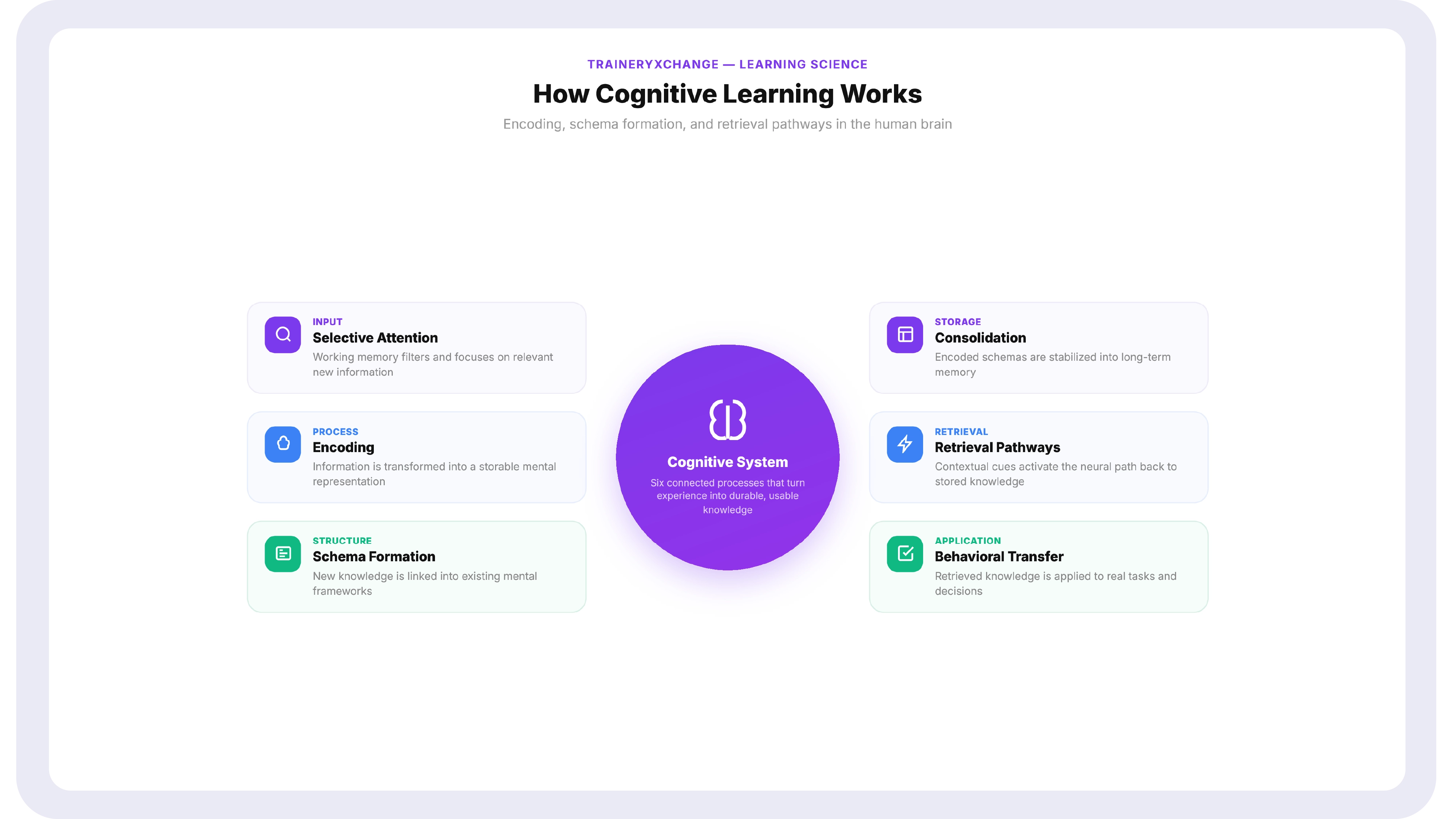
Diagram of cognitive learning theory showing encoding, schema formation, and retrieval pathways in the human brain

The Core Benefits of Cognitive Learning Theory in Training Programs

When training programs are deliberately designed around cognitive learning principles, the measurable benefits extend across the learner experience, the L&D function, and organizational performance.

Benefit 1: Stronger Long-Term Knowledge Retention

Information that is processed actively, connected to prior knowledge, and retrieved at spaced intervals is retained far longer than content consumed in a single session and tested immediately. This is the most consistent finding in learning science research, replicated across domains and populations.

In corporate training terms, this means employees who complete a cognitively designed compliance program in February are more likely to apply the correct procedure correctly in October. Employees who complete a generic information-transfer course are likely to retain 10 to 20 percent of its content within a week of completion.

Benefit 2: Faster and More Reliable Skill Transfer

The ability to apply learned knowledge in a new context is the ultimate measure of training effectiveness. Cognitive learning theory explains that transfer is most reliable when learning is connected to realistic scenarios, existing role-specific schemas, and the specific environment where the skill will be used.

Programs designed around transfer deliberately use job-relevant scenarios, connect new content to what learners already understand, and structure practice in conditions that mirror actual work situations.

Benefit 3: Reduced Training Volume Without Reduced Outcomes

One of the most commercially significant benefits of cognitive learning design is efficiency. When training programs are designed to reduce extraneous cognitive load, space content appropriately, and activate retrieval, they produce equivalent or better learning outcomes in significantly less time.

Organizations that replace bloated annual compliance marathons with spaced, cognitively designed microlearning modules typically reduce total training time while improving assessment performance and behavioral compliance in audits.

Benefit 4: Higher Learner Engagement

Learners disengage when training feels irrelevant, repetitive, or cognitively mismatched. A course that overwhelms working memory produces anxiety and avoidance. A course that is too simple produces disengagement. Cognitive learning theory provides designers with the tools to calibrate challenge appropriately, connect content to what the learner already cares about, and create experiences that feel purposeful rather than obligatory.

Benefit 5: Measurable ROI on Training Investment

The benefit that matters most to organizational decision-makers is return on investment. Cognitive learning design produces outcomes that are measurable: higher post-training assessment scores, reduced error rates in compliance-sensitive roles, faster time-to-competence for new hires, and lower retraining costs over time. These outcomes translate directly into the business case for L&D investment in platforms, content, and instructional design capacity.

10 Real-World Examples of Cognitive Learning Theory in Corporate Training

The following examples illustrate how specific cognitive learning principles are applied across common corporate training contexts. Each connects a theoretical principle to a practical design decision and its measurable outcome.

# Cognitive Principle Training Context Real-World Application Outcome
1 Schema Activation Onboarding Begin onboarding with a "What do you already know?" activity that connects prior experience before introducing organization-specific policies and processes. Faster understanding of complex policy and process content during the first weeks.
2 Spaced Repetition Compliance Training Replace annual compliance sessions with monthly five-minute microlearning modules and retrieval activities. Higher audit performance and lower policy violation rates.
3 Retrieval Practice Product Knowledge Training Use scenario-based quizzes several days after product training instead of only reviewing the original content. Better product recall during live customer conversations.
4 Cognitive Load Reduction Software Training Divide ERP or software training into short modules, each focused on a single workflow with no redundant content. Reduced time to proficiency and fewer support requests.
5 Meaningful Learning Safety Training Use learners' actual job sites, equipment, and role-specific hazards instead of generic warehouse examples. Higher assessment scores and fewer reportable incidents.
6 Metacognitive Reflection Leadership Development End each leadership module with structured reflection linked to participants' current workplace challenges. Greater application of learning reported during manager check-ins.
7 Worked Examples Technical Upskilling Introduce new technical skills through complete worked examples before requiring independent practice. Faster progression through learning paths with fewer errors.
8 Elaborative Interrogation Sales Training Ask learners to explain why specific objection responses work based on buyer psychology instead of memorizing scripts. Higher conversion rates and stronger objection-handling skills.
9 Interleaving Manager Training Alternate communication, coaching, performance management, and feedback topics rather than teaching one topic at a time. Stronger knowledge transfer across contexts and better long-term retention.
10 Transfer-Appropriate Processing Customer Service Training Practice using the same communication channels, tools, and customer scenarios employees will encounter on the job. Lower average handling time and higher first-contact resolution rates.

Cognitive Learning vs Behaviorism vs Constructivism: Which Approach Fits Your Training Need?

Cognitive learning theory is one of three dominant frameworks in instructional design. Understanding how it compares to behaviorism and constructivism helps L&D teams make intentional design decisions rather than defaulting to familiar formats.

Framework Core Premise Learner Role Instructional Approach Strengths Limitations Best For
Behaviorism Learning is a change in observable behavior through stimulus, response, and reinforcement. Passive learner whose behavior is shaped through external reinforcement. Repetition, drills, immediate corrective feedback, reinforcement, and rewards. Highly effective for procedural skills; easy to standardize, measure, and track. Limited support for complex thinking, problem-solving, and conceptual understanding. Safety procedures, compliance training, operational checklists, and basic skill acquisition.
Cognitive Learning Learning involves internal mental processing, schema formation, memory, and knowledge transfer. Active processor who connects new knowledge to existing mental models. Spaced repetition, retrieval practice, schema-building, and cognitive load management. Builds durable retention, reliable skill transfer, and scales effectively with technology. Requires intentional instructional design and outcomes are less immediately visible. Complex skills, compliance understanding, leadership development, and analytical roles.
Constructivism Learners build knowledge through experience, reflection, collaboration, and social interaction. Active co-creator of knowledge and meaning. Project-based learning, collaborative activities, real-world problem solving, and experiential learning. Develops judgment, adaptability, creativity, collaboration, and critical thinking. More difficult to standardize, assess consistently, and scale across large organizations. Innovation, cross-functional collaboration, leadership development, and advanced capability building.

Most effective enterprise training programs use all three frameworks in different proportions depending on the learning objective, the learner population, and the required outcome. The mistake is applying a single framework to all training needs.

How to Apply Cognitive Learning Theory in Corporate Training: A Practical Framework

Translating cognitive learning principles from theory to training program design requires a structured approach. The following framework gives L&D teams a repeatable process for applying cognitive learning across any training initiative.

Step 1: Identify What the Learner Already Knows (Schema Audit)

Before designing any learning experience, identify the existing knowledge schemas your target learners hold. What do they already understand about the topic? What misconceptions might they bring? What prior experiences can you connect new content to? This informs sequencing decisions and determines how much scaffolding the learning experience needs to provide.

Step 2: Define the Transfer Goal, Not the Content Goal

Most training programs are designed around content coverage. Cognitive learning design starts with transfer: what will the learner do differently, more accurately, or more reliably after completing this program? Defining the transfer goal first determines which cognitive strategies, spaced retrieval, scenario practice, and elaborative questioning are most appropriate.

Step 3: Reduce Cognitive Load in Every Design Decision

Review every design element against three questions: Does this visual support the learning objective or add noise? Does this audio track duplicate what is already on screen? Does this section introduce too many new concepts before the previous ones are consolidated? Eliminating extraneous load is often the fastest improvement available to L&D teams working with existing content libraries.

Step 4: Build in Retrieval at the Right Intervals

Retrieval practice should not be limited to end-of-course assessments. Design knowledge checks after every major concept, schedule follow-up review modules at 3, 7, and 14 days post-training, and use adaptive questioning to ensure retrieval difficulty is calibrated to each learner's demonstrated knowledge level.

Step 5: Measure Transfer, Not Completion

Completion rates measure administrative compliance. Transfer measures learning effectiveness. Design measurement into the program from the beginning by identifying the behavioral or performance indicator that would confirm transfer has occurred. Then track it at 30, 60, and 90 days post-training using manager observation, performance data, or quality metrics, not another assessment.
Drive Verifiable Capabilities and Compliance

TraineryXchange's enterprise learning platform supports role-based paths, spaced delivery, adaptive assessments, and audit-ready compliance reporting. Request a demo to see how it works across your workforce.

Book a Demo
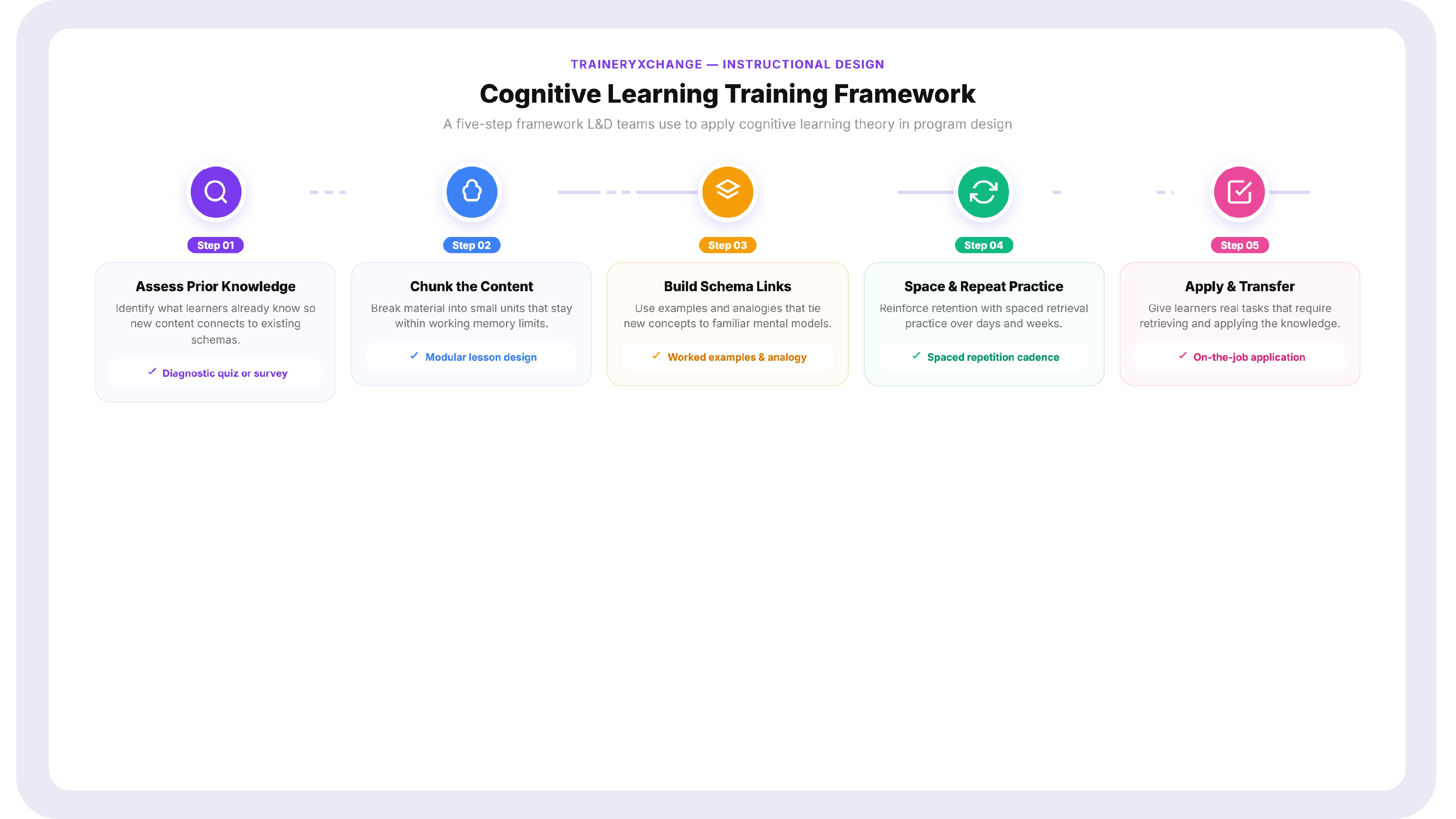
Five-step framework diagram showing how L&D teams apply cognitive learning theory in corporate training program design

How Microlearning Supports Cognitive Learning Principles

Microlearning has become one of the most discussed formats in corporate L&D but its effectiveness depends entirely on whether its design reflects cognitive principles or simply shortens conventional content.

A 5-minute video that presents information without retrieval practice, schema connection, or spacing is not cognitive microlearning. It is a shorter version of the same information-transfer activity that produces limited learning outcomes at full length.

Cognitive microlearning has specific characteristics that distinguish it from content-shortening exercises:

  • One learning objective per module reduces intrinsic and extraneous cognitive load simultaneously.
  • Scenario-based knowledge checks embedded within the module activate retrieval practice before the forgetting curve takes effect.
  • Designed for repetition and spacing, each module is revisited at intervals aligned with memory consolidation timelines.
  • Role and context specific connects directly to the learner's schemas, increasing encoding efficiency.
  • Delivered in the workflow, cognitive transfer is highest when learning occurs closest to the environment where the skill is applied.

Enterprise learning platforms that support automated delivery scheduling, role-based assignment, and adaptive sequencing are the infrastructure that makes cognitive microlearning practical at scale rather than a manual administrative project.

Measuring Learning Outcomes with Cognitive Learning Principles

Cognitive learning theory changes not only how training is designed but how its effectiveness is measured. Standard metrics completion rate, pass score, learner satisfaction measure activity and experience, not learning. Cognitive measurement focuses on what the learner can do differently after training and whether that change persists.

Measurement Type What It Measures Cognitive Learning Equivalent How to Track
Completion Rate Administrative confirmation that a learner started and completed the assigned training. Not a learning measure; only indicates participation. Track separately as an operational metric rather than evidence of learning effectiveness.
Immediate Assessment Score Short-term recall immediately after learners finish the training. Fragile measure that does not reliably predict long-term retention or workplace transfer. Use as a baseline only, then follow with delayed retrieval assessments.
Delayed Retrieval Score Knowledge retention measured at 7, 14, and 30 days after training. Strong predictor of durable learning and long-term retention. Use automated follow-up assessments through the LMS or learning platform.
Transfer Indicator Observable behavior change or measurable performance improvement after training. The definitive measure of successful cognitive learning transfer. Combine manager observation, performance metrics, quality audits, and operational KPIs.
Retraining Rate Frequency of employees requiring training on the same topic again. An inverse measure of knowledge retention and successful transfer. Track topic-specific retraining requests over a rolling 12-month period.

Organizations that measure delayed retrieval and transfer indicators alongside completion rates can build a genuine evidence base for training program effectiveness and make informed decisions about which programs, content types, and delivery formats produce the strongest cognitive learning outcomes.

Cognitive learning theory is the framework that separates training programs that produce measurable workforce capability from training programs that produce completion certificates.

Its benefits, stronger retention, faster skill transfer, reduced training volume, higher learner engagement, and improved training ROI are not theoretical promises. They are the consistent outcomes of applying evidence-based learning science to program design, content selection, and delivery timing.

The practical application of cognitive learning in corporate training requires intentional design choices: activating prior knowledge before introducing new content, reducing extraneous cognitive load in every course element, building in retrieval practice at appropriate intervals, and measuring transfer rather than completion.

At scale, these choices require infrastructure. An enterprise learning platform that supports role-based personalization, spaced delivery, adaptive assessment, and audit-ready reporting is not just a convenience. It is what makes cognitive learning design operationally viable across hundreds or thousands of learners simultaneously.


Enterprise Learning Architecture

Transform Enterprise Training into Verifiable Workforce Capability

TraineryXchange gives your L&D team instant access to a 10,000+ course library, built-in or LTI-integrated LMS, role-based learning paths, spaced delivery automation, and compliance tracking, all deployable in less than 24 hours. If your training programs are producing completions without capability, request a demo and see how cognitive learning design at enterprise scale actually works.

Book a Demo

Key Takeaways

  • Cognitive learning theory explains how people process, store, and retrieve information and why most conventional training fails to produce lasting behavior change.
  • The practical benefits of cognitive learning include stronger knowledge retention, faster skill transfer, and measurably higher training ROI.
  • Real-world examples of cognitive learning in corporate training span onboarding, compliance, leadership development, and technical upskilling.
  • Reducing cognitive load, applying spaced repetition, and using retrieval practice are the three highest-impact techniques L&D teams can implement immediately.
  • An enterprise learning platform built around cognitive principles makes these techniques scalable across distributed workforces without adding administrative burden.

What Is Cognitive Learning Theory?

Cognitive learning theory is a framework in educational psychology that explains how the mind actively processes, organizes, and retrieves information. Rather than viewing learners as passive recipients of content, it focuses on the internal mental processes involved in understanding and memory. Developed through contributions from Piaget, Vygotsky, Ausubel, and Sweller, cognitive learning theory holds that meaningful learning occurs when new information connects to existing knowledge structures called schemas. In corporate training, it provides a science-backed foundation for designing programs that produce genuine comprehension and on-the-job skill transfer, not just completion rates.

Why Cognitive Learning Theory Matters More Than Ever in Corporate Training

Most organizations invest significantly in training and receive disappointing returns. Employees complete courses, pass assessments, and then struggle to apply what they learned when it matters. This is not a motivation problem or a content quality problem. It is a design problem.

The root cause is that most corporate training is built around information delivery rather than how human memory actually works. Content is organized for convenience, not for encoding. Courses are scheduled around administrative timelines, not the learning science that governs retention. Assessments measure recall immediately after exposure, not retrieval weeks later when application is required.

Cognitive learning theory provides the corrective framework. It explains precisely why training fails to transfer, what conditions allow information to move from short-term exposure into long-term memory, and how instructional design choices either support or undermine every learning investment an organization makes.

For L&D teams, HR leaders, and training managers, understanding cognitive learning theory is not an academic exercise. It is the foundation of every training program that produces measurable workforce outcomes.

Develop High-Impact, Role-Based Capabilities

Explore how TraineryXchange delivers role-based, cognitively aligned learning programs across your workforce. See the content marketplace.

Book a Demo
Diagram of cognitive learning theory showing encoding, schema formation, and retrieval pathways in the human brain

The Core Benefits of Cognitive Learning Theory in Training Programs

When training programs are deliberately designed around cognitive learning principles, the measurable benefits extend across the learner experience, the L&D function, and organizational performance.

Benefit 1: Stronger Long-Term Knowledge Retention

Information that is processed actively, connected to prior knowledge, and retrieved at spaced intervals is retained far longer than content consumed in a single session and tested immediately. This is the most consistent finding in learning science research, replicated across domains and populations.

In corporate training terms, this means employees who complete a cognitively designed compliance program in February are more likely to apply the correct procedure correctly in October. Employees who complete a generic information-transfer course are likely to retain 10 to 20 percent of its content within a week of completion.

Benefit 2: Faster and More Reliable Skill Transfer

The ability to apply learned knowledge in a new context is the ultimate measure of training effectiveness. Cognitive learning theory explains that transfer is most reliable when learning is connected to realistic scenarios, existing role-specific schemas, and the specific environment where the skill will be used.

Programs designed around transfer deliberately use job-relevant scenarios, connect new content to what learners already understand, and structure practice in conditions that mirror actual work situations.

Benefit 3: Reduced Training Volume Without Reduced Outcomes

One of the most commercially significant benefits of cognitive learning design is efficiency. When training programs are designed to reduce extraneous cognitive load, space content appropriately, and activate retrieval, they produce equivalent or better learning outcomes in significantly less time.

Organizations that replace bloated annual compliance marathons with spaced, cognitively designed microlearning modules typically reduce total training time while improving assessment performance and behavioral compliance in audits.

Benefit 4: Higher Learner Engagement

Learners disengage when training feels irrelevant, repetitive, or cognitively mismatched. A course that overwhelms working memory produces anxiety and avoidance. A course that is too simple produces disengagement. Cognitive learning theory provides designers with the tools to calibrate challenge appropriately, connect content to what the learner already cares about, and create experiences that feel purposeful rather than obligatory.

Benefit 5: Measurable ROI on Training Investment

The benefit that matters most to organizational decision-makers is return on investment. Cognitive learning design produces outcomes that are measurable: higher post-training assessment scores, reduced error rates in compliance-sensitive roles, faster time-to-competence for new hires, and lower retraining costs over time. These outcomes translate directly into the business case for L&D investment in platforms, content, and instructional design capacity.

10 Real-World Examples of Cognitive Learning Theory in Corporate Training

The following examples illustrate how specific cognitive learning principles are applied across common corporate training contexts. Each connects a theoretical principle to a practical design decision and its measurable outcome.

# Cognitive Principle Training Context Real-World Application Outcome
1 Schema Activation Onboarding Begin onboarding with a "What do you already know?" activity that connects prior experience before introducing organization-specific policies and processes. Faster understanding of complex policy and process content during the first weeks.
2 Spaced Repetition Compliance Training Replace annual compliance sessions with monthly five-minute microlearning modules and retrieval activities. Higher audit performance and lower policy violation rates.
3 Retrieval Practice Product Knowledge Training Use scenario-based quizzes several days after product training instead of only reviewing the original content. Better product recall during live customer conversations.
4 Cognitive Load Reduction Software Training Divide ERP or software training into short modules, each focused on a single workflow with no redundant content. Reduced time to proficiency and fewer support requests.
5 Meaningful Learning Safety Training Use learners' actual job sites, equipment, and role-specific hazards instead of generic warehouse examples. Higher assessment scores and fewer reportable incidents.
6 Metacognitive Reflection Leadership Development End each leadership module with structured reflection linked to participants' current workplace challenges. Greater application of learning reported during manager check-ins.
7 Worked Examples Technical Upskilling Introduce new technical skills through complete worked examples before requiring independent practice. Faster progression through learning paths with fewer errors.
8 Elaborative Interrogation Sales Training Ask learners to explain why specific objection responses work based on buyer psychology instead of memorizing scripts. Higher conversion rates and stronger objection-handling skills.
9 Interleaving Manager Training Alternate communication, coaching, performance management, and feedback topics rather than teaching one topic at a time. Stronger knowledge transfer across contexts and better long-term retention.
10 Transfer-Appropriate Processing Customer Service Training Practice using the same communication channels, tools, and customer scenarios employees will encounter on the job. Lower average handling time and higher first-contact resolution rates.

Cognitive Learning vs Behaviorism vs Constructivism: Which Approach Fits Your Training Need?

Cognitive learning theory is one of three dominant frameworks in instructional design. Understanding how it compares to behaviorism and constructivism helps L&D teams make intentional design decisions rather than defaulting to familiar formats.

Framework Core Premise Learner Role Instructional Approach Strengths Limitations Best For
Behaviorism Learning is a change in observable behavior through stimulus, response, and reinforcement. Passive learner whose behavior is shaped through external reinforcement. Repetition, drills, immediate corrective feedback, reinforcement, and rewards. Highly effective for procedural skills; easy to standardize, measure, and track. Limited support for complex thinking, problem-solving, and conceptual understanding. Safety procedures, compliance training, operational checklists, and basic skill acquisition.
Cognitive Learning Learning involves internal mental processing, schema formation, memory, and knowledge transfer. Active processor who connects new knowledge to existing mental models. Spaced repetition, retrieval practice, schema-building, and cognitive load management. Builds durable retention, reliable skill transfer, and scales effectively with technology. Requires intentional instructional design and outcomes are less immediately visible. Complex skills, compliance understanding, leadership development, and analytical roles.
Constructivism Learners build knowledge through experience, reflection, collaboration, and social interaction. Active co-creator of knowledge and meaning. Project-based learning, collaborative activities, real-world problem solving, and experiential learning. Develops judgment, adaptability, creativity, collaboration, and critical thinking. More difficult to standardize, assess consistently, and scale across large organizations. Innovation, cross-functional collaboration, leadership development, and advanced capability building.

Most effective enterprise training programs use all three frameworks in different proportions depending on the learning objective, the learner population, and the required outcome. The mistake is applying a single framework to all training needs.

How to Apply Cognitive Learning Theory in Corporate Training: A Practical Framework

Translating cognitive learning principles from theory to training program design requires a structured approach. The following framework gives L&D teams a repeatable process for applying cognitive learning across any training initiative.

Step 1: Identify What the Learner Already Knows (Schema Audit)

Before designing any learning experience, identify the existing knowledge schemas your target learners hold. What do they already understand about the topic? What misconceptions might they bring? What prior experiences can you connect new content to? This informs sequencing decisions and determines how much scaffolding the learning experience needs to provide.

Step 2: Define the Transfer Goal, Not the Content Goal

Most training programs are designed around content coverage. Cognitive learning design starts with transfer: what will the learner do differently, more accurately, or more reliably after completing this program? Defining the transfer goal first determines which cognitive strategies, spaced retrieval, scenario practice, and elaborative questioning are most appropriate.

Step 3: Reduce Cognitive Load in Every Design Decision

Review every design element against three questions: Does this visual support the learning objective or add noise? Does this audio track duplicate what is already on screen? Does this section introduce too many new concepts before the previous ones are consolidated? Eliminating extraneous load is often the fastest improvement available to L&D teams working with existing content libraries.

Step 4: Build in Retrieval at the Right Intervals

Retrieval practice should not be limited to end-of-course assessments. Design knowledge checks after every major concept, schedule follow-up review modules at 3, 7, and 14 days post-training, and use adaptive questioning to ensure retrieval difficulty is calibrated to each learner's demonstrated knowledge level.

Step 5: Measure Transfer, Not Completion

Completion rates measure administrative compliance. Transfer measures learning effectiveness. Design measurement into the program from the beginning by identifying the behavioral or performance indicator that would confirm transfer has occurred. Then track it at 30, 60, and 90 days post-training using manager observation, performance data, or quality metrics, not another assessment.

Drive Verifiable Capabilities and Compliance

TraineryXchange's enterprise learning platform supports role-based paths, spaced delivery, adaptive assessments, and audit-ready compliance reporting. Request a demo to see how it works across your workforce.

Book a Demo
Five-step framework diagram showing how L&D teams apply cognitive learning theory in corporate training program design

How Microlearning Supports Cognitive Learning Principles

Microlearning has become one of the most discussed formats in corporate L&D but its effectiveness depends entirely on whether its design reflects cognitive principles or simply shortens conventional content.

A 5-minute video that presents information without retrieval practice, schema connection, or spacing is not cognitive microlearning. It is a shorter version of the same information-transfer activity that produces limited learning outcomes at full length.

Cognitive microlearning has specific characteristics that distinguish it from content-shortening exercises:

  • One learning objective per module reduces intrinsic and extraneous cognitive load simultaneously.
  • Scenario-based knowledge checks embedded within the module activate retrieval practice before the forgetting curve takes effect.
  • Designed for repetition and spacing, each module is revisited at intervals aligned with memory consolidation timelines.
  • Role and context specific connects directly to the learner's schemas, increasing encoding efficiency.
  • Delivered in the workflow, cognitive transfer is highest when learning occurs closest to the environment where the skill is applied.

Enterprise learning platforms that support automated delivery scheduling, role-based assignment, and adaptive sequencing are the infrastructure that makes cognitive microlearning practical at scale rather than a manual administrative project.

Measuring Learning Outcomes with Cognitive Learning Principles

Cognitive learning theory changes not only how training is designed but how its effectiveness is measured. Standard metrics completion rate, pass score, learner satisfaction measure activity and experience, not learning. Cognitive measurement focuses on what the learner can do differently after training and whether that change persists.

Measurement Type What It Measures Cognitive Learning Equivalent How to Track
Completion Rate Administrative confirmation that a learner started and completed the assigned training. Not a learning measure; only indicates participation. Track separately as an operational metric rather than evidence of learning effectiveness.
Immediate Assessment Score Short-term recall immediately after learners finish the training. Fragile measure that does not reliably predict long-term retention or workplace transfer. Use as a baseline only, then follow with delayed retrieval assessments.
Delayed Retrieval Score Knowledge retention measured at 7, 14, and 30 days after training. Strong predictor of durable learning and long-term retention. Use automated follow-up assessments through the LMS or learning platform.
Transfer Indicator Observable behavior change or measurable performance improvement after training. The definitive measure of successful cognitive learning transfer. Combine manager observation, performance metrics, quality audits, and operational KPIs.
Retraining Rate Frequency of employees requiring training on the same topic again. An inverse measure of knowledge retention and successful transfer. Track topic-specific retraining requests over a rolling 12-month period.

Organizations that measure delayed retrieval and transfer indicators alongside completion rates can build a genuine evidence base for training program effectiveness and make informed decisions about which programs, content types, and delivery formats produce the strongest cognitive learning outcomes.

Cognitive learning theory is the framework that separates training programs that produce measurable workforce capability from training programs that produce completion certificates.

Its benefits, stronger retention, faster skill transfer, reduced training volume, higher learner engagement, and improved training ROI are not theoretical promises. They are the consistent outcomes of applying evidence-based learning science to program design, content selection, and delivery timing.

The practical application of cognitive learning in corporate training requires intentional design choices: activating prior knowledge before introducing new content, reducing extraneous cognitive load in every course element, building in retrieval practice at appropriate intervals, and measuring transfer rather than completion.

At scale, these choices require infrastructure. An enterprise learning platform that supports role-based personalization, spaced delivery, adaptive assessment, and audit-ready reporting is not just a convenience. It is what makes cognitive learning design operationally viable across hundreds or thousands of learners simultaneously.

Enterprise Learning Architecture

Transform Enterprise Training into Verifiable Workforce Capability

TraineryXchange gives your L&D team instant access to a 10,000+ course library, built-in or LTI-integrated LMS, role-based learning paths, spaced delivery automation, and compliance tracking, all deployable in less than 24 hours. If your training programs are producing completions without capability, request a demo and see how cognitive learning design at enterprise scale actually works.

Book a Demo

Frequently Asked Questions

How does an enterprise learning platform support cognitive learning at scale?
What should corporate training programs do to reduce cognitive load for learners?
How can L&D teams measure whether cognitive learning strategies are working?
How does cognitive learning theory differ from behaviorism in workplace training?
What are the most practical examples of cognitive learning theory in corporate training?
What are the main benefits of cognitive learning theory for employee training?