Learning Strategy vs Training Strategy: Which One Does Your Organization Actually Have?

Updated On:
June 3, 2026

Mahesh Kumar

Founder, TraineryHCM.com
Learning Strategy vs Training Strategy

Table of Contents

Ask an HR leader to describe their organization's approach to employee development, and most will describe a calendar. Here are the compliance courses that run quarterly. Here is the leadership program that launches in Q3. Here is the onboarding training for new hires. Every item has a title, a date, and a completion target.

That is a training strategy. It is not a learning strategy. The distinction matters more than it might initially appear, and getting it wrong is one reason L&D budgets face scrutiny every planning cycle.

This article explains the difference between a learning strategy and a training strategy, how to identify which one your organization currently uses, and how to build the right blend of both. It also addresses the content infrastructure and platform decisions that support each approach, because strategy without execution is a document that sits in a shared drive.

Learning Strategy vs Training Strategy

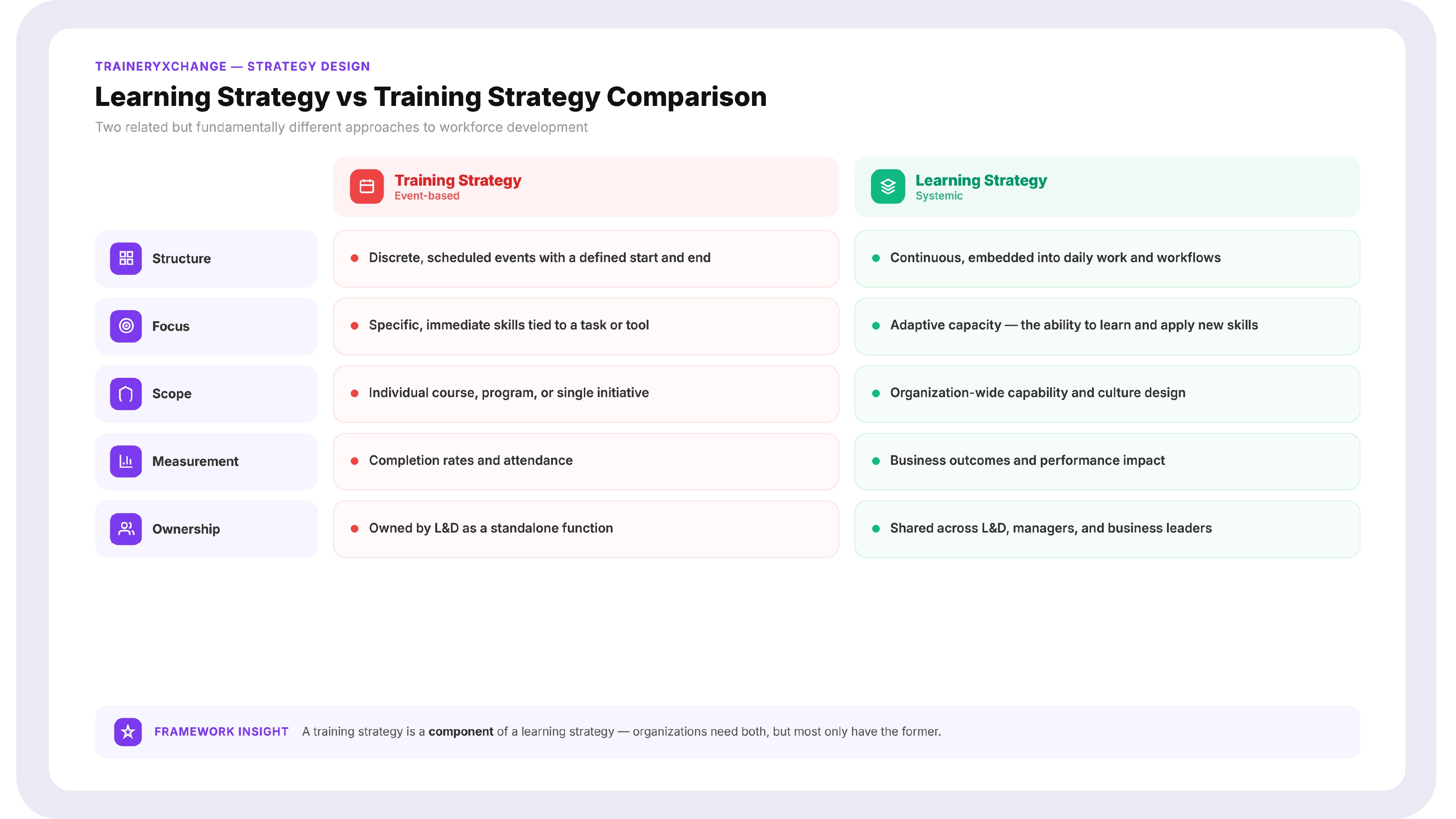
A training strategy is an organizational plan that uses defined programs, courses, and structured content to close specific skill gaps and ensure employees can perform their current roles effectively. A learning strategy operates at a broader level: it defines how an organization builds ongoing capacity for growth, adaptation, and knowledge transfer across its workforce. Training strategies are event-based and measurable by completion. Learning strategies are systemic and measured by long-term outcomes like internal mobility, skill retention, and workforce adaptability. Most organizations need both. The right balance depends on the stability of roles in the business, the pace of industry change, and whether the primary L&D challenge is closing known skill gaps or building capacity for unknown future challenges.

Before Choosing a Strategy, Choose the Right Content Library

TraineryXchange gives your L&D team 799+ curated courses covering compliance, leadership, and professional development — ready to support both your training programs and your broader learning culture. Start your free trial. Browse the Course Library — Free Trial

Book a Demo
Diagram showing the differences between a training strategy (event-based, specific skills, completion-measured) and a learning strategy (systemic, adaptive capacity, outcome-measured)

What Is a Training Strategy?

A training strategy is a structured organizational plan for closing specific skill gaps through defined learning programs. It answers a concrete question: what do employees need to know or be able to do right now, and how will the organization teach them?

Training strategies are characterized by clear inputs and outputs. A compliance training strategy, for example, identifies which regulations require documented training, maps those requirements to employee roles, selects or builds the courses that cover the content, deploys them on a defined schedule, and tracks completion. The outcome is measurable and auditable: either employees completed the training, or they did not.

What a training strategy covers

  • Onboarding programs that teach new hires how to perform their roles from Day 1
  • Compliance and regulatory training required by law or industry standards
  • Product and process training when new tools, systems, or procedures are introduced
  • Skills gap training tied to a specific, identified performance deficit
  • Safety training with documented completion requirements

Where training strategies excel

Training strategies produce reliable, measurable results for well-defined problems. When a new regulation requires that all employees complete data privacy training by a set date, a training strategy is delivered. When a sales team needs to learn a new product line before the next quarter, a training strategy delivers. The problem is specific. The solution is structured. The measurement is binary.

The limitation appears when the problem is not specific. When an organization needs its workforce to become more adaptable, more innovative, or better at navigating ambiguity, a training program cannot solve it. You cannot deploy a course titled 'Be More Adaptable' and expect measurable change in organizational resilience.

What Is a Learning Strategy?

A learning strategy is a broader organizational plan that defines how a company builds and sustains the capability of its workforce over time, not just for current roles but for future challenges that have not yet been fully defined. Where a training strategy is transactional, a learning strategy is systemic.

A learning strategy asks different questions: How do people develop judgment, not just skills? How does knowledge move through the organization when experienced employees leave? How do we build a workforce that can learn faster than the market changes? These are harder questions, and they require a different set of answers.

What a learning strategy covers

  • A culture of continuous learning where development is embedded in daily work, not scheduled as separate events
  • Leadership development pathways that build capability over 12 to 24 months, not in a single program
  • A peer learning infrastructure that allows expertise to transfer between employees without formal training sessions
  • Self-directed learning access where employees can build skills relevant to future roles, not just their current responsibilities
  • Skill mapping and talent mobility tools that connect individual development to organizational succession planning

Where learning strategies produce results that training cannot

The business case for a learning strategy is documented consistently across workforce research. Organizations that invest deliberately in building learning cultures, not just training programs, outperform those that do not across retention, innovation, and long-term profitability.

This does not mean abandoning training programs. It means recognizing that training programs are components of a learning strategy, not substitutes for one. A mature learning strategy includes structured training for specific, time-bound needs and broader capability-building for the organization's adaptive capacity.

Dimension Training Strategy Learning Strategy
Primary Question What do employees need to know right now? How will our workforce keep developing over time?
Time Horizon Short-term: Days to months Long-term: 1 to 3 years
Trigger Identified skill gaps or compliance requirements Strategic business goals and long-term workforce planning
Format Defined courses, programs, workshops, and events Courses, coaching, peer learning, stretch assignments, and self-directed learning
Measurement Completion rates, knowledge assessments, certifications, and audit records Internal mobility, retention, performance trends, and skill growth
Learner Role Passive recipient of assigned content Active owner of their development journey
Content Source Pre-built courses from internal or external providers Curated learning libraries combined with self-directed resources
Success Looks Like Employees complete required training by the deadline Employees continuously build skills for future roles and business needs
When It Fails When the underlying business or cultural problem remains unresolved When learning is disconnected from measurable business outcomes
Budget Allocation Fixed cost per course, program, or compliance requirement Ongoing investment in platforms, content, coaching, and learning culture

How to Know Which One Your Organization Currently Has

This is rarely a difficult diagnosis. The signs of each approach are visible in how L&D work is organized and measured.

Signs your organization currently operates with a training strategy

  • Your annual L&D plan is primarily a training calendar with courses, dates, and attendance targets
  • Success is reported as completion percentages: '94% of employees completed the mandatory training'
  • Training requests come primarily from managers or compliance teams, identifying specific gaps
  • The LMS is used primarily for assigning courses and tracking completion, not for self-directed development
  • New training programs are added in response to business requests, but old ones are rarely retired
  • L&D conversations with leadership center on 'did employees complete the training?', not 'did employees improve?'

Signs your organization is operating with a learning strategy

  • Employees have access to a development library and actively use it for growth outside mandatory requirements
  • L&D reports to senior leadership include skill growth trends, internal promotion rates, and capability benchmarks
  • Managers are equipped and expected to have regular development conversations with their teams
  • The organization tracks what employees are learning relative to the skills the business will need in two to three years
  • Peer learning, mentorship, and on-the-job development are recognized as formal parts of the L&D approach
  • Training programs are evaluated not just for completion but for behavior change 90 days post-training

A Framework for Moving from a Training Strategy to a Learning Strategy

Most organizations do not need to abandon their training strategy. They need to build a learning strategy around it. The following framework helps L&D leaders assess where they are and what to build next.

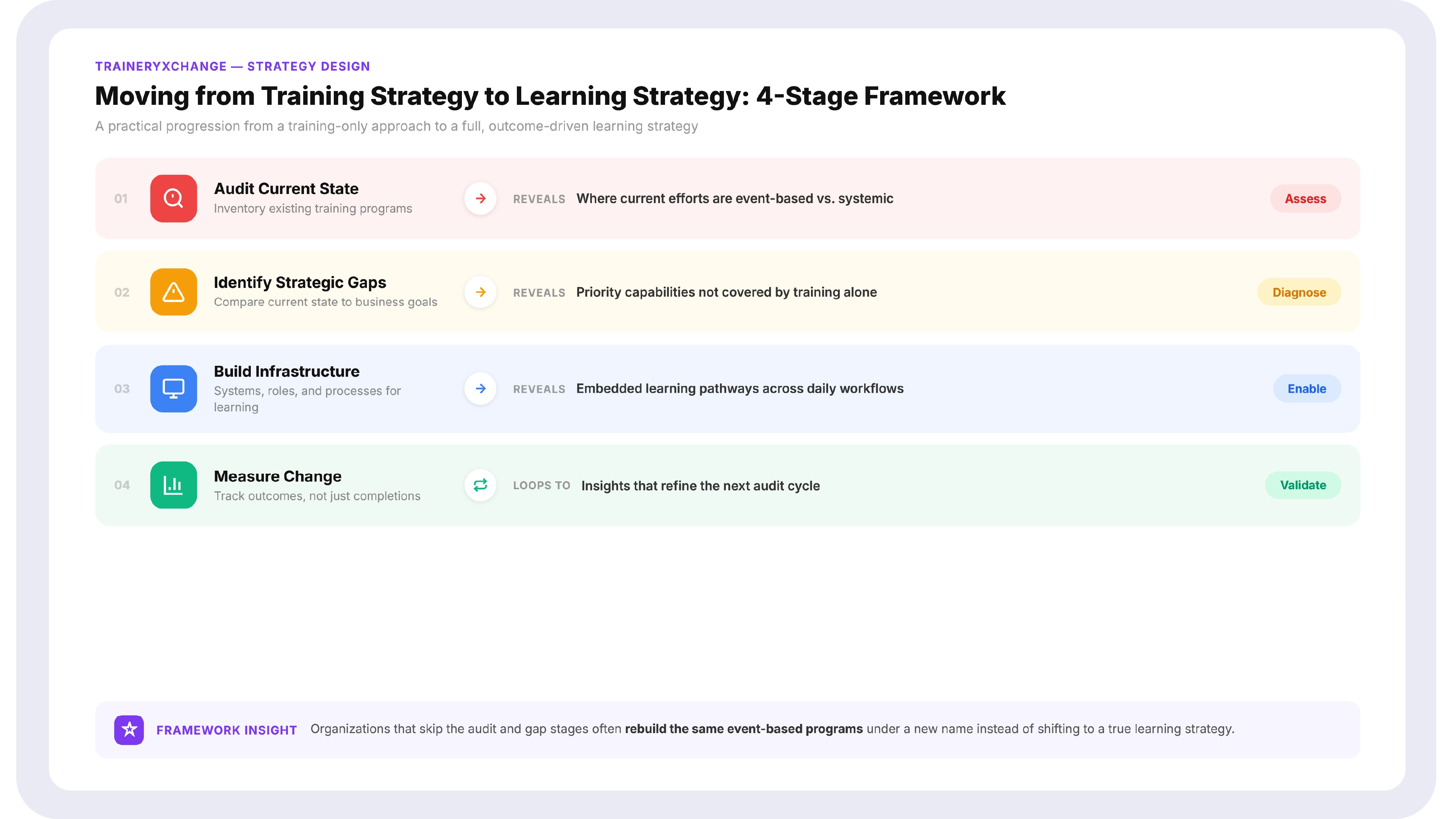
Stage 1: Audit what you have

Map your current training programs across four categories: mandatory compliance, role-specific skills, professional development, and leadership. For each program, identify whether it is addressing a defined near-term gap (training strategy) or building long-term capability (learning strategy). Most organizations find their portfolio is 80 to 90 percent training and 10 to 20 percent learning.

Stage 2: Identify the strategic gaps

Have a conversation with your executive team about what capabilities the organization will need in two years that it does not have today. The skills that are emerging in your industry, the roles that will change due to automation or new tools, and the leadership pipeline you will need as senior employees approach retirement. These are the gaps a training strategy alone cannot close.

Stage 3: Build the learning infrastructure alongside the training programs

You do not replace training programs with a learning strategy. You build the infrastructure for continuous learning around the training that already exists. This means choosing a platform that supports both structured course assignments for training programs and self-directed library access for learning beyond requirements. It means equipping managers to have development conversations, not just compliance conversations. It means creating visible pathways from current roles to future opportunities.

Stage 4: Measure different things

A training strategy measures completion. A learning strategy measures change. If you want to evolve your approach, you need to evolve your metrics. Start tracking behavior change 90 days after major training programs: are managers applying the feedback techniques they learned? Add skill growth tracking: Is the organization building capability in areas identified as strategically important? Track internal mobility: are employees who engage with development content more likely to take on expanded responsibilities?

The Right Platform Supports Both Approaches

TraineryXchange gives L&D teams a curated content library for structured training programs and an open discovery library for self-directed learning — all in one subscription with a native LMS included. Pricing is published publicly. Compare Plans and Pricing

Book a Demo
Four-stage framework diagram showing the progression from a training-only approach to a full learning strategy: audit, identify gaps, build infrastructure, measure change

The Content Infrastructure Behind Each Approach

Strategy choices and platform choices are connected. A training strategy and a learning strategy require different content infrastructure, and choosing a platform designed for one approach to support the other creates operational friction.

What a training strategy needs from a content platform

  • Reliable access to current, accurate compliance and skills content across the categories the organization needs to train
  • Easy bulk assignment of courses to defined employee groups based on role, location, or compliance requirements
  • Completion tracking and certification generation that produce audit-ready records without manual administration
  • Content that updates automatically when regulations change, without requiring the L&D team to manage re-uploads

What a learning strategy needs from a content platform

  • A broader content library that employees can search and access for self-directed development beyond assigned courses
  • Multiple content formats: not just video courses but short-form modules, articles, and skill-based pathways
  • Skill tagging that allows learners to discover content relevant to their career goals, not just their compliance requirements
  • Analytics that show which content employees are choosing voluntarily, not just what they were assigned

Where most platforms fall short

The most common platform mistake in this area is choosing a platform that does only one thing well. A compliance-focused LMS that excels at assignment and tracking may be unusable for self-directed learning. A consumer-style learning experience platform with excellent content discovery may struggle to produce audit-ready compliance records.

Organizations building toward a learning strategy need a platform that handles structured training programs for the compliance and onboarding requirements while also providing the content depth and access model that supports self-directed development. These are not incompatible features, but they do require intentional evaluation during platform selection.

The practical checklist for evaluating a platform against both strategy types: Does it support both admin-assigned training and employee-initiated access? Does compliance content update automatically? Can employees browse and discover content beyond their assigned courses? Does reporting cover both completion (training strategy) and content engagement trends (learning strategy)?

Practical Next Steps for L&D Leaders

The difference between a learning strategy and a training strategy is not philosophical. It is operational. It affects how you allocate budget, which platform you choose, how you measure impact, and how you present your function's value to leadership.

Most organizations currently operate predominantly with a training strategy. That is not a failure; compliance requirements, onboarding programs, and skills training all require it. The problem is when the training calendar is the entirety of the L&D approach, without the infrastructure for continuous development, self-directed learning, or long-term capability building.

The practical path forward is not to replace training programs with a learning strategy. It is to build the learning infrastructure alongside them: a content library that employees can access beyond their required courses, metrics that track behavior change and skill growth rather than just completion, and managers equipped to reinforce development through regular conversation rather than delegating it entirely to L&D.

Start by auditing your current portfolio. Determine what percentage addresses immediate performance gaps and what percentage builds long-term capability. Then decide, based on your organization's strategic priorities, which direction the balance needs to shift and what platform and content decisions will support that shift.

Hybrid Learning Framework

Build Your Learning Strategy on a Platform That Supports Both

TraineryXchange gives L&D teams 799+ curated courses for structured training programs, self-directed development, and everything in between. Native LMS included. SCORM Dispatch for automatic content updates. Transparent pricing without a sales call. Start Your Free Trial Today

Book a Demo

Key Takeaways

  • A training strategy and a learning strategy are not the same thing. Most organizations have a training calendar and call it a strategy
  • Training strategies address current skill gaps through defined programs. Learning strategies build the organizational capacity to keep adapting as roles, markets, and technology change.
  •  Choosing between them is not an either-or decision — both are needed, but in different proportions depending on your workforce and business goals.
  •  The content infrastructure supporting each approach is fundamentally different. Training strategies need reliable, current content libraries. Learning strategies require multi-format resources, peer-learning infrastructure, and skill-tracking capability.
  • Most organizations underinvest in learning strategy because it is harder to measure. The business case for it, however, is strong: organizations with intentional learning cultures report 11 percent greater profitability than those focused on training alone.

Ask an HR leader to describe their organization's approach to employee development, and most will describe a calendar. Here are the compliance courses that run quarterly. Here is the leadership program that launches in Q3. Here is the onboarding training for new hires. Every item has a title, a date, and a completion target.

That is a training strategy. It is not a learning strategy. The distinction matters more than it might initially appear, and getting it wrong is one reason L&D budgets face scrutiny every planning cycle.

This article explains the difference between a learning strategy and a training strategy, how to identify which one your organization currently uses, and how to build the right blend of both. It also addresses the content infrastructure and platform decisions that support each approach, because strategy without execution is a document that sits in a shared drive.

Learning Strategy vs Training Strategy

A training strategy is an organizational plan that uses defined programs, courses, and structured content to close specific skill gaps and ensure employees can perform their current roles effectively. A learning strategy operates at a broader level: it defines how an organization builds ongoing capacity for growth, adaptation, and knowledge transfer across its workforce. Training strategies are event-based and measurable by completion. Learning strategies are systemic and measured by long-term outcomes like internal mobility, skill retention, and workforce adaptability. Most organizations need both. The right balance depends on the stability of roles in the business, the pace of industry change, and whether the primary L&D challenge is closing known skill gaps or building capacity for unknown future challenges.

Before Choosing a Strategy, Choose the Right Content Library

TraineryXchange gives your L&D team 799+ curated courses covering compliance, leadership, and professional development — ready to support both your training programs and your broader learning culture. Start your free trial. Browse the Course Library — Free Trial

Book a Demo
Diagram showing the differences between a training strategy (event-based, specific skills, completion-measured) and a learning strategy (systemic, adaptive capacity, outcome-measured)

What Is a Training Strategy?

A training strategy is a structured organizational plan for closing specific skill gaps through defined learning programs. It answers a concrete question: what do employees need to know or be able to do right now, and how will the organization teach them?

Training strategies are characterized by clear inputs and outputs. A compliance training strategy, for example, identifies which regulations require documented training, maps those requirements to employee roles, selects or builds the courses that cover the content, deploys them on a defined schedule, and tracks completion. The outcome is measurable and auditable: either employees completed the training, or they did not.

What a training strategy covers

  • Onboarding programs that teach new hires how to perform their roles from Day 1
  • Compliance and regulatory training required by law or industry standards
  • Product and process training when new tools, systems, or procedures are introduced
  • Skills gap training tied to a specific, identified performance deficit
  • Safety training with documented completion requirements

Where training strategies excel

Training strategies produce reliable, measurable results for well-defined problems. When a new regulation requires that all employees complete data privacy training by a set date, a training strategy is delivered. When a sales team needs to learn a new product line before the next quarter, a training strategy delivers. The problem is specific. The solution is structured. The measurement is binary.

The limitation appears when the problem is not specific. When an organization needs its workforce to become more adaptable, more innovative, or better at navigating ambiguity, a training program cannot solve it. You cannot deploy a course titled 'Be More Adaptable' and expect measurable change in organizational resilience.

What Is a Learning Strategy?

A learning strategy is a broader organizational plan that defines how a company builds and sustains the capability of its workforce over time, not just for current roles but for future challenges that have not yet been fully defined. Where a training strategy is transactional, a learning strategy is systemic.

A learning strategy asks different questions: How do people develop judgment, not just skills? How does knowledge move through the organization when experienced employees leave? How do we build a workforce that can learn faster than the market changes? These are harder questions, and they require a different set of answers.

What a learning strategy covers

  • A culture of continuous learning where development is embedded in daily work, not scheduled as separate events
  • Leadership development pathways that build capability over 12 to 24 months, not in a single program
  • A peer learning infrastructure that allows expertise to transfer between employees without formal training sessions
  • Self-directed learning access where employees can build skills relevant to future roles, not just their current responsibilities
  • Skill mapping and talent mobility tools that connect individual development to organizational succession planning

Where learning strategies produce results that training cannot

The business case for a learning strategy is documented consistently across workforce research. Organizations that invest deliberately in building learning cultures, not just training programs, outperform those that do not across retention, innovation, and long-term profitability.

This does not mean abandoning training programs. It means recognizing that training programs are components of a learning strategy, not substitutes for one. A mature learning strategy includes structured training for specific, time-bound needs and broader capability-building for the organization's adaptive capacity.

Dimension Training Strategy Learning Strategy
Primary Question What do employees need to know right now? How will our workforce keep developing over time?
Time Horizon Short-term: Days to months Long-term: 1 to 3 years
Trigger Identified skill gaps or compliance requirements Strategic business goals and long-term workforce planning
Format Defined courses, programs, workshops, and events Courses, coaching, peer learning, stretch assignments, and self-directed learning
Measurement Completion rates, knowledge assessments, certifications, and audit records Internal mobility, retention, performance trends, and skill growth
Learner Role Passive recipient of assigned content Active owner of their development journey
Content Source Pre-built courses from internal or external providers Curated learning libraries combined with self-directed resources
Success Looks Like Employees complete required training by the deadline Employees continuously build skills for future roles and business needs
When It Fails When the underlying business or cultural problem remains unresolved When learning is disconnected from measurable business outcomes
Budget Allocation Fixed cost per course, program, or compliance requirement Ongoing investment in platforms, content, coaching, and learning culture

How to Know Which One Your Organization Currently Has

This is rarely a difficult diagnosis. The signs of each approach are visible in how L&D work is organized and measured.

Signs your organization currently operates with a training strategy

  • Your annual L&D plan is primarily a training calendar with courses, dates, and attendance targets
  • Success is reported as completion percentages: '94% of employees completed the mandatory training'
  • Training requests come primarily from managers or compliance teams, identifying specific gaps
  • The LMS is used primarily for assigning courses and tracking completion, not for self-directed development
  • New training programs are added in response to business requests, but old ones are rarely retired
  • L&D conversations with leadership center on 'did employees complete the training?', not 'did employees improve?'

Signs your organization is operating with a learning strategy

  • Employees have access to a development library and actively use it for growth outside mandatory requirements
  • L&D reports to senior leadership include skill growth trends, internal promotion rates, and capability benchmarks
  • Managers are equipped and expected to have regular development conversations with their teams
  • The organization tracks what employees are learning relative to the skills the business will need in two to three years
  • Peer learning, mentorship, and on-the-job development are recognized as formal parts of the L&D approach
  • Training programs are evaluated not just for completion but for behavior change 90 days post-training

A Framework for Moving from a Training Strategy to a Learning Strategy

Most organizations do not need to abandon their training strategy. They need to build a learning strategy around it. The following framework helps L&D leaders assess where they are and what to build next.

Stage 1: Audit what you have

Map your current training programs across four categories: mandatory compliance, role-specific skills, professional development, and leadership. For each program, identify whether it is addressing a defined near-term gap (training strategy) or building long-term capability (learning strategy). Most organizations find their portfolio is 80 to 90 percent training and 10 to 20 percent learning.

Stage 2: Identify the strategic gaps

Have a conversation with your executive team about what capabilities the organization will need in two years that it does not have today. The skills that are emerging in your industry, the roles that will change due to automation or new tools, and the leadership pipeline you will need as senior employees approach retirement. These are the gaps a training strategy alone cannot close.

Stage 3: Build the learning infrastructure alongside the training programs

You do not replace training programs with a learning strategy. You build the infrastructure for continuous learning around the training that already exists. This means choosing a platform that supports both structured course assignments for training programs and self-directed library access for learning beyond requirements. It means equipping managers to have development conversations, not just compliance conversations. It means creating visible pathways from current roles to future opportunities.

Stage 4: Measure different things

A training strategy measures completion. A learning strategy measures change. If you want to evolve your approach, you need to evolve your metrics. Start tracking behavior change 90 days after major training programs: are managers applying the feedback techniques they learned? Add skill growth tracking: Is the organization building capability in areas identified as strategically important? Track internal mobility: are employees who engage with development content more likely to take on expanded responsibilities?

The Right Platform Supports Both Approaches

TraineryXchange gives L&D teams a curated content library for structured training programs and an open discovery library for self-directed learning — all in one subscription with a native LMS included. Pricing is published publicly. Compare Plans and Pricing

Book a Demo
Four-stage framework diagram showing the progression from a training-only approach to a full learning strategy: audit, identify gaps, build infrastructure, measure change

The Content Infrastructure Behind Each Approach

Strategy choices and platform choices are connected. A training strategy and a learning strategy require different content infrastructure, and choosing a platform designed for one approach to support the other creates operational friction.

What a training strategy needs from a content platform

  • Reliable access to current, accurate compliance and skills content across the categories the organization needs to train
  • Easy bulk assignment of courses to defined employee groups based on role, location, or compliance requirements
  • Completion tracking and certification generation that produce audit-ready records without manual administration
  • Content that updates automatically when regulations change, without requiring the L&D team to manage re-uploads

What a learning strategy needs from a content platform

  • A broader content library that employees can search and access for self-directed development beyond assigned courses
  • Multiple content formats: not just video courses but short-form modules, articles, and skill-based pathways
  • Skill tagging that allows learners to discover content relevant to their career goals, not just their compliance requirements
  • Analytics that show which content employees are choosing voluntarily, not just what they were assigned

Where most platforms fall short

The most common platform mistake in this area is choosing a platform that does only one thing well. A compliance-focused LMS that excels at assignment and tracking may be unusable for self-directed learning. A consumer-style learning experience platform with excellent content discovery may struggle to produce audit-ready compliance records.

Organizations building toward a learning strategy need a platform that handles structured training programs for the compliance and onboarding requirements while also providing the content depth and access model that supports self-directed development. These are not incompatible features, but they do require intentional evaluation during platform selection.

The practical checklist for evaluating a platform against both strategy types: Does it support both admin-assigned training and employee-initiated access? Does compliance content update automatically? Can employees browse and discover content beyond their assigned courses? Does reporting cover both completion (training strategy) and content engagement trends (learning strategy)?

Practical Next Steps for L&D Leaders

The difference between a learning strategy and a training strategy is not philosophical. It is operational. It affects how you allocate budget, which platform you choose, how you measure impact, and how you present your function's value to leadership.

Most organizations currently operate predominantly with a training strategy. That is not a failure; compliance requirements, onboarding programs, and skills training all require it. The problem is when the training calendar is the entirety of the L&D approach, without the infrastructure for continuous development, self-directed learning, or long-term capability building.

The practical path forward is not to replace training programs with a learning strategy. It is to build the learning infrastructure alongside them: a content library that employees can access beyond their required courses, metrics that track behavior change and skill growth rather than just completion, and managers equipped to reinforce development through regular conversation rather than delegating it entirely to L&D.

Start by auditing your current portfolio. Determine what percentage addresses immediate performance gaps and what percentage builds long-term capability. Then decide, based on your organization's strategic priorities, which direction the balance needs to shift and what platform and content decisions will support that shift.

Hybrid Learning Framework

Build Your Learning Strategy on a Platform That Supports Both

TraineryXchange gives L&D teams 799+ curated courses for structured training programs, self-directed development, and everything in between. Native LMS included. SCORM Dispatch for automatic content updates. Transparent pricing without a sales call. Start Your Free Trial Today

Book a Demo

Frequently Asked Questions

Which is better for employee retention: a learning strategy or a training strategy?
What content does a learning strategy require that a training strategy does not?
How long does it take to shift from a training strategy to a learning strategy?
How do you measure the success of a learning strategy compared to a training strategy?
Can an organization have both a learning strategy and a training strategy at the same time?
What is the main difference between a learning strategy and a training strategy?