Competency Framework vs Skills Framework: What HR and L&D Leaders Need to Know

Updated On:
June 9, 2026

Mahesh Kumar

Founder, TraineryHCM.com
Competency Framework vs Skills Framework

Table of Contents

What Is the Difference Between a Competency Framework and a Skills Framework?

A competency framework defines the behaviors, knowledge, attitudes, and values that characterize effective performance in a role or organization. It answers the question: What does good look like in this job? A skills framework defines the specific, observable, and measurable capabilities required to perform particular tasks or functions. It answers the question: what must someone be able to do? Competency frameworks tend to be broader, role-level constructs used for hiring, performance management, and culture alignment. Skills frameworks are more granular capability inventories used for workforce planning, gap analysis, learning design, and internal mobility. Both are strategic HR tools, but they serve different purposes and are most powerful when used together.

Why This Distinction Matters Now More Than Ever

HR and L&D leaders are under simultaneous pressure to develop talent faster, deploy it more flexibly, and demonstrate the workforce capability required to execute business strategy. Meeting all three demands requires a clear, shared language for describing what employees know, what they can do, and what they need to develop.

Competency frameworks and skills frameworks both provide parts of that language, but they answer different questions and serve different organizational purposes. Confusing the two or choosing one when the other is required produces workforce planning gaps, misaligned training investments, and performance management systems that measure the wrong things.

This confusion is common and costly. Organizations that deploy competency frameworks when they need skills data cannot identify specific capability gaps with the precision required for targeted training investment. Organizations that build skills inventories without connecting them to behavioral performance expectations end up with elaborate taxonomies that do not inform management decisions or development conversations.

The organizations getting this right are the ones building skills-based workforce strategies that actually improve talent mobility, reduce capability gaps, and accelerate skill development understand how to use both frameworks in combination, and when each one should take the lead.
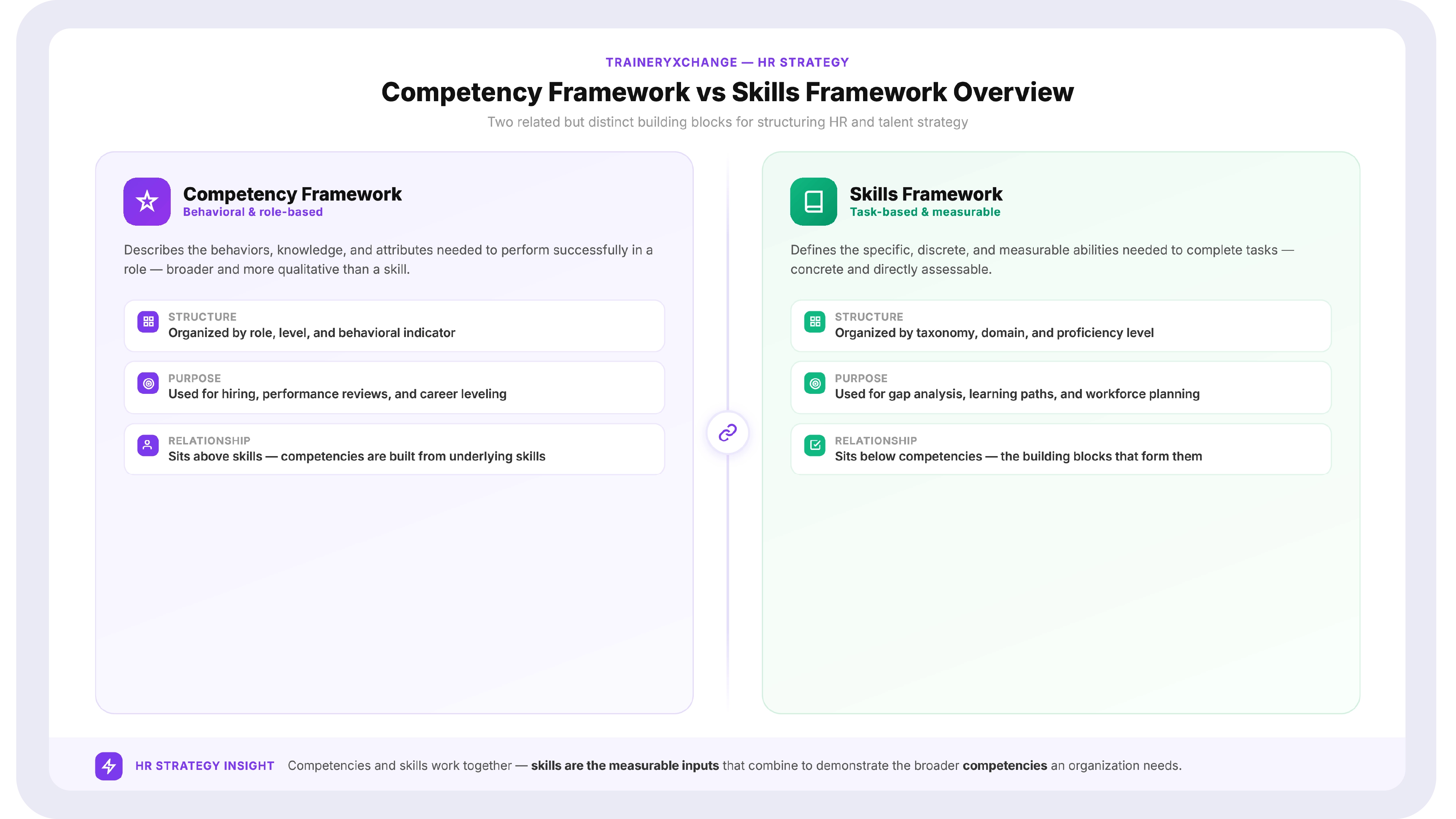
Side-by-side diagram comparing a competency framework and a skills framework, showing their structure, purpose, and relationship in HR strategy

Align Enterprise Learning Directly to Strategic Capabilities

TraineryXchange connects training content directly to your skills and competency framework, enabling role-based learning paths and automated gap-targeted course assignment. Explore the enterprise learning platform.

Book a Demo

Defining Each Framework Precisely

What Is a Competency Framework?

A competency framework is a structured model that defines the behaviors, knowledge, attitudes, and values required for effective performance across roles in an organization. Competencies are typically organized by level: foundational competencies that apply to all employees, role-specific competencies that differentiate functions or departments, and leadership competencies that describe expectations at management and executive levels.

Competencies are inherently behavioral. They describe how someone performs, not just what they can do. A competency like 'stakeholder influence' describes a pattern of behavior across multiple situations, building relationships, communicating with clarity, adapting approach to the audience rather than a single discrete capability.

Competency frameworks are most commonly used for:

  • Recruitment and selection: defining the behavioral profile of a successful hire
  • Performance management provides shared behavioral standards for evaluation conversations
  • Leadership development identifies the behaviors expected at each leadership level
  • Succession planning, assessing readiness against defined behavioral benchmarks
  • Culture alignment, communicating the values and working styles, and the organization's rewards

What Is a Skills Framework?

A skills framework, sometimes called a skills taxonomy or capability framework, is a structured inventory of the specific, measurable capabilities required to perform defined tasks, functions, or roles within an organization. Unlike competencies, which describe behavioral patterns, skills are discrete and observable: a person either has a skill to a defined level of proficiency or they do not.

Skills frameworks range from simple role-based capability lists to sophisticated skills ontologies that map hundreds of capabilities across proficiency levels, job families, and organizational functions. Modern skills frameworks typically define each skill with a name, a description, and three to five proficiency levels ranging from awareness through expert performance.

Skills frameworks are most commonly used for:

  • Workforce planning, identifying capability gaps between the current and future state workforce requirements
  • Skills gap analysis comparing employee capability profiles against role requirements at scale
  • Internal mobility matching employees to open roles or project opportunities based on verified skill profiles
  • Learning design determines which training programs are required for which employee populations
  • Career pathing shows employees the skill development progression required to advance into target roles

Competency Framework vs Skills Framework: Side-by-Side Comparison

Dimension Competency Framework Skills Framework
Definition A structured model of behaviors, knowledge, attitudes, and values that characterize effective performance in a role or organization. A structured inventory of specific, measurable capabilities required to perform defined tasks, functions, or roles.
Level of Granularity Broad behavioral clusters describing patterns of effective performance across multiple situations. Granular, discrete capabilities that are individually observable and assessable.
What It Answers What does good performance look like in this role or organization? What specific capabilities must an employee possess to perform a task or function?
Primary Focus Behavior, attitude, and values that describe how someone works. Knowledge, skills, and abilities that describe what someone can do.
Typical Scope 20–40 competencies covering all roles and organizational levels. Hundreds to thousands of skills organized by function, role family, and proficiency level.
Assessment Method Behavioral observation, 360-degree feedback, performance reviews, and calibration. Skills assessments, credential verification, manager validation, and demonstrated proficiency.
Primary HR Use Cases Recruitment, performance management, leadership development, and succession planning. Workforce planning, skills gap analysis, internal mobility, learning pathways, and career development.
Learning Connection Identifies behavioral development needs and informs leadership and management training. Drives personalized learning paths and targeted course assignments based on verified skill gaps.
Technology Requirement Competency models in an HRIS or performance management platform. Skills taxonomy within a talent intelligence platform, LXP, or enterprise learning platform.
Rate of Change Relatively stable and typically updated every two to three years. Highly dynamic and continuously updated as business needs and market skill demands evolve.
Best for Organizations That... Need consistent behavioral standards for hiring, performance, culture, and leadership development. Are building a skills-based organization with precise workforce planning, internal mobility, and personalized learning at scale.

When to Use a Competency Framework vs a Skills Framework

The choice between these two frameworks is not always binary. Many organizations need both, operating in parallel, with each serving a distinct strategic purpose. The decision about which to prioritize or how to sequence their development depends on organizational maturity, the primary workforce challenge being addressed, and the available HR technology infrastructure.

Use a Competency Framework When:

  • You are building or refreshing a performance management system and need shared behavioral standards for evaluation conversations across managers.
  • You are defining leadership expectations at multiple levels and need a behavioral model that informs promotion decisions, development planning, and succession calibration.
  • You are embedding organizational values into HR processes, hiring, performance, and recognition, and need a framework that connects culture to observable behavior.
  • Your organization is in an early stage of HR maturity and needs a structured, accessible framework that managers can understand and apply without extensive training.
  • You are designing a recruitment and selection process that needs to standardize behavioral interview criteria and hiring decision frameworks.

Use a Skills Framework When:

  • You are building a workforce planning capability and need to assess current versus future state capability requirements at the role, function, or organizational level.
  • You want to enable internal mobility by matching employees to open roles or project opportunities based on verified skills rather than job title or tenure.
  • You are designing personalized learning programs and need to assign training content based on individual skill gaps rather than role-level assumptions.
  • You are building career pathing infrastructure that shows employees the specific capability development required to advance into target roles.
  • You are implementing a skills-based organization strategy that replaces or supplements job-title-centric talent decisions with capability-based ones.

Use Both When:

  • You need behavioral performance standards for management and evaluation alongside granular capability data for learning design and workforce planning.
  • You are building an integrated talent management system where hiring criteria, performance expectations, development planning, and internal mobility are all connected.
  • Your organization is large enough that generic learning assignments produce inefficiency, and you need skills data to target training investment precisely.

How Skills Frameworks Support Skills-Based Organizations

Skills-based organization design is one of the most significant shifts in talent management strategy of the past decade. Rather than organizing work, talent decisions, and development investments around job titles and org chart position, skills-based organizations use verified employee skill profiles as the primary data layer for every consequential talent decision.

This shift has been accelerated by three converging factors:

  • The pace of skill obsolescence has increased. Job titles that existed five years ago may require entirely different capabilities today, and traditional job-description-based talent management cannot keep pace with that rate of change.
  • Internal mobility has become a strategic retention and productivity lever. Organizations that can match employees to internal opportunities based on verified skills reduce external hiring costs and improve retention among high-potential employees who would otherwise leave for growth opportunities.
  • AI and automation have made skills data scalable. Skills intelligence platforms that infer employee skill profiles from work history, credentials, and learning completion and match those profiles to opportunity data at scale, have made skills-based approaches operationally viable for organizations of all sizes.

A well-designed skills framework is the foundational data layer that makes skills-based organization design operational. Without a structured, organization-specific skills taxonomy, there is no consistent language for describing capability, no basis for skills gap measurement, and no way to connect training investment to workforce planning requirements.
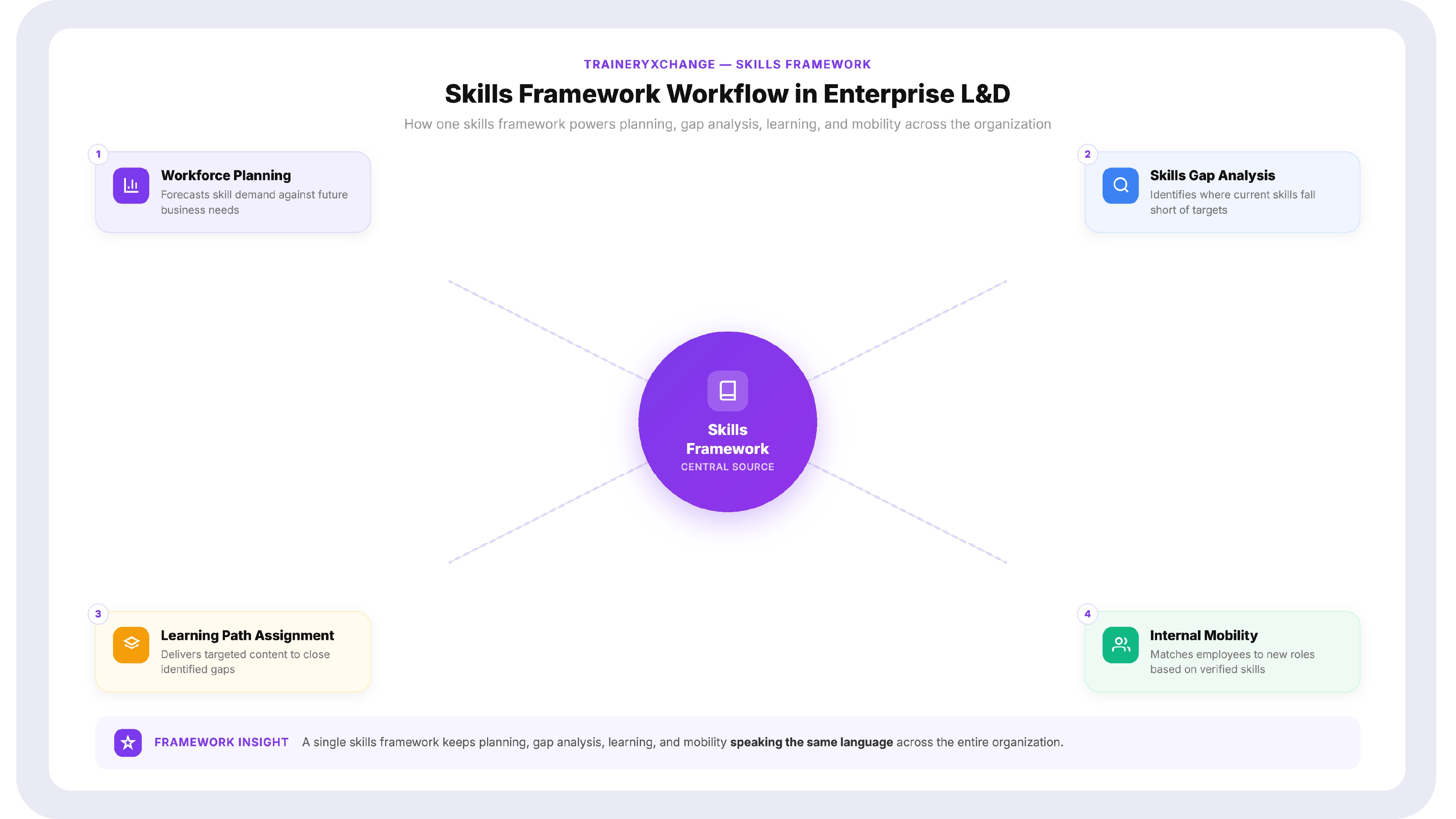
Diagram showing how a skills framework connects workforce planning, skills gap analysis, learning path assignment, and internal mobility in an enterprise organization

Automate Development Based on Real Capability Gaps

TraineryXchange's learning experience platform integrates with your skills framework to automate learning path assignment based on verified skill gaps and role requirements. Request a demo to see skills-connected learning in action.

Book a Demo

How Enterprise Learning Platforms Use Skills Frameworks for Personalized Learning

The connection between skills frameworks and learning program design is where the strategic value of capability data becomes operationally measurable. Without a skills framework, learning assignments are based on role assumptions: everyone in this job family receives this curriculum. With a skills framework, learning assignments are based on verified individual capability gaps, making every training investment more targeted and more efficient.

Skills-Connected Learning Path Assignment

An enterprise learning platform integrated with a skills framework can automatically assign learning content based on the gap between an employee's current verified skill level and the proficiency required for their current role or a target future role. This eliminates the manual curation burden on L&D teams while producing learning experiences that feel relevant to each learner.

Skill Gap Visibility at Scale

At the organizational level, a skills framework connected to a learning platform provides HR and L&D leaders with real-time visibility into capability gaps across teams, functions, and business units. This data transforms workforce planning from an annual estimation exercise into a continuously updated capability dashboard that can inform hiring decisions, internal mobility recommendations, and training investment prioritization.

Learning Outcome Measurement Connected to Capability

Traditional learning measurement tracks completion. Skills-connected learning measurement tracks capability change. When a learning platform records that an employee completed a data analysis module, a skills framework connection allows that completion to update the employee's verified skill profile at the appropriate proficiency level, making the learning investment visible as capability development rather than just training activity.

Pre-Built Course Libraries Mapped to Skills

One of the highest-value features in a modern enterprise learning platform is a curated content library with courses pre-mapped to skills taxonomy categories. Rather than requiring L&D teams to manually tag thousands of courses against their organization's skills framework, a platform with pre-built skills mappings allows organizations to adopt a content library and immediately activate skills-connected learning assignments without months of taxonomy mapping work.

Common Mistakes When Building Competency and Skills Frameworks

Mistake Why It Happens Consequence How to Avoid It
Building a Competency Framework When the Primary Need Is Skills Data Competency frameworks are more familiar to HR teams, while skills frameworks can appear more technical. Generic behavioral standards cannot support skills analysis, learning personalization, or internal mobility. Define the primary business use case first. If the goal is workforce planning, skills intelligence, or personalized learning, begin with a skills framework.
Creating a Skills Taxonomy That Is Too Large to Maintain Organizations try to capture every possible skill instead of prioritizing the capabilities that matter most for current and near-future roles. The taxonomy becomes outdated quickly, adoption declines, and managers struggle to navigate unnecessary complexity. Start with the skills most critical to strategic workforce priorities and expand the taxonomy incrementally as governance capacity grows.
Treating Frameworks as One-Time Projects Instead of Living Systems Initial framework development receives attention, but ongoing governance and maintenance are underestimated. The framework becomes outdated within 12–18 months as job requirements and market demands evolve. Assign framework ownership to HR or L&D and establish a governance process that reviews and updates the framework at least annually.
Building Competency Frameworks Without Connecting Them to Learning Performance management and learning systems operate independently with different owners. Competency gaps identified during reviews are not translated into learning actions because no connection exists. Integrate competency frameworks with the learning platform so identified gaps automatically generate learning recommendations.
Using Industry-Generic Frameworks Without Customization Organizations license third-party competency or skills frameworks instead of tailoring them to their business. The framework fails to reflect the organization's specific roles, culture, or strategic priorities. Use external frameworks as a starting point, then customize them to reflect the capabilities that differentiate your organization.
Assessing Skills Through Self-Declaration Only Self-assessment is low effort, easy to deploy, and requires little manager involvement. Skills data becomes unreliable because self-assessed proficiency often differs from demonstrated capability. Combine self-assessments with manager validation, skills assessments, credential verification, and demonstrated work evidence.

How AI and Skills Intelligence Are Reshaping Framework Management

The historical barrier to skills-based workforce strategies was operational: building, maintaining, and activating a skills taxonomy across thousands of employees required manual effort that did not scale. Skills, intelligence platforms, and AI-enabled capabilities are removing that barrier.

Automated Skills Inference

AI tools can infer employee skill profiles from structured data, such as job titles, work history, credentials, certifications, and completed training, reducing the dependence on self-assessment for initial profile population. While inferred profiles require human validation, they provide a starting point that makes skills framework adoption significantly faster and reduces the self-declaration bias that undermines data quality.

Dynamic Skills Taxonomy Management

Skills intelligence platforms can monitor emerging skill signals from job market data, industry publications, and internal performance patterns, flagging skills that are growing in organizational relevance and identifying capabilities that are becoming obsolete. This transforms skills taxonomy management from a periodic manual review into a continuously informed governance process.

Skills-to-Opportunity Matching at Scale

The most commercially significant application of AI in skills framework management is opportunity matching: using verified employee skill profiles to surface internal mobility options, project assignments, or mentoring connections that employees and managers would not otherwise identify. Organizations that implement this capability reduce external hiring costs for internal skills and improve retention among employees who would otherwise leave for career development opportunities.

Personalized Learning Activation

AI-enabled enterprise learning platforms can activate personalized learning recommendations based on the gap between an employee's verified skill profile and their role requirements or development aspirations. Rather than requiring L&D teams to manually design individual learning paths, the platform surfaces the most relevant courses from the content library based on each learner's specific capability gap at a scale that manual curation cannot achieve.

Linking Skills Frameworks to Workforce Planning, Internal Mobility, and Career Pathing

A skills framework that exists only in a document or spreadsheet has limited organizational value. Its strategic value is realized when it is connected to the talent processes that shape workforce decisions: planning, mobility, and career development.

Workforce Planning

Strategic workforce planning requires comparing the capability profile of the current workforce against the capability requirements of the future business strategy. Without a skills framework, this comparison is based on headcount and job titles. A skills framework, it is based on verified capability data, enabling planners to identify specific skill gaps that cannot be addressed by existing employee development and must be filled through hiring, contracting, or strategic reskilling programs.

Internal Mobility

Internal mobility rates are a leading indicator of organizational health, talent retention, and development culture. Skills frameworks enable internal mobility by providing a common capability language for matching employees to open roles or project opportunities. Employees with verified skill profiles can be matched to positions where their skills create immediate value, and development gaps between their current profile and the target role can be automatically surfaced as a learning path.

Career Pathing

Career pathing that is grounded in a skills framework moves beyond generic career ladder diagrams to show employees precisely what capabilities they need to develop to move into target roles. Rather than telling an employee to 'develop leadership skills' to advance, a skills-connected career path shows them the specific competencies and skills required at the target level, their current proficiency against each, and the learning resources available to close each gap.

The competency framework versus skills framework debate is, in practice, a false choice for most mature organizations. Competency frameworks provide the behavioral language for performance management, hiring, and culture alignment. Skills frameworks provide the granular capability data for workforce planning, learning targeting, and internal mobility. Both are necessary, and both are most powerful when connected and to the HR and learning technology systems that activate them.

For HR and L&D leaders making framework decisions today, the most important question is not which type of framework to build but what organizational problem you are trying to solve. If the answer is performance management and leadership development, start with competencies. If the answer is workforce planning, skills gap analysis, or personalized learning at scale, start with skills. If the answer is all of the above, build both with a clear integration plan.

The organizations that will execute talent strategy most effectively in the next three to five years are those that have built clean skills data, connected it to learning and workforce planning systems, and used it to make talent decisions based on verified capability rather than assumptions embedded in job titles and org chart position.
Enterprise Capability Development

Measure and Automate Capability Growth Across Your Workforce

TraineryXchange's enterprise learning platform connects directly to your skills and competency framework, enabling automated learning path assignment based on verified skill gaps, pre-built course libraries mapped to common skills taxonomies, and real-time visibility into capability development across your workforce. Request a demo to see how skills-connected learning works at enterprise scale.

Book a Demo

Key Takeaways

  • A competency framework defines the behaviors, knowledge, and values required for effective performance in a role. A skills framework defines the specific, measurable capabilities a person needs to perform a task or function.
  • The two frameworks are not mutually exclusive. Most mature organizations use both, with skills frameworks providing the granular capability data that competency frameworks organize into performance expectations.
  • The right choice depends on organizational maturity, workforce strategy, and the primary use case: competency frameworks support performance management and culture alignment, while skills frameworks support workforce planning, internal mobility, and personalized learning.
  • Skills-based organizations are accelerating the adoption of skills frameworks as the foundation for talent decisions, replacing traditional job-title-centric models.
  • Enterprise learning platforms that integrate with skills frameworks can automate personalized learning path assignment, identify skill gaps at the team or organizational level, and connect training completion to measurable capability outcomes.

What Is the Difference Between a Competency Framework and a Skills Framework?

A competency framework defines the behaviors, knowledge, attitudes, and values that characterize effective performance in a role or organization. It answers the question: What does good look like in this job? A skills framework defines the specific, observable, and measurable capabilities required to perform particular tasks or functions. It answers the question: what must someone be able to do? Competency frameworks tend to be broader, role-level constructs used for hiring, performance management, and culture alignment. Skills frameworks are more granular capability inventories used for workforce planning, gap analysis, learning design, and internal mobility. Both are strategic HR tools, but they serve different purposes and are most powerful when used together.

Why This Distinction Matters Now More Than Ever

HR and L&D leaders are under simultaneous pressure to develop talent faster, deploy it more flexibly, and demonstrate the workforce capability required to execute business strategy. Meeting all three demands requires a clear, shared language for describing what employees know, what they can do, and what they need to develop.

Competency frameworks and skills frameworks both provide parts of that language, but they answer different questions and serve different organizational purposes. Confusing the two or choosing one when the other is required produces workforce planning gaps, misaligned training investments, and performance management systems that measure the wrong things.

This confusion is common and costly. Organizations that deploy competency frameworks when they need skills data cannot identify specific capability gaps with the precision required for targeted training investment. Organizations that build skills inventories without connecting them to behavioral performance expectations end up with elaborate taxonomies that do not inform management decisions or development conversations.

The organizations getting this right are the ones building skills-based workforce strategies that actually improve talent mobility, reduce capability gaps, and accelerate skill development understand how to use both frameworks in combination, and when each one should take the lead.

Side-by-side diagram comparing a competency framework and a skills framework, showing their structure, purpose, and relationship in HR strategy

Align Enterprise Learning Directly to Strategic Capabilities

TraineryXchange connects training content directly to your skills and competency framework, enabling role-based learning paths and automated gap-targeted course assignment. Explore the enterprise learning platform.

Book a Demo

Defining Each Framework Precisely

What Is a Competency Framework?

A competency framework is a structured model that defines the behaviors, knowledge, attitudes, and values required for effective performance across roles in an organization. Competencies are typically organized by level: foundational competencies that apply to all employees, role-specific competencies that differentiate functions or departments, and leadership competencies that describe expectations at management and executive levels.

Competencies are inherently behavioral. They describe how someone performs, not just what they can do. A competency like 'stakeholder influence' describes a pattern of behavior across multiple situations, building relationships, communicating with clarity, adapting approach to the audience rather than a single discrete capability.

Competency frameworks are most commonly used for:

  • Recruitment and selection: defining the behavioral profile of a successful hire
  • Performance management provides shared behavioral standards for evaluation conversations
  • Leadership development identifies the behaviors expected at each leadership level
  • Succession planning, assessing readiness against defined behavioral benchmarks
  • Culture alignment, communicating the values and working styles, and the organization's rewards

What Is a Skills Framework?

A skills framework, sometimes called a skills taxonomy or capability framework, is a structured inventory of the specific, measurable capabilities required to perform defined tasks, functions, or roles within an organization. Unlike competencies, which describe behavioral patterns, skills are discrete and observable: a person either has a skill to a defined level of proficiency or they do not.

Skills frameworks range from simple role-based capability lists to sophisticated skills ontologies that map hundreds of capabilities across proficiency levels, job families, and organizational functions. Modern skills frameworks typically define each skill with a name, a description, and three to five proficiency levels ranging from awareness through expert performance.

Skills frameworks are most commonly used for:

  • Workforce planning, identifying capability gaps between the current and future state workforce requirements
  • Skills gap analysis comparing employee capability profiles against role requirements at scale
  • Internal mobility matching employees to open roles or project opportunities based on verified skill profiles
  • Learning design determines which training programs are required for which employee populations
  • Career pathing shows employees the skill development progression required to advance into target roles

Competency Framework vs Skills Framework: Side-by-Side Comparison

Dimension Competency Framework Skills Framework
Definition A structured model of behaviors, knowledge, attitudes, and values that characterize effective performance in a role or organization. A structured inventory of specific, measurable capabilities required to perform defined tasks, functions, or roles.
Level of Granularity Broad behavioral clusters describing patterns of effective performance across multiple situations. Granular, discrete capabilities that are individually observable and assessable.
What It Answers What does good performance look like in this role or organization? What specific capabilities must an employee possess to perform a task or function?
Primary Focus Behavior, attitude, and values that describe how someone works. Knowledge, skills, and abilities that describe what someone can do.
Typical Scope 20–40 competencies covering all roles and organizational levels. Hundreds to thousands of skills organized by function, role family, and proficiency level.
Assessment Method Behavioral observation, 360-degree feedback, performance reviews, and calibration. Skills assessments, credential verification, manager validation, and demonstrated proficiency.
Primary HR Use Cases Recruitment, performance management, leadership development, and succession planning. Workforce planning, skills gap analysis, internal mobility, learning pathways, and career development.
Learning Connection Identifies behavioral development needs and informs leadership and management training. Drives personalized learning paths and targeted course assignments based on verified skill gaps.
Technology Requirement Competency models in an HRIS or performance management platform. Skills taxonomy within a talent intelligence platform, LXP, or enterprise learning platform.
Rate of Change Relatively stable and typically updated every two to three years. Highly dynamic and continuously updated as business needs and market skill demands evolve.
Best for Organizations That... Need consistent behavioral standards for hiring, performance, culture, and leadership development. Are building a skills-based organization with precise workforce planning, internal mobility, and personalized learning at scale.

When to Use a Competency Framework vs a Skills Framework

The choice between these two frameworks is not always binary. Many organizations need both, operating in parallel, with each serving a distinct strategic purpose. The decision about which to prioritize or how to sequence their development depends on organizational maturity, the primary workforce challenge being addressed, and the available HR technology infrastructure.

Use a Competency Framework When:

  • You are building or refreshing a performance management system and need shared behavioral standards for evaluation conversations across managers.
  • You are defining leadership expectations at multiple levels and need a behavioral model that informs promotion decisions, development planning, and succession calibration.
  • You are embedding organizational values into HR processes, hiring, performance, and recognition, and need a framework that connects culture to observable behavior.
  • Your organization is in an early stage of HR maturity and needs a structured, accessible framework that managers can understand and apply without extensive training.
  • You are designing a recruitment and selection process that needs to standardize behavioral interview criteria and hiring decision frameworks.

Use a Skills Framework When:

  • You are building a workforce planning capability and need to assess current versus future state capability requirements at the role, function, or organizational level.
  • You want to enable internal mobility by matching employees to open roles or project opportunities based on verified skills rather than job title or tenure.
  • You are designing personalized learning programs and need to assign training content based on individual skill gaps rather than role-level assumptions.
  • You are building career pathing infrastructure that shows employees the specific capability development required to advance into target roles.
  • You are implementing a skills-based organization strategy that replaces or supplements job-title-centric talent decisions with capability-based ones.

Use Both When:

  • You need behavioral performance standards for management and evaluation alongside granular capability data for learning design and workforce planning.
  • You are building an integrated talent management system where hiring criteria, performance expectations, development planning, and internal mobility are all connected.
  • Your organization is large enough that generic learning assignments produce inefficiency, and you need skills data to target training investment precisely.

How Skills Frameworks Support Skills-Based Organizations

Skills-based organization design is one of the most significant shifts in talent management strategy of the past decade. Rather than organizing work, talent decisions, and development investments around job titles and org chart position, skills-based organizations use verified employee skill profiles as the primary data layer for every consequential talent decision.

This shift has been accelerated by three converging factors:

  • The pace of skill obsolescence has increased. Job titles that existed five years ago may require entirely different capabilities today, and traditional job-description-based talent management cannot keep pace with that rate of change.
  • Internal mobility has become a strategic retention and productivity lever. Organizations that can match employees to internal opportunities based on verified skills reduce external hiring costs and improve retention among high-potential employees who would otherwise leave for growth opportunities.
  • AI and automation have made skills data scalable. Skills intelligence platforms that infer employee skill profiles from work history, credentials, and learning completion and match those profiles to opportunity data at scale, have made skills-based approaches operationally viable for organizations of all sizes.

A well-designed skills framework is the foundational data layer that makes skills-based organization design operational. Without a structured, organization-specific skills taxonomy, there is no consistent language for describing capability, no basis for skills gap measurement, and no way to connect training investment to workforce planning requirements.

Diagram showing how a skills framework connects workforce planning, skills gap analysis, learning path assignment, and internal mobility in an enterprise organization

Automate Development Based on Real Capability Gaps

TraineryXchange's learning experience platform integrates with your skills framework to automate learning path assignment based on verified skill gaps and role requirements. Request a demo to see skills-connected learning in action.

Book a Demo

How Enterprise Learning Platforms Use Skills Frameworks for Personalized Learning

The connection between skills frameworks and learning program design is where the strategic value of capability data becomes operationally measurable. Without a skills framework, learning assignments are based on role assumptions: everyone in this job family receives this curriculum. With a skills framework, learning assignments are based on verified individual capability gaps, making every training investment more targeted and more efficient.

Skills-Connected Learning Path Assignment

An enterprise learning platform integrated with a skills framework can automatically assign learning content based on the gap between an employee's current verified skill level and the proficiency required for their current role or a target future role. This eliminates the manual curation burden on L&D teams while producing learning experiences that feel relevant to each learner.

Skill Gap Visibility at Scale

At the organizational level, a skills framework connected to a learning platform provides HR and L&D leaders with real-time visibility into capability gaps across teams, functions, and business units. This data transforms workforce planning from an annual estimation exercise into a continuously updated capability dashboard that can inform hiring decisions, internal mobility recommendations, and training investment prioritization.

Learning Outcome Measurement Connected to Capability

Traditional learning measurement tracks completion. Skills-connected learning measurement tracks capability change. When a learning platform records that an employee completed a data analysis module, a skills framework connection allows that completion to update the employee's verified skill profile at the appropriate proficiency level, making the learning investment visible as capability development rather than just training activity.

Pre-Built Course Libraries Mapped to Skills

One of the highest-value features in a modern enterprise learning platform is a curated content library with courses pre-mapped to skills taxonomy categories. Rather than requiring L&D teams to manually tag thousands of courses against their organization's skills framework, a platform with pre-built skills mappings allows organizations to adopt a content library and immediately activate skills-connected learning assignments without months of taxonomy mapping work.

Common Mistakes When Building Competency and Skills Frameworks

Mistake Why It Happens Consequence How to Avoid It
Building a Competency Framework When the Primary Need Is Skills Data Competency frameworks are more familiar to HR teams, while skills frameworks can appear more technical. Generic behavioral standards cannot support skills analysis, learning personalization, or internal mobility. Define the primary business use case first. If the goal is workforce planning, skills intelligence, or personalized learning, begin with a skills framework.
Creating a Skills Taxonomy That Is Too Large to Maintain Organizations try to capture every possible skill instead of prioritizing the capabilities that matter most for current and near-future roles. The taxonomy becomes outdated quickly, adoption declines, and managers struggle to navigate unnecessary complexity. Start with the skills most critical to strategic workforce priorities and expand the taxonomy incrementally as governance capacity grows.
Treating Frameworks as One-Time Projects Instead of Living Systems Initial framework development receives attention, but ongoing governance and maintenance are underestimated. The framework becomes outdated within 12–18 months as job requirements and market demands evolve. Assign framework ownership to HR or L&D and establish a governance process that reviews and updates the framework at least annually.
Building Competency Frameworks Without Connecting Them to Learning Performance management and learning systems operate independently with different owners. Competency gaps identified during reviews are not translated into learning actions because no connection exists. Integrate competency frameworks with the learning platform so identified gaps automatically generate learning recommendations.
Using Industry-Generic Frameworks Without Customization Organizations license third-party competency or skills frameworks instead of tailoring them to their business. The framework fails to reflect the organization's specific roles, culture, or strategic priorities. Use external frameworks as a starting point, then customize them to reflect the capabilities that differentiate your organization.
Assessing Skills Through Self-Declaration Only Self-assessment is low effort, easy to deploy, and requires little manager involvement. Skills data becomes unreliable because self-assessed proficiency often differs from demonstrated capability. Combine self-assessments with manager validation, skills assessments, credential verification, and demonstrated work evidence.

How AI and Skills Intelligence Are Reshaping Framework Management

The historical barrier to skills-based workforce strategies was operational: building, maintaining, and activating a skills taxonomy across thousands of employees required manual effort that did not scale. Skills, intelligence platforms, and AI-enabled capabilities are removing that barrier.

Automated Skills Inference

AI tools can infer employee skill profiles from structured data, such as job titles, work history, credentials, certifications, and completed training, reducing the dependence on self-assessment for initial profile population. While inferred profiles require human validation, they provide a starting point that makes skills framework adoption significantly faster and reduces the self-declaration bias that undermines data quality.

Dynamic Skills Taxonomy Management

Skills intelligence platforms can monitor emerging skill signals from job market data, industry publications, and internal performance patterns, flagging skills that are growing in organizational relevance and identifying capabilities that are becoming obsolete. This transforms skills taxonomy management from a periodic manual review into a continuously informed governance process.

Skills-to-Opportunity Matching at Scale

The most commercially significant application of AI in skills framework management is opportunity matching: using verified employee skill profiles to surface internal mobility options, project assignments, or mentoring connections that employees and managers would not otherwise identify. Organizations that implement this capability reduce external hiring costs for internal skills and improve retention among employees who would otherwise leave for career development opportunities.

Personalized Learning Activation

AI-enabled enterprise learning platforms can activate personalized learning recommendations based on the gap between an employee's verified skill profile and their role requirements or development aspirations. Rather than requiring L&D teams to manually design individual learning paths, the platform surfaces the most relevant courses from the content library based on each learner's specific capability gap at a scale that manual curation cannot achieve.

Linking Skills Frameworks to Workforce Planning, Internal Mobility, and Career Pathing

A skills framework that exists only in a document or spreadsheet has limited organizational value. Its strategic value is realized when it is connected to the talent processes that shape workforce decisions: planning, mobility, and career development.

Workforce Planning

Strategic workforce planning requires comparing the capability profile of the current workforce against the capability requirements of the future business strategy. Without a skills framework, this comparison is based on headcount and job titles. A skills framework, it is based on verified capability data, enabling planners to identify specific skill gaps that cannot be addressed by existing employee development and must be filled through hiring, contracting, or strategic reskilling programs.

Internal Mobility

Internal mobility rates are a leading indicator of organizational health, talent retention, and development culture. Skills frameworks enable internal mobility by providing a common capability language for matching employees to open roles or project opportunities. Employees with verified skill profiles can be matched to positions where their skills create immediate value, and development gaps between their current profile and the target role can be automatically surfaced as a learning path.

Career Pathing

Career pathing that is grounded in a skills framework moves beyond generic career ladder diagrams to show employees precisely what capabilities they need to develop to move into target roles. Rather than telling an employee to 'develop leadership skills' to advance, a skills-connected career path shows them the specific competencies and skills required at the target level, their current proficiency against each, and the learning resources available to close each gap.

The competency framework versus skills framework debate is, in practice, a false choice for most mature organizations. Competency frameworks provide the behavioral language for performance management, hiring, and culture alignment. Skills frameworks provide the granular capability data for workforce planning, learning targeting, and internal mobility. Both are necessary, and both are most powerful when connected and to the HR and learning technology systems that activate them.

For HR and L&D leaders making framework decisions today, the most important question is not which type of framework to build but what organizational problem you are trying to solve. If the answer is performance management and leadership development, start with competencies. If the answer is workforce planning, skills gap analysis, or personalized learning at scale, start with skills. If the answer is all of the above, build both with a clear integration plan.

The organizations that will execute talent strategy most effectively in the next three to five years are those that have built clean skills data, connected it to learning and workforce planning systems, and used it to make talent decisions based on verified capability rather than assumptions embedded in job titles and org chart position.
Enterprise Capability Development

Measure and Automate Capability Growth Across Your Workforce

TraineryXchange's enterprise learning platform connects directly to your skills and competency framework, enabling automated learning path assignment based on verified skill gaps, pre-built course libraries mapped to common skills taxonomies, and real-time visibility into capability development across your workforce. Request a demo to see how skills-connected learning works at enterprise scale.

Book a Demo

Frequently Asked Questions

How is AI changing the way organizations build and manage skills frameworks?
How do enterprise learning platforms connect to skills frameworks?
What are the most common mistakes organizations make when building a skills framework?
How does a skills framework support a skills-based organization strategy?
When should an organization use a competency framework versus a skills framework?
What is the fundamental difference between a competency framework and a skills framework?