
The ROI of Outsourced Training Content for Small and Mid-Size Businesses

For most SMBs, outsourced training content offers better ROI than building in-house by saving time, reducing hidden costs, and lowering compliance risk.

Mahesh Kumar

Founder, TraineryHCM.com

Table of Content

The ROI of Outsourced Training Content for Small and Mid-Size Businesses

The Build vs Buy Question Every L&D Team Eventually Faces

At some point, every HR or L&D team in a small or mid-size business reaches the same crossroads. You need a compliance training program. Or a new hire onboarding curriculum. Or sales enablement content. And someone asks: should we build this ourselves or buy it?

Building sounds appealing. Custom content. Your branding. Your process. No ongoing subscription. But the math rarely works out the way it looks at first glance, especially for SMBs that do not have a dedicated instructional design team, a video production budget, or the time to maintain content as regulations and processes change.

This article breaks down the full cost of building training content in-house vs licensing it from a curated marketplace, including the hidden costs most organizations do not count, and the ROI calculation you can use to make the case internally.

What Outsourcing Training Content Actually Means

Outsourcing training content does not mean sending your L&D work offshore or losing control of what your employees learn. In the context of SMB training programs, it means licensing pre-built, professionally produced courses from a curated training marketplace rather than building every course from scratch internally.

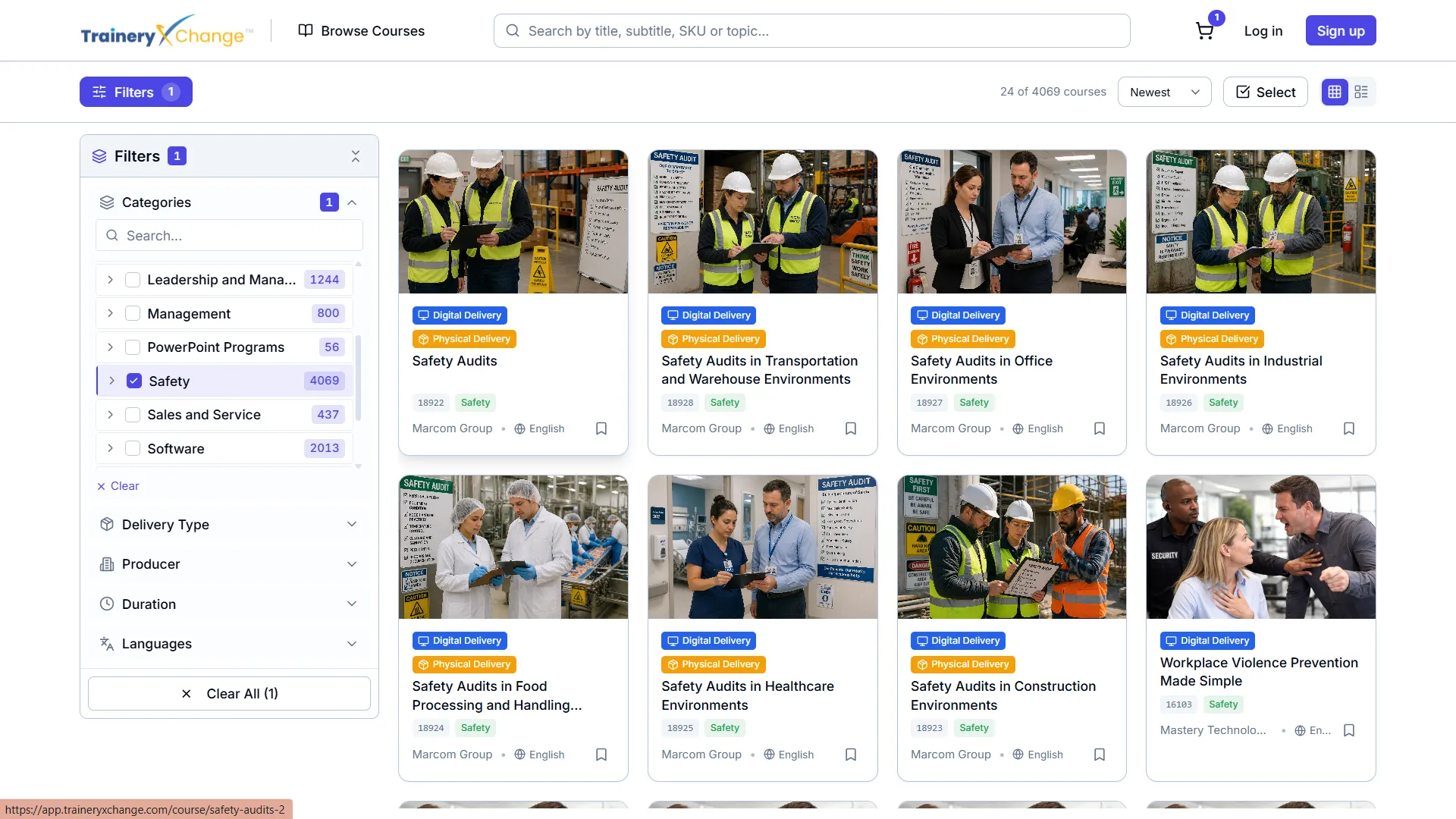
A training content marketplace like TraineryXchange gives you access to thousands of courses, across compliance, onboarding, technical skills, leadership, DEI, and more, that are ready to deploy the day you subscribe. You do not build them. You select the ones that fit your program, assign them to employees, and track completions.

The content is produced by specialist providers who do this full-time: instructional designers, subject matter experts, video production teams, and legal reviewers. For compliance content especially, that expertise is not something a generalist HR team can easily replicate.

The Full Cost of Building Training Content In-House

The most common mistake in build vs buy analysis is counting only the visible costs. Most organizations calculate: instructional designer salary + authoring tool license. What they miss is everything else.

Cost Factor Build In-House Outsource via Marketplace
Instructional designer salary $65,000 – $90,000/yr Included in marketplace subscription
Subject matter expert (SME) time $5,000 – $20,000 per course Included in content licensing fee
Authoring tool license (Articulate, etc.) $1,400 – $5,000/yr Not required
Video production (if applicable) $3,000 – $15,000 per course Included
LMS to host and deliver content $3,000 – $15,000/yr Included in TraineryXchange subscription
Content update and maintenance $2,000 – $8,000 per course revision Included — auto-updated via dispatch
Compliance review (legal sign-off) $1,000 – $5,000 per course Included by content provider
Time to first learner (average) 3 – 6 months Same day or next day
Annual cost (50-person team, est.) $80,000 – $180,000+ $3,000 – $8,000

ROI Calculator: Build vs Buy for a 50-Person Team

The following calculation uses conservative estimates for a 50-person SMB with a standard compliance and onboarding training program (approximately 8 training hours per employee per year). Adjust the numbers for your organization's actual situation.

Metric Build In-House (50 staff) Outsource to Marketplace
Number of employees trained 50 people 50 people
Training hours required (avg per employee) 8 hours/year 8 hours/year
Internal build cost (ID + SME + tools) $120,000/year N/A
Marketplace subscription cost N/A $5,000/year
LMS cost (separate) $8,000/year Included — $0
Employee time cost (8 hrs @ avg $35/hr) $14,000/year $14,000/year
Total annual training cost $142,000 $19,000
Cost per trained employee $2,840 $380
ROI of switching to outsourced 87% cost reduction

4 ROI Factors That Do Not Show Up in a Spreadsheet

The cost comparison above captures the financial picture. But there are four ROI factors that are harder to quantify and equally important for the decision.

1. Speed to deployment

When your HR team identifies a training need, a new regulation, a compliance gap, an onboarding issue, how long does it take to put training in front of employees? Building in-house averages 3 to 6 months from brief to launch. A training marketplace delivers the same outcome the same day. In fast-moving compliance environments, that lag is not just inconvenient, it is a liability exposure window.

2. Content quality and learner engagement

Instructional designers who specialize in a particular content domain produce better learning outcomes than generalist HR teams building courses on top of their existing workload. Marketplace content from specialist providers typically scores higher on learner engagement, knowledge retention, and completion rates than internally-produced content with similar resources.

Higher completion rates matter for compliance: if your employees do not finish the training, the business is not protected even if you have the content license.

3. Compliance risk reduction

The financial cost of a compliance failure, an OSHA citation, an EEOC harassment settlement, a GDPR enforcement action, dwarfs the cost of any training program. Outsourcing to a provider that maintains legally reviewed, regularly updated compliance content reduces the risk that your training program is the weakest link in a regulatory defense.

According to NAVEX's Ethics and Compliance Program Effectiveness data, organizations with structured, regularly updated compliance training programs report significantly lower rates of misconduct and regulatory violations than those with ad hoc or outdated programs.

4. L&D team bandwidth reallocation

When your L&D team is not building content, they are doing something more valuable: designing learning journeys, coaching managers, analyzing performance gaps, running facilitated programs. Outsourcing content creation frees internal L&D resources for high-impact strategic work that a marketplace cannot replace.

5 Signs Your Organization Should Outsource Training Content

Not every organization is at the right point to make this shift. These signals indicate that the ROI of outsourcing is likely positive for your team right now.

# Signal Why It Matters
1 Your L&D team spends more than 20% of their time building content rather than running programs Content creation is consuming bandwidth that should go toward learning strategy, facilitation, and impact measurement.
2 It takes more than 60 days from “we need this training” to “training is live” A curated marketplace delivers courses same-day or next-day. If your build cycle is 3 to 6 months, you are slower than your business needs.
3 Your compliance training content is more than 18 months old Regulations change. If your OSHA, harassment, or data privacy training has not been updated in 18+ months, you may be running non-compliant content without knowing it.
4 You are paying for both an LMS and a content vendor separately You are paying for two platforms where one all-in-one solution covers both. The consolidation ROI alone typically justifies switching.
5 Your learner completion rates are below 70% Low completion often signals content quality issues — not learner motivation. Curated marketplace content from specialist providers typically outperforms internally-produced content on engagement metrics.

What Outsourced Content Does Not Replace

Outsourcing is not a complete L&D strategy. It is a content sourcing strategy. There are things a training marketplace cannot and should not replace:

  • Highly custom content specific to your proprietary processes, products, or company culture  if no marketplace course covers it, you need to build it.
  • Manager coaching and leadership facilitation these require live human interaction and organizational context.
  • Learning strategy, needs analysis, and program design these are the core competencies of your internal L&D team.
  • Performance support tools specific to your systems job aids, process guides, and product documentation are typically internal builds.

The strongest L&D programs in SMBs use a blended approach: marketplace content for breadth and compliance coverage, and internal builds for the 10 to 15 percent of training that genuinely requires customization.

How to Evaluate a Training Content Marketplace Before You Subscribe

Not all training marketplaces are equal. Before committing to a subscription, use this evaluation framework.

What to Evaluate Questions to Ask the Vendor
Content quality standard How are courses vetted before listing? What is the rejection rate? Are compliance courses reviewed by legal or subject matter experts?
Content coverage breadth Does the library cover your specific compliance requirements (OSHA, harassment, DEI, data privacy, industry-specific)?
Update frequency How often is compliance content updated? When a regulation changes, how quickly does the platform update the affected courses?
Delivery format SCORM dispatch (auto-updates, multi-LMS) vs native files (more control, manual updates). Does the platform support both?
LMS included or separate? Is tracking and reporting built in, or do you need to purchase a separate LMS? Factor this into your total cost comparison.
Pricing model Per-seat vs per-course vs bulk subscription. Is pricing publicly listed or require a sales call?
Completion certificates Are certificates generated automatically on completion? Are they branded and audit-ready?
Reporting and audit trails Can you export completion reports for audits? By department, by course, by date range?
Free trial or sample content Can you review content quality before purchasing? A vendor confident in their content will offer this.

See What Outsourcing Training Content Costs on TraineryXchange

TraineryXchange gives SMBs access to 10,000+ curated courses across compliance, onboarding, leadership, and technical skills — all with a native LMS included. No instructional designer needed. No separate LMS purchase. Book a demo to see the platform in action, or start with the free trial to browse the library before you subscribe.
The ROI of Outsourced Training Content for Small and Mid-Size Businesses

The Build vs Buy Question Every L&D Team Eventually Faces

At some point, every HR or L&D team in a small or mid-size business reaches the same crossroads. You need a compliance training program. Or a new hire onboarding curriculum. Or sales enablement content. And someone asks: should we build this ourselves or buy it?

Building sounds appealing. Custom content. Your branding. Your process. No ongoing subscription. But the math rarely works out the way it looks at first glance, especially for SMBs that do not have a dedicated instructional design team, a video production budget, or the time to maintain content as regulations and processes change.

This article breaks down the full cost of building training content in-house vs licensing it from a curated marketplace, including the hidden costs most organizations do not count, and the ROI calculation you can use to make the case internally.

What Outsourcing Training Content Actually Means

Outsourcing training content does not mean sending your L&D work offshore or losing control of what your employees learn. In the context of SMB training programs, it means licensing pre-built, professionally produced courses from a curated training marketplace rather than building every course from scratch internally.

A training content marketplace like TraineryXchange gives you access to thousands of courses, across compliance, onboarding, technical skills, leadership, DEI, and more, that are ready to deploy the day you subscribe. You do not build them. You select the ones that fit your program, assign them to employees, and track completions.

The content is produced by specialist providers who do this full-time: instructional designers, subject matter experts, video production teams, and legal reviewers. For compliance content especially, that expertise is not something a generalist HR team can easily replicate.

The Full Cost of Building Training Content In-House

The most common mistake in build vs buy analysis is counting only the visible costs. Most organizations calculate: instructional designer salary + authoring tool license. What they miss is everything else.

Cost Factor Build In-House Outsource via Marketplace
Instructional designer salary $65,000 – $90,000/yr Included in marketplace subscription
Subject matter expert (SME) time $5,000 – $20,000 per course Included in content licensing fee
Authoring tool license (Articulate, etc.) $1,400 – $5,000/yr Not required
Video production (if applicable) $3,000 – $15,000 per course Included
LMS to host and deliver content $3,000 – $15,000/yr Included in TraineryXchange subscription
Content update and maintenance $2,000 – $8,000 per course revision Included — auto-updated via dispatch
Compliance review (legal sign-off) $1,000 – $5,000 per course Included by content provider
Time to first learner (average) 3 – 6 months Same day or next day
Annual cost (50-person team, est.) $80,000 – $180,000+ $3,000 – $8,000

ROI Calculator: Build vs Buy for a 50-Person Team

The following calculation uses conservative estimates for a 50-person SMB with a standard compliance and onboarding training program (approximately 8 training hours per employee per year). Adjust the numbers for your organization's actual situation.

Metric Build In-House (50 staff) Outsource to Marketplace
Number of employees trained 50 people 50 people
Training hours required (avg per employee) 8 hours/year 8 hours/year
Internal build cost (ID + SME + tools) $120,000/year N/A
Marketplace subscription cost N/A $5,000/year
LMS cost (separate) $8,000/year Included — $0
Employee time cost (8 hrs @ avg $35/hr) $14,000/year $14,000/year
Total annual training cost $142,000 $19,000
Cost per trained employee $2,840 $380
ROI of switching to outsourced 87% cost reduction

4 ROI Factors That Do Not Show Up in a Spreadsheet

The cost comparison above captures the financial picture. But there are four ROI factors that are harder to quantify and equally important for the decision.

1. Speed to deployment

When your HR team identifies a training need, a new regulation, a compliance gap, an onboarding issue, how long does it take to put training in front of employees? Building in-house averages 3 to 6 months from brief to launch. A training marketplace delivers the same outcome the same day. In fast-moving compliance environments, that lag is not just inconvenient, it is a liability exposure window.

2. Content quality and learner engagement

Instructional designers who specialize in a particular content domain produce better learning outcomes than generalist HR teams building courses on top of their existing workload. Marketplace content from specialist providers typically scores higher on learner engagement, knowledge retention, and completion rates than internally-produced content with similar resources.

Higher completion rates matter for compliance: if your employees do not finish the training, the business is not protected even if you have the content license.

3. Compliance risk reduction

The financial cost of a compliance failure, an OSHA citation, an EEOC harassment settlement, a GDPR enforcement action, dwarfs the cost of any training program. Outsourcing to a provider that maintains legally reviewed, regularly updated compliance content reduces the risk that your training program is the weakest link in a regulatory defense.

According to NAVEX's Ethics and Compliance Program Effectiveness data, organizations with structured, regularly updated compliance training programs report significantly lower rates of misconduct and regulatory violations than those with ad hoc or outdated programs.

4. L&D team bandwidth reallocation

When your L&D team is not building content, they are doing something more valuable: designing learning journeys, coaching managers, analyzing performance gaps, running facilitated programs. Outsourcing content creation frees internal L&D resources for high-impact strategic work that a marketplace cannot replace.

5 Signs Your Organization Should Outsource Training Content

Not every organization is at the right point to make this shift. These signals indicate that the ROI of outsourcing is likely positive for your team right now.

# Signal Why It Matters
1 Your L&D team spends more than 20% of their time building content rather than running programs Content creation is consuming bandwidth that should go toward learning strategy, facilitation, and impact measurement.
2 It takes more than 60 days from “we need this training” to “training is live” A curated marketplace delivers courses same-day or next-day. If your build cycle is 3 to 6 months, you are slower than your business needs.
3 Your compliance training content is more than 18 months old Regulations change. If your OSHA, harassment, or data privacy training has not been updated in 18+ months, you may be running non-compliant content without knowing it.
4 You are paying for both an LMS and a content vendor separately You are paying for two platforms where one all-in-one solution covers both. The consolidation ROI alone typically justifies switching.
5 Your learner completion rates are below 70% Low completion often signals content quality issues — not learner motivation. Curated marketplace content from specialist providers typically outperforms internally-produced content on engagement metrics.

What Outsourced Content Does Not Replace

Outsourcing is not a complete L&D strategy. It is a content sourcing strategy. There are things a training marketplace cannot and should not replace:

  • Highly custom content specific to your proprietary processes, products, or company culture  if no marketplace course covers it, you need to build it.
  • Manager coaching and leadership facilitation these require live human interaction and organizational context.
  • Learning strategy, needs analysis, and program design these are the core competencies of your internal L&D team.
  • Performance support tools specific to your systems job aids, process guides, and product documentation are typically internal builds.

The strongest L&D programs in SMBs use a blended approach: marketplace content for breadth and compliance coverage, and internal builds for the 10 to 15 percent of training that genuinely requires customization.

How to Evaluate a Training Content Marketplace Before You Subscribe

Not all training marketplaces are equal. Before committing to a subscription, use this evaluation framework.

What to Evaluate Questions to Ask the Vendor
Content quality standard How are courses vetted before listing? What is the rejection rate? Are compliance courses reviewed by legal or subject matter experts?
Content coverage breadth Does the library cover your specific compliance requirements (OSHA, harassment, DEI, data privacy, industry-specific)?
Update frequency How often is compliance content updated? When a regulation changes, how quickly does the platform update the affected courses?
Delivery format SCORM dispatch (auto-updates, multi-LMS) vs native files (more control, manual updates). Does the platform support both?
LMS included or separate? Is tracking and reporting built in, or do you need to purchase a separate LMS? Factor this into your total cost comparison.
Pricing model Per-seat vs per-course vs bulk subscription. Is pricing publicly listed or require a sales call?
Completion certificates Are certificates generated automatically on completion? Are they branded and audit-ready?
Reporting and audit trails Can you export completion reports for audits? By department, by course, by date range?
Free trial or sample content Can you review content quality before purchasing? A vendor confident in their content will offer this.

See What Outsourcing Training Content Costs on TraineryXchange

TraineryXchange gives SMBs access to 10,000+ curated courses across compliance, onboarding, leadership, and technical skills — all with a native LMS included. No instructional designer needed. No separate LMS purchase. Book a demo to see the platform in action, or start with the free trial to browse the library before you subscribe.
Frequently Asked Questions

How do I calculate the ROI of outsourced training for my organization?
Does outsourcing training content work for small businesses with fewer than 50 employees?
What is the difference between a training content marketplace and a custom content vendor?
Can I outsource compliance training content?
How much does it cost to outsource training content for a small business?
Is outsourced training content as effective as custom-built content?
What does outsourcing training content include?
What is the ROI of outsourcing training content vs building in-house?