Leadership Development Platforms: 2026 Buyer’s Guide

Compare leadership development platforms by learning content, coaching and mentoring workflows, assessments, analytics, integrations, administration, and implementation needs.

Updated On:
June 21, 2026

Mahesh Kumar

Founder, TraineryHCM.com
Leadership development platforms buyer’s guide

Table of Contents

Leadership development software is a broad category. Some platforms are designed around coaching or mentoring, some around leadership courses and learning paths, some around assessments or cohort programs, and some are general learning platforms that can support leadership development alongside onboarding, compliance, and other training.

That variety makes a feature checklist alone a weak way to choose a platform. The better starting point is to define the leadership-development problem the organization is trying to solve, the audiences involved, the evidence required, and the systems the platform must work with.

Quick answer: A leadership development platform is software used to organize one or more parts of leadership development, such as learning content, assessments, coaching, mentoring, cohort programs, practice, progress tracking, or reporting. There is no single feature set that every leadership platform must include. Buyers should compare products against their actual program design and verify current capabilities with each vendor.

Leadership Development Platform vs. LMS vs. LXP

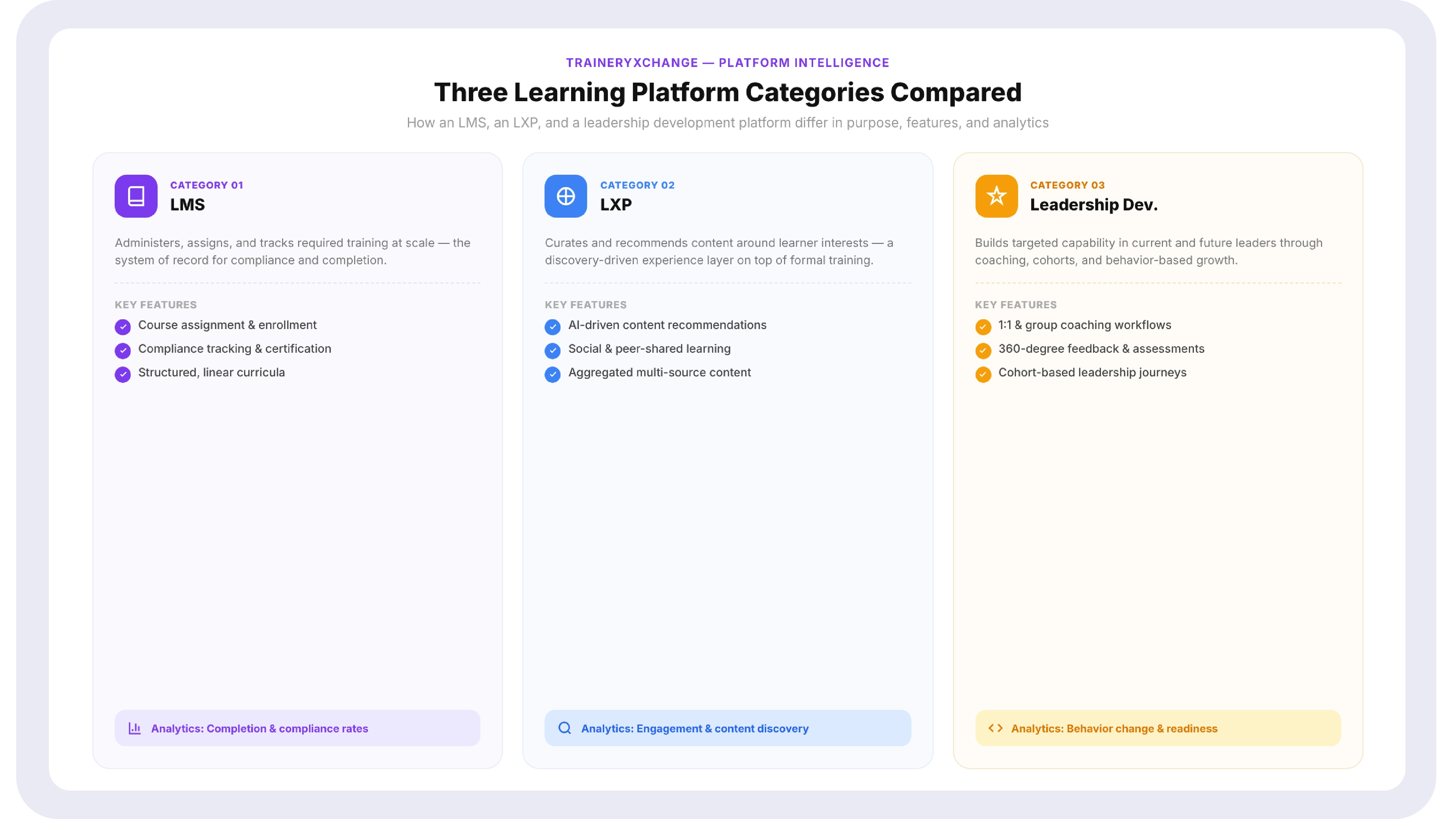
The boundaries between learning-management systems, learning-experience platforms, coaching platforms, mentoring software, and leadership-development products are not fixed. Many vendors now combine capabilities that historically belonged to different categories.

CategoryTypical FocusPossible Leadership UseWhat to Verify
LMSAdministration, assignment, delivery, tracking, records, and reporting for formal learning.Leadership courses, manager curricula, onboarding for new supervisors, required learning, assessments.Learning-path controls, content compatibility, reporting, groups, integrations, administration.
LXPDiscovery, curation, recommendations, aggregation, and learner-driven development.Leadership content discovery, personalized development, communities, skills-based recommendations.Content sources, recommendation logic, administration, data ownership, reporting, integrations.
Coaching or mentoring platformHuman development relationships, matching, sessions, goals, and program administration.Executive coaching, manager coaching, mentoring programs, peer-development networks.Matching method, coach or mentor supply, privacy, session records, outcomes, integrations.
Leadership-development platformA product positioned specifically around manager or leader development.May combine content, assessments, cohorts, coaching, mentoring, practice, or analytics.Which capabilities are native, which require partners, and which are available only in certain plans.

An organization may need one platform or several connected tools. Consolidation can simplify administration, but a specialist product may provide deeper functionality for a particular use case. The right architecture depends on existing systems, program design, data requirements, budget, and support capacity.

Compare Leadership Learning Against Your Existing Stack

TraineryXchange can help teams review leadership content, delivery, and TraineryLMS options alongside the systems they already use. Available features and integrations depend on the selected configuration.
Book a Demo
Side-by-side comparison diagram showing the differences between an LMS, a learning experience platform, and a leadership development platform across purpose, features, and analytics

Leadership Development Platform Features to Evaluate

The sections below are evaluation areas, not universal must-have features. A product that is strong for a coaching-led executive program may look very different from one designed for first-time manager training at scale.

Learning paths and content administration

Look at how administrators create programs, group learners, sequence content, manage cohorts, set due dates, and review progress. If the organization already owns leadership content, confirm the formats and delivery methods the platform supports.

Content library access

Ready-made leadership content can reduce internal production work for common topics such as communication, coaching, feedback, delegation, change management, conflict, and manager fundamentals. Buyers should review the actual publishers and courses rather than relying on catalog-size claims alone.

Check subject-matter expertise, update practices, learning objectives, accessibility, language availability, licensing, assessment, delivery format, and LMS compatibility for the content you plan to use.

Assessments and competency frameworks

Assessments can support development planning when they are appropriate for the capability and used carefully. Platforms may offer self-assessment, manager assessment, multi-rater feedback, knowledge tests, skills assessments, or integrations with external assessment providers.

Verify whether an assessment is validated for the intended purpose and how scores are interpreted. A change in an assessment score should not automatically be treated as proof of improved leadership effectiveness.

Coaching and mentoring workflows

If coaching or mentoring is part of the program, evaluate participant matching, scheduling, goals, session administration, privacy, notes, reporting, and support for internal or external coaches and mentors. The appropriate level of tracking depends on the program and confidentiality expectations.

Practice and application

Leadership development often requires more than content consumption. Consider whether the program needs scenarios, role-play, projects, manager follow-up, peer discussion, reflection, action plans, or workplace assignments. Some of these may occur inside the platform; others may be managed through the program design.

Reporting and analytics

Start with the decisions the reporting must support. Learning metrics can include participation, completion, assessment activity, cohort progress, or content use. Business measures such as promotion, retention, engagement, or team performance usually live in HR, performance, or analytics systems and require separate interpretation.

Be cautious with dashboards that label a learner as "promotion ready" or claim to measure leadership effectiveness without explaining the underlying data and methodology.

Integrations, identity, and data flow

Review SSO, user provisioning, HRIS connections, LMS integrations, APIs, communication tools, exports, and data ownership. Integration availability differs by vendor, plan, and customer environment. Ask which system is the source of truth for users, roles, completion records, and program data.

Security, privacy, accessibility, and support

Leadership programs can contain sensitive assessment, coaching, or career-development information. Review security documentation, access controls, retention, privacy roles, accessibility requirements, support responsibilities, and implementation practices that apply to your organization.

How Company Size Can Influence Platform Selection

Headcount affects complexity, but it should not be used as the only selection rule. A 300-person regulated organization operating across multiple countries may have more demanding requirements than a 5,000-person organization running one simple manager course.

Organization ContextCommon PrioritiesQuestions to Ask
Smaller or simpler programsEase of administration, ready-made content, straightforward reporting, manageable implementation.Can the current team administer the program without dedicated platform specialists? What support is included?
Growing or multi-department programsDelegated administration, role-based learning paths, integrations, multiple leadership audiences, content breadth.Can different business units manage their audiences while central L&D retains governance?
Complex enterprise programsMultiple regions, identity and data integrations, localization, security review, complex reporting, implementation governance.How are roles, regions, permissions, data flows, support, and change management handled at scale?

Do not assume a vendor is appropriate for an organization simply because it markets itself to SMB, mid-market, or enterprise buyers. Test the product against the workflows and constraints that matter.
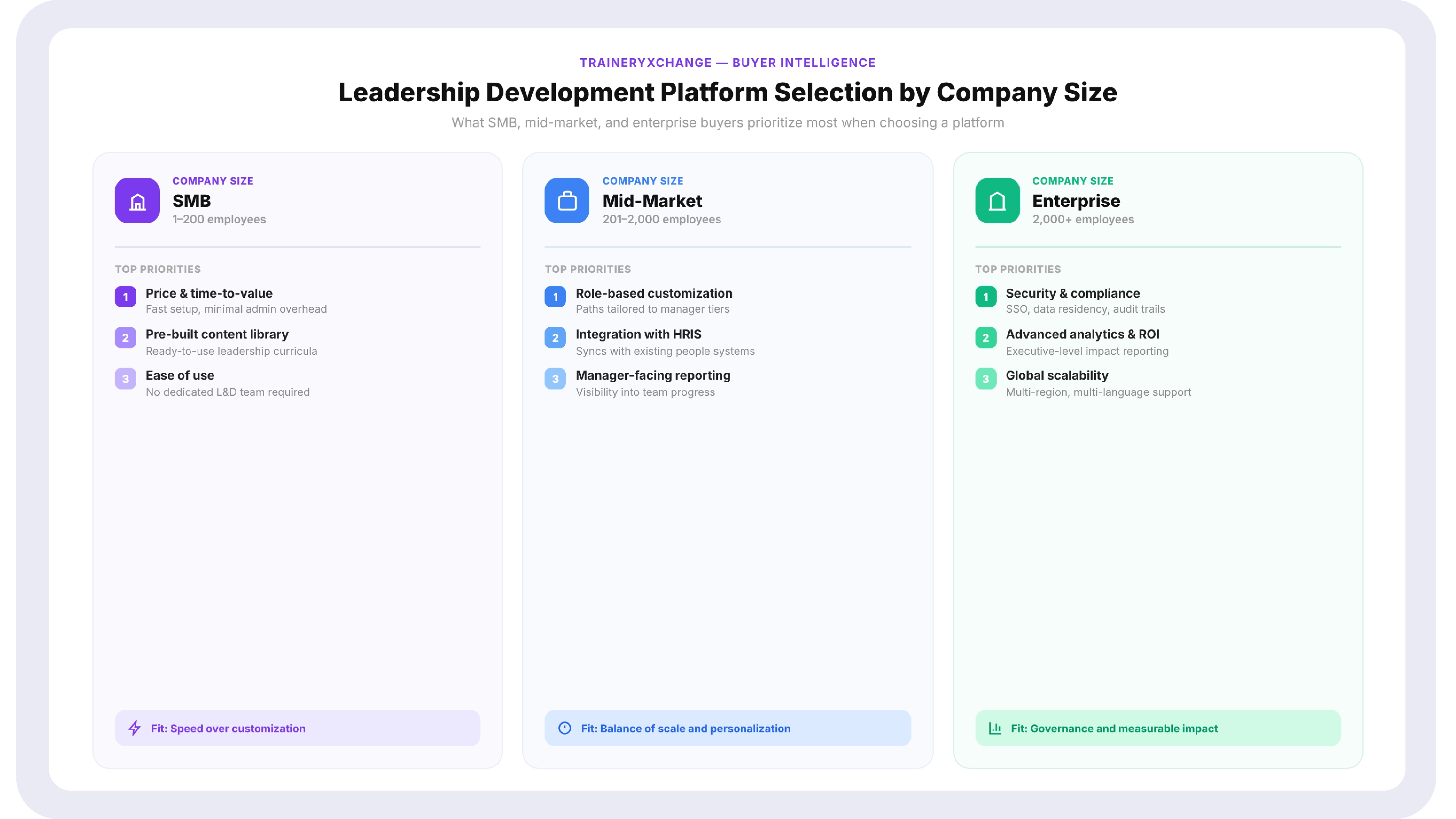
Three-column visual showing SMB, mid-market, and enterprise priority features for leadership development platform selection

Off-the-Shelf Leadership Content vs. Custom Content

Most leadership programs use a mix of common leadership topics and organization-specific material. The appropriate sourcing strategy depends on what employees must learn and how closely the material must reflect internal expectations.

When licensed content can fit

External content can be useful for general management and professional-development topics when the learning objectives, audience, quality, licensing, accessibility, and delivery requirements are suitable. It can reduce the amount of content the internal team needs to produce and maintain.

When custom content is important

Internal content is often necessary for organization-specific leadership expectations, policies, systems, performance processes, operating models, escalation routes, or case examples. External courses cannot know how your company wants managers to handle those responsibilities.

What to verify before licensing

  • Who created and reviews the course?
  • When was it last updated?
  • Which leadership level and context is it designed for?
  • Does it include practice or assessment appropriate to the goal?
  • Which languages and accessibility features are available?
  • How is the course licensed and delivered?
  • Can completion data be exported or retained as required?

How to Measure Leadership Development

Measurement should begin with the purpose of the program. A first-time manager program might focus on application of core management practices, while an executive-coaching program may use different evidence entirely.

Separate activity, capability, behavior, and business outcomes

LevelExamplesWhat It Can Tell You
Learning activityEnrollment, participation, completion, attendance, content useWhether people engaged with the program
Capability evidenceAssessments, work samples, scenarios, observed practiceWhether targeted knowledge or skill evidence changed
Behavior evidenceManager observation, employee feedback, coaching follow-up, workplace examplesWhether participants are applying practices in their work
Business outcomesRetention, promotion, engagement, productivity, quality, customer measuresWhat changed in the business, but not necessarily why it changed

Business outcomes are influenced by many variables. If retention improves after leadership training, the program may have contributed, but compensation, labor-market conditions, workload, reorganizations, manager changes, hiring, policy, and other factors may also matter. Avoid presenting simple before-and-after comparisons as proof of causation.

Build a measurement plan before launch

  1. Define the leadership behaviors or capabilities the program is intended to develop.
  2. Select a baseline that can realistically be measured again later.
  3. Choose learning and application evidence that matches the objective.
  4. Identify which business measures are relevant and where they are stored.
  5. Document the time period and comparison method before reviewing results.
  6. Report limitations and other plausible influences alongside the findings.

Common Mistakes When Selecting Leadership Development Software

  1. Starting with a feature list. Define the leadership use cases, audiences, and outcomes first.
  2. Using price as the only comparison. Compare total requirements, licensing, implementation, content, administration, integrations, and support.
  3. Assuming every advertised capability is included. Verify plan-level availability, configuration, partners, and implementation dependencies.
  4. Ignoring content fit. Review the actual courses and publishers that would be assigned.
  5. Underestimating integration and administration. Map identity, user lifecycle, data ownership, reporting, and support workflows.
  6. Excluding managers and program owners from evaluation. Test real workflows with the people who will administer and use the program.
  7. Buying before defining measurement. Make sure the platform can provide the evidence the program actually needs.

Unified Learning Platform or Standalone Leadership Tool?

A specialist leadership platform can be a good fit when an organization needs deep coaching, mentoring, assessment, cohort, or leadership-specific functionality. A broader learning platform can be a good fit when leadership development needs to share administration, identity, content, and reporting infrastructure with other training programs.

Neither architecture is automatically better. Compare the trade-offs in program depth, learner experience, integrations, data ownership, vendor count, administration, cost, security review, and implementation.

Review Leadership Content and Delivery Options

TraineryXchange provides access to curated training content and TraineryLMS options. Discuss the leadership topics, audience, delivery method, reporting, and integrations required for your program before selecting a configuration.

Book a Demo

Leadership Development Platform Evaluation Checklist

  • Which leadership audiences and use cases must the platform support?
  • Does the program require content, coaching, mentoring, assessments, cohorts, practice, or a combination?
  • Which capabilities are native, integrated, or delivered through partners?
  • Which content providers and licensing models are available?
  • How are users provisioned, grouped, and removed?
  • Which HRIS, LMS, identity, or communication integrations are required?
  • What learning records and exports are available?
  • How are assessment, coaching, and career-development data protected?
  • What accessibility and localization requirements apply?
  • What implementation, administrator training, and ongoing support are included?
  • What will be measured at baseline and after the program?
  • What are the renewal, data-export, and termination terms?

The best leadership development platform is the one that fits the program the organization can actually operate and measure. Use vendor demonstrations to test real workflows rather than generic feature tours, and ask vendors to distinguish current capabilities from roadmap items.

Build a Leadership Learning Plan Around Your Requirements

Talk with TraineryXchange about leadership content discovery, curation, licensing, delivery, and TraineryLMS options. Available features, content, and integrations depend on the selected solution and configuration.

Book a Demo


Key Takeaways

  • Leadership development platforms vary by focus: some emphasize coaching or mentoring, while others center on learning content, assessments, cohort programs, or broader LMS infrastructure.
  • The right fit depends on the organization’s use cases, existing systems, content strategy, administration, security, audiences, and implementation resources.
  • AI recommendations, 360-degree feedback, succession analytics, mentoring workflows, and other advanced capabilities should be verified platform by platform rather than treated as universal requirements.
  • Off-the-shelf leadership content can reduce internal production work, while organization-specific frameworks, policies, terminology, and scenarios may still require custom material.
  • Measure learning activity separately from business outcomes, and avoid assuming leadership training alone caused changes in retention, promotion, engagement, or team performance.

Leadership development software is a broad category. Some platforms are designed around coaching or mentoring, some around leadership courses and learning paths, some around assessments or cohort programs, and some are general learning platforms that can support leadership development alongside onboarding, compliance, and other training.

That variety makes a feature checklist alone a weak way to choose a platform. The better starting point is to define the leadership-development problem the organization is trying to solve, the audiences involved, the evidence required, and the systems the platform must work with.

Quick answer: A leadership development platform is software used to organize one or more parts of leadership development, such as learning content, assessments, coaching, mentoring, cohort programs, practice, progress tracking, or reporting. There is no single feature set that every leadership platform must include. Buyers should compare products against their actual program design and verify current capabilities with each vendor.

Leadership Development Platform vs. LMS vs. LXP

The boundaries between learning-management systems, learning-experience platforms, coaching platforms, mentoring software, and leadership-development products are not fixed. Many vendors now combine capabilities that historically belonged to different categories.

CategoryTypical FocusPossible Leadership UseWhat to Verify
LMSAdministration, assignment, delivery, tracking, records, and reporting for formal learning.Leadership courses, manager curricula, onboarding for new supervisors, required learning, assessments.Learning-path controls, content compatibility, reporting, groups, integrations, administration.
LXPDiscovery, curation, recommendations, aggregation, and learner-driven development.Leadership content discovery, personalized development, communities, skills-based recommendations.Content sources, recommendation logic, administration, data ownership, reporting, integrations.
Coaching or mentoring platformHuman development relationships, matching, sessions, goals, and program administration.Executive coaching, manager coaching, mentoring programs, peer-development networks.Matching method, coach or mentor supply, privacy, session records, outcomes, integrations.
Leadership-development platformA product positioned specifically around manager or leader development.May combine content, assessments, cohorts, coaching, mentoring, practice, or analytics.Which capabilities are native, which require partners, and which are available only in certain plans.

An organization may need one platform or several connected tools. Consolidation can simplify administration, but a specialist product may provide deeper functionality for a particular use case. The right architecture depends on existing systems, program design, data requirements, budget, and support capacity.

Compare Leadership Learning Against Your Existing Stack

TraineryXchange can help teams review leadership content, delivery, and TraineryLMS options alongside the systems they already use. Available features and integrations depend on the selected configuration.

Book a Demo
Side-by-side comparison diagram showing the differences between an LMS, a learning experience platform, and a leadership development platform across purpose, features, and analytics

Leadership Development Platform Features to Evaluate

The sections below are evaluation areas, not universal must-have features. A product that is strong for a coaching-led executive program may look very different from one designed for first-time manager training at scale.

Learning paths and content administration

Look at how administrators create programs, group learners, sequence content, manage cohorts, set due dates, and review progress. If the organization already owns leadership content, confirm the formats and delivery methods the platform supports.

Content library access

Ready-made leadership content can reduce internal production work for common topics such as communication, coaching, feedback, delegation, change management, conflict, and manager fundamentals. Buyers should review the actual publishers and courses rather than relying on catalog-size claims alone.

Check subject-matter expertise, update practices, learning objectives, accessibility, language availability, licensing, assessment, delivery format, and LMS compatibility for the content you plan to use.

Assessments and competency frameworks

Assessments can support development planning when they are appropriate for the capability and used carefully. Platforms may offer self-assessment, manager assessment, multi-rater feedback, knowledge tests, skills assessments, or integrations with external assessment providers.

Verify whether an assessment is validated for the intended purpose and how scores are interpreted. A change in an assessment score should not automatically be treated as proof of improved leadership effectiveness.

Coaching and mentoring workflows

If coaching or mentoring is part of the program, evaluate participant matching, scheduling, goals, session administration, privacy, notes, reporting, and support for internal or external coaches and mentors. The appropriate level of tracking depends on the program and confidentiality expectations.

Practice and application

Leadership development often requires more than content consumption. Consider whether the program needs scenarios, role-play, projects, manager follow-up, peer discussion, reflection, action plans, or workplace assignments. Some of these may occur inside the platform; others may be managed through the program design.

Reporting and analytics

Start with the decisions the reporting must support. Learning metrics can include participation, completion, assessment activity, cohort progress, or content use. Business measures such as promotion, retention, engagement, or team performance usually live in HR, performance, or analytics systems and require separate interpretation.

Be cautious with dashboards that label a learner as "promotion ready" or claim to measure leadership effectiveness without explaining the underlying data and methodology.

Integrations, identity, and data flow

Review SSO, user provisioning, HRIS connections, LMS integrations, APIs, communication tools, exports, and data ownership. Integration availability differs by vendor, plan, and customer environment. Ask which system is the source of truth for users, roles, completion records, and program data.

Security, privacy, accessibility, and support

Leadership programs can contain sensitive assessment, coaching, or career-development information. Review security documentation, access controls, retention, privacy roles, accessibility requirements, support responsibilities, and implementation practices that apply to your organization.

How Company Size Can Influence Platform Selection

Headcount affects complexity, but it should not be used as the only selection rule. A 300-person regulated organization operating across multiple countries may have more demanding requirements than a 5,000-person organization running one simple manager course.

Organization ContextCommon PrioritiesQuestions to Ask
Smaller or simpler programsEase of administration, ready-made content, straightforward reporting, manageable implementation.Can the current team administer the program without dedicated platform specialists? What support is included?
Growing or multi-department programsDelegated administration, role-based learning paths, integrations, multiple leadership audiences, content breadth.Can different business units manage their audiences while central L&D retains governance?
Complex enterprise programsMultiple regions, identity and data integrations, localization, security review, complex reporting, implementation governance.How are roles, regions, permissions, data flows, support, and change management handled at scale?

Do not assume a vendor is appropriate for an organization simply because it markets itself to SMB, mid-market, or enterprise buyers. Test the product against the workflows and constraints that matter.

Three-column visual showing SMB, mid-market, and enterprise priority features for leadership development platform selection

Off-the-Shelf Leadership Content vs. Custom Content

Most leadership programs use a mix of common leadership topics and organization-specific material. The appropriate sourcing strategy depends on what employees must learn and how closely the material must reflect internal expectations.

When licensed content can fit

External content can be useful for general management and professional-development topics when the learning objectives, audience, quality, licensing, accessibility, and delivery requirements are suitable. It can reduce the amount of content the internal team needs to produce and maintain.

When custom content is important

Internal content is often necessary for organization-specific leadership expectations, policies, systems, performance processes, operating models, escalation routes, or case examples. External courses cannot know how your company wants managers to handle those responsibilities.

What to verify before licensing

  • Who created and reviews the course?
  • When was it last updated?
  • Which leadership level and context is it designed for?
  • Does it include practice or assessment appropriate to the goal?
  • Which languages and accessibility features are available?
  • How is the course licensed and delivered?
  • Can completion data be exported or retained as required?

How to Measure Leadership Development

Measurement should begin with the purpose of the program. A first-time manager program might focus on application of core management practices, while an executive-coaching program may use different evidence entirely.

Separate activity, capability, behavior, and business outcomes

LevelExamplesWhat It Can Tell You
Learning activityEnrollment, participation, completion, attendance, content useWhether people engaged with the program
Capability evidenceAssessments, work samples, scenarios, observed practiceWhether targeted knowledge or skill evidence changed
Behavior evidenceManager observation, employee feedback, coaching follow-up, workplace examplesWhether participants are applying practices in their work
Business outcomesRetention, promotion, engagement, productivity, quality, customer measuresWhat changed in the business, but not necessarily why it changed

Business outcomes are influenced by many variables. If retention improves after leadership training, the program may have contributed, but compensation, labor-market conditions, workload, reorganizations, manager changes, hiring, policy, and other factors may also matter. Avoid presenting simple before-and-after comparisons as proof of causation.

Build a measurement plan before launch

  1. Define the leadership behaviors or capabilities the program is intended to develop.
  2. Select a baseline that can realistically be measured again later.
  3. Choose learning and application evidence that matches the objective.
  4. Identify which business measures are relevant and where they are stored.
  5. Document the time period and comparison method before reviewing results.
  6. Report limitations and other plausible influences alongside the findings.

Common Mistakes When Selecting Leadership Development Software

  1. Starting with a feature list. Define the leadership use cases, audiences, and outcomes first.
  2. Using price as the only comparison. Compare total requirements, licensing, implementation, content, administration, integrations, and support.
  3. Assuming every advertised capability is included. Verify plan-level availability, configuration, partners, and implementation dependencies.
  4. Ignoring content fit. Review the actual courses and publishers that would be assigned.
  5. Underestimating integration and administration. Map identity, user lifecycle, data ownership, reporting, and support workflows.
  6. Excluding managers and program owners from evaluation. Test real workflows with the people who will administer and use the program.
  7. Buying before defining measurement. Make sure the platform can provide the evidence the program actually needs.

Unified Learning Platform or Standalone Leadership Tool?

A specialist leadership platform can be a good fit when an organization needs deep coaching, mentoring, assessment, cohort, or leadership-specific functionality. A broader learning platform can be a good fit when leadership development needs to share administration, identity, content, and reporting infrastructure with other training programs.

Neither architecture is automatically better. Compare the trade-offs in program depth, learner experience, integrations, data ownership, vendor count, administration, cost, security review, and implementation.

Review Leadership Content and Delivery Options

TraineryXchange provides access to curated training content and TraineryLMS options. Discuss the leadership topics, audience, delivery method, reporting, and integrations required for your program before selecting a configuration.

Book a Demo

Leadership Development Platform Evaluation Checklist

  • Which leadership audiences and use cases must the platform support?
  • Does the program require content, coaching, mentoring, assessments, cohorts, practice, or a combination?
  • Which capabilities are native, integrated, or delivered through partners?
  • Which content providers and licensing models are available?
  • How are users provisioned, grouped, and removed?
  • Which HRIS, LMS, identity, or communication integrations are required?
  • What learning records and exports are available?
  • How are assessment, coaching, and career-development data protected?
  • What accessibility and localization requirements apply?
  • What implementation, administrator training, and ongoing support are included?
  • What will be measured at baseline and after the program?
  • What are the renewal, data-export, and termination terms?

The best leadership development platform is the one that fits the program the organization can actually operate and measure. Use vendor demonstrations to test real workflows rather than generic feature tours, and ask vendors to distinguish current capabilities from roadmap items.

Build a Leadership Learning Plan Around Your Requirements

Talk with TraineryXchange about leadership content discovery, curation, licensing, delivery, and TraineryLMS options. Available features, content, and integrations depend on the selected solution and configuration.

Book a Demo

Frequently Asked Questions

What are common mistakes when selecting a leadership development platform?
When does off-the-shelf leadership content make sense compared with custom courses?
How should organizations measure leadership development results?
What should buyers evaluate in a leadership development platform in 2026?
How should company size influence leadership development platform selection?
What is the difference between a leadership development platform and an LMS?