
%201.svg)
Food safety training courses online can help hospitality teams standardize the everyday practices that protect guests, employees, and the business. The hard part is choosing the right course for each role. A line cook, dishwasher, shift supervisor, and food protection manager do not need identical training, even though their work overlaps throughout a service.
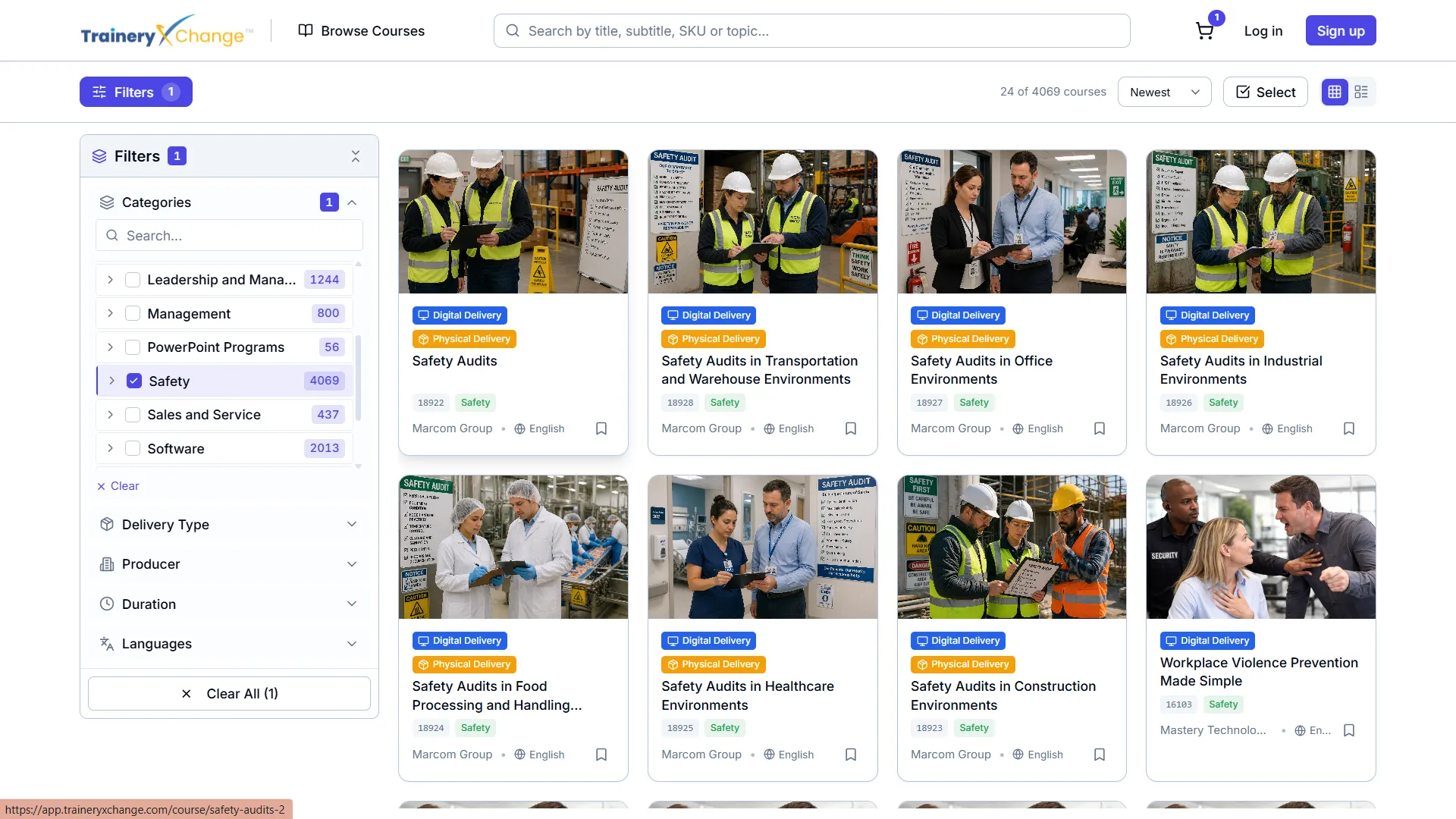
This guide reviews ten TraineryXchange catalog titles that fit restaurant, hotel, catering, and food-service operations. The list is based on course relevance, role coverage, practical behavior change, and catalog availability observed on August 12, 2026. It is a role-fit guide, not a claim that one course or provider is universally best. Course availability, language options, and licensing can change, so confirm the current listing in the TraineryXchange food safety catalog before assigning training.
Training Completion and Food Safety Certification Are Different
Hospitality buyers often use “course,” “certificate,” and “certification” as if they mean the same thing. They do not. An operational course can document that an employee completed training on sanitation, personal hygiene, allergens, or a restaurant procedure. A food handler certificate or Certified Food Protection Manager credential may need to come from a program accepted by the state or local regulator.
The FDA Food Code is a model code, not a single nationwide restaurant law. State, tribal, territorial, and local authorities decide whether and how to adopt it. The 2022 Food Code says the person in charge should be a certified food protection manager who passes a test that is part of an accredited program, with an exception for operations the regulator deems minimal risk. The ANAB food protection manager directory identifies certification bodies accredited under the Conference for Food Protection standard.
How We Selected These Food Safety Courses
The strongest food safety training plan is a curriculum, not a single annual click-through. We favored titles that help a hospitality employer cover five common needs:
Use a training needs analysis to map these needs to actual jobs and locations, then compare the findings with a structured training gap analysis and a training needs assessment questionnaire when managers and employees see different risks. That prevents overtraining office staff while leaving high-risk kitchen roles with gaps.
10 Best Food Safety Training Courses Online for Hospitality Teams
1. Back of the House: Food Safety Plans
This is the best starting point for the people who translate policy into line checks, opening routines, corrective actions, and shift supervision. Assign it to kitchen managers and chefs before they coach others. Follow the online lesson with a review of the location’s actual food safety plan, temperature logs, escalation contacts, and corrective-action process.
2. Food and Beverage: Food Safety Plans
Hotels, resorts, clubs, and caterers often operate beyond one kitchen. Banquets, bars, room service, temporary event areas, and satellite service points can create different handoffs. This title fits leaders who need a broader view of the food-and-beverage operation. Pair it with a location map that identifies where food is received, stored, prepared, transported, held, and served.
3. Food Safety Sanitation
Sanitation training works best when every shift uses the same definitions and verification steps. This course is a useful foundation for food handlers and utility teams, followed by hands-on demonstrations using the equipment and products at the site. The catalog also showed a Spanish version on the research date, which can support a multilingual training strategy when that version matches employee language needs.
4. Food Handling Safety
Food handling decisions happen from delivery through service. Assign this title to employees who receive ingredients, prepare food, plate dishes, replenish buffets, or handle ready-to-eat items. Managers should connect the course to station-specific observations and coaching. A Spanish catalog version was also visible during research, but the current language and format options should be confirmed before licensing.
5. Personal Hygiene for Food Safety
Personal hygiene deserves its own assignment because it influences every station. CDC research notes that food worker hands are a common route for contamination and that training is associated with better handwashing practices. The CDC restaurant handwashing guidance also stresses the role of accessible sinks, supplies, and manager attention. In other words, the course should sit inside a working system, not carry the entire burden alone.
6. Overview of HACCP
HACCP awareness helps managers understand why certain steps receive tighter controls and documentation. Use this overview for managers, chefs, and compliance leads who participate in hazard reviews or operational controls. Do not present an overview course as the establishment’s HACCP plan or as proof that a specialized process is approved. Those decisions belong with qualified internal specialists and the applicable regulator.
7. Kitchen Safety
Food safety training can fail when it ignores the physical realities of kitchen work. Slips, heat, sharp tools, lifting, equipment, and rushed movement affect whether employees can follow procedures consistently. Kitchen Safety broadens the program for new hires and cross-trained staff. It should complement, not replace, the sanitation and food handling assignments above.
8. Safety Orientation for Restaurants
This course is a practical first-week assignment for restaurant employees because it establishes a restaurant context before the learner moves into role-specific modules. Include it in a structured employee onboarding sequence, then add food handling, sanitation, allergens, and station practice according to the job.
9. Dishwashers: Safe Work Practices
Dish and warewashing teams protect the boundary between soiled and clean items while working with heat, water, chemicals, racks, and fast turnaround. A dedicated assignment recognizes that this role has distinct exposures and workflow decisions. Reinforce the online course with the site’s machine checks, chemical procedures, clean-storage rules, and reporting steps.
10. Dealing with Allergens in Food Processing and Handling Environments
General food safety content rarely gives allergen controls enough room. This title helps fill that gap for kitchen employees and supervisors who receive special requests or handle ingredients. The local follow-up should cover recipe information, communication between front and back of house, prevention of cross-contact, and the exact escalation process. Managers should use the terminology and procedures required by their jurisdiction and company policy.
A Practical Assignment Map by Hospitality Role
A role-based plan is easier to manage than assigning all ten titles to everyone. The following starting map can be adjusted through a role-based training analysis:
How to Choose an Online Food Safety Training Provider
Keyword research shows buyers often look for “food safety training online,” “food safety training online free,” and “online food safety training and certification.” Price matters, but a low-cost course that cannot fit the workforce, document completion, or satisfy the applicable rule can create rework.
Before licensing, ask:
For shift-based operations, also review whether the delivery approach works for deskless and shift-based employees. A strong course choice can still fail when logins, device access, course length, or scheduled learning time do not fit the operating environment.
A training marketplace buyer checklist helps procurement, operations, and compliance compare options on the same dimensions.
Build the Course Into Daily Operations
Online learning establishes consistent knowledge. Managers turn that knowledge into reliable behavior through demonstrations, observation, feedback, and documentation. CDC studies have found that restaurants with certified kitchen managers were less likely to have outbreaks and had better food-safety practices. See the CDC summary on outbreaks and certified managers.
A practical rollout can follow four steps:
Use a consistent training records process, map assigned renewal dates into the corporate training compliance calendar, and set retention rules with legal and compliance stakeholders because requirements vary by location and credential type.
What Hospitality Teams Should Do Next
Start with the work, not the course count. Identify the food safety decisions each role makes, confirm the jurisdiction’s credential requirements, and assign the smallest curriculum that covers those risks. Then connect each online course to local practice, observation, and records.




%5B1%5D.svg)
