How to Build a Leadership Development Program: A Step-by-Step Guide

A practical six-step guide to designing leadership development for emerging leaders, new managers, managers of managers, and senior leaders.

Updated On:
July 4, 2026

Mahesh Kumar

Founder, TraineryHCM.com
How to Build a Leadership Development Program: A Step-by-Step Guide

Table of Contents

Quick answer: Build a leadership development program by assessing business and leadership needs, defining leadership stages, selecting content for each stage, choosing delivery methods, setting measures before launch, and improving the program through scheduled reviews. Most organizations benefit from a blended content model: source training for broadly applicable leadership skills and create custom material for company-specific processes, expectations, and culture.

A leadership development program should connect learning to the work leaders are expected to perform. That connection is easy to lose when a team begins by purchasing courses or drafting a curriculum before it has defined the roles, behaviors, and business priorities the program should support.

The framework below gives learning and development (L&D) teams a practical sequence for moving from an initial needs assessment to a program that can be assigned, measured, and improved. It also explains how to make the build-versus-buy decision and how learning priorities change from emerging leader to senior leader.

Consider a hypothetical company that responds to weak engagement scores by buying a large leadership course library. Six months later, completion is high, but managers still avoid difficult feedback conversations because the program never defined or practiced that behavior. This planning example is not a client story. It illustrates why content selection should follow a diagnosis of the work leaders need to perform.

The Six-Step Leadership Development Framework
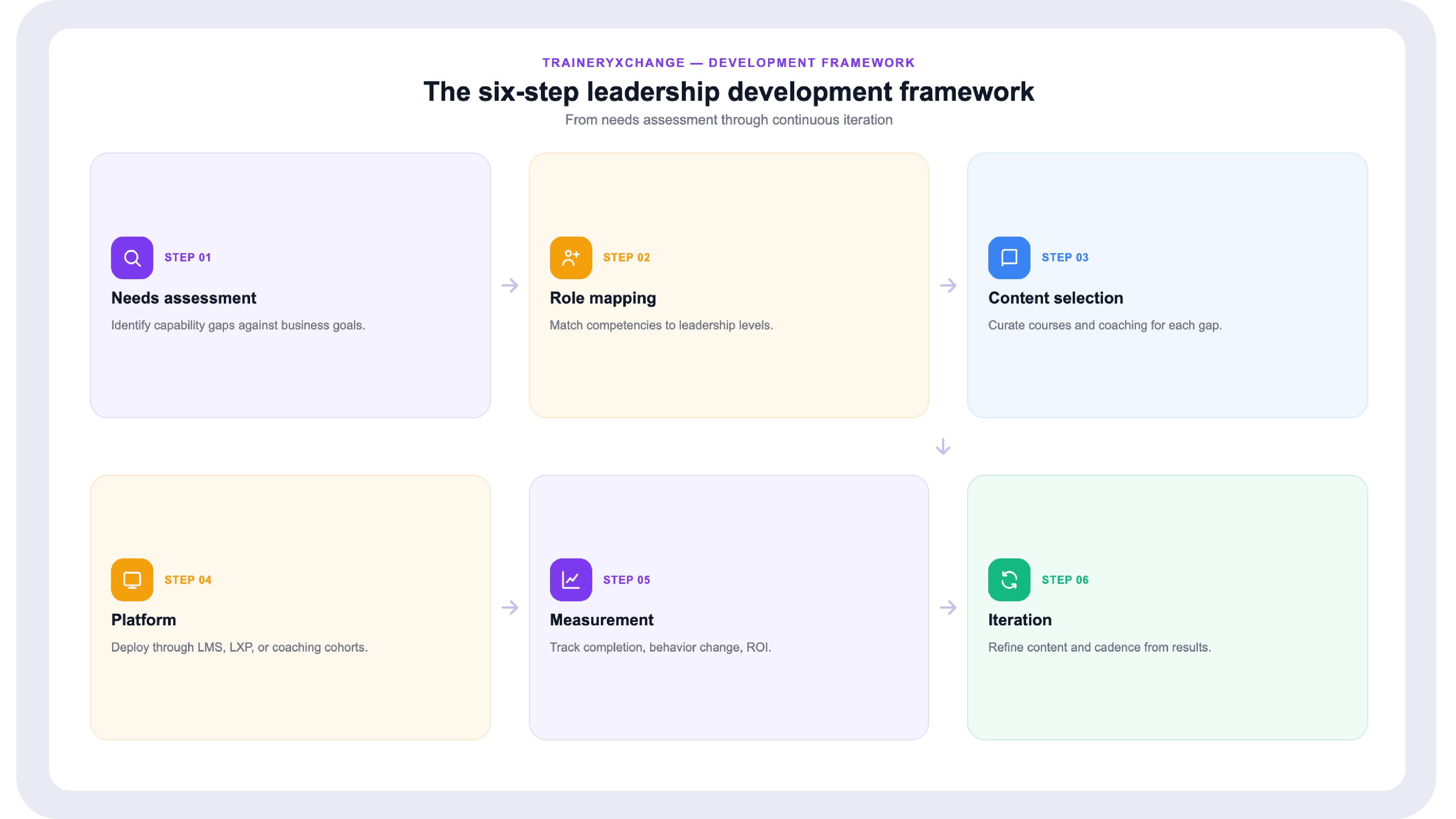
The Six-Step Leadership Development Framework

Step 1: Assess Business and Leadership Needs

Start with the outcomes the organization needs, not a generic list of leadership competencies. A useful assessment combines business priorities with evidence about current leadership performance. Review employee survey themes, performance data, succession plans, exit feedback, customer concerns, safety or quality trends, and recurring challenges raised by managers.

Then speak with the people who experience those challenges. Interviews, focus groups, manager surveys, and skip-level conversations can reveal where expectations are unclear or where leaders lack practice. A 360-degree assessment may help when the organization has the resources and safeguards to administer it well, but it is not the only option.

Translate each need into an observable behavior. “Improve communication” is too broad to design or measure. “Set clear priorities in weekly team meetings,” “give specific performance feedback,” or “explain the reason for a change” gives the program a practical target. The Association for Talent Development recommends connecting business measures with the behavior and learning intended to influence them. The Center for Creative Leadership likewise advises defining intended outcomes before selecting an evaluation approach.

Step 2: Define Leadership Stages and Role Expectations

Leadership is not one job. An employee preparing to lead peers needs a different learning path from a senior leader responsible for strategy across functions. Create a small number of stages that reflect how leadership work changes in your organization. Four common stages are emerging leader, first-time manager, manager of managers, and senior leader.

For each stage, document the audience, entry criteria, role expectations, priority behaviors, required learning, and expected application. Entry criteria might include a new appointment, nomination through succession planning, or demonstrated readiness for expanded responsibility. Clear criteria help reduce inconsistent enrollment and prevent the program from becoming a reward that is disconnected from role needs.

Keep the stage model understandable. If every job family has its own curriculum, administration can become difficult. Where possible, establish a shared leadership core and add targeted modules for functions, regions, or regulated responsibilities.

Step 3: Design the Curriculum and Choose Build, Buy, or Blend

Map each target behavior to a learning experience. Some needs are well suited to self-paced courses, while others require discussion, practice, coaching, or application on the job. A curriculum can combine short digital lessons, manager-led conversations, workshops, peer learning, simulations, job aids, coaching, and workplace assignments.

At this stage, decide which content to create internally and which to source. Broad topics such as feedback, delegation, communication, coaching, conflict resolution, and time management may be available from established publishers. Company values, internal decision rights, proprietary frameworks, promotion processes, and organization-specific case studies usually require internal context.

A content curation process can help L&D teams evaluate relevance, instructional quality, audience fit, accessibility, delivery format, and licensing before placing courses into a learning path. Content selection should follow the needs assessment rather than substitute for it.

Step 4: Select Delivery Methods and Platform Requirements

Choose the delivery approach after the learning design is clear. The platform should support the assignments, learner groups, completion data, reporting, and content formats the program actually requires. It should also fit the organization's identity management, privacy, accessibility, and procurement requirements.

If the organization already uses a learning management system (LMS), confirm how licensed content will be delivered and tracked. Depending on the course, provider, LMS, and configuration, options may include SCORM packages, xAPI, or a Learning Tools Interoperability (LTI) connection. TraineryXchange also presents TraineryLMS as a delivery option. Compatibility and data flow should be confirmed for the selected content and environment before launch.

Plan the human delivery system as carefully as the technology. Identify facilitators, coaches, program administrators, executive sponsors, and participants' managers. Provide discussion guides and application prompts so managers know how to reinforce learning without turning every course into another administrative task.

Step 5: Define Measures Before Launch

Define success before the first participant enrolls. Completion and satisfaction can show whether people reached and responded to the program, but they do not establish whether behavior changed. Add measures that reflect the program's stated outcomes.

For a feedback module, measures might include a knowledge check, a practice observation, participant confidence, employee feedback about conversation quality, and evidence that managers are holding the expected conversations. For a succession-focused program, measures might include readiness ratings, internal movement, or the quality of development plans. Business measures should be selected only when there is a plausible connection to the targeted behavior.

Establish the baseline, data owner, collection method, review date, and decision rule for each measure. This makes evaluation part of program design rather than a report assembled after the program ends.

Step 6: Pilot, Review, and Improve

Run a pilot with a representative group before a broader rollout. Include participants from different functions, locations, and experience levels when the program will serve a varied audience. Test the content, workload, communications, accessibility, technical workflow, manager support, and measurement process.

Collect evidence at planned intervals. Review where participants stop, which activities produce useful application, whether managers reinforce the program, and whether the measures are practical to collect. Revise the sequence, content, support materials, or delivery approach based on what the evidence shows.

Iteration should continue after launch. Set a formal review cadence and define who can approve content changes. A leadership program is a managed portfolio of learning experiences, not a static set of courses.

Build vs. Buy: The Decision Most Teams Underestimate

The choice is rarely all custom or all sourced. A blended approach can give the program organizational relevance without requiring the internal team to create every foundational lesson.

Factor Build Custom Content Source Existing Content
Context Can reflect internal language, processes, examples, and decision rights Often provides broadly applicable practices that must be checked for organizational fit
Internal resources Requires subject-matter input, instructional design, production, review, and maintenance Requires evaluation, licensing, curation, implementation, and vendor management
Control Offers direct control over scope, examples, branding, and revisions Scope and update decisions depend on the publisher and license terms
Best use Internal processes, proprietary frameworks, company expectations, and organization-specific scenarios Foundational skills such as communication, delegation, feedback, coaching, and conflict management
Key diligence Confirm ownership, review standards, accessibility, maintenance capacity, and version control Confirm quality, audience fit, accessibility, formats, licensing, update practices, and delivery compatibility

Build content when the organization itself is the source of truth. Source content when the learning objective is broadly applicable and a suitable course already exists. Blend the two when a sourced lesson needs an internal introduction, discussion guide, scenario, or workplace assignment to make it relevant.

Before making the decision, estimate the full effort on both sides. Custom development includes discovery, writing, design, review, production, accessibility, testing, and ongoing maintenance. Sourced content includes evaluation, contracting, curation, implementation, and vendor oversight. A build-versus-buy comparison can help teams document those trade-offs.

Explore Leadership Training Content

Browse leadership courses by topic and compare options against the stages, behaviors, and delivery requirements in the program plan.

Browse Leadership Courses

Leadership Stages and What Content Each One Actually Needs
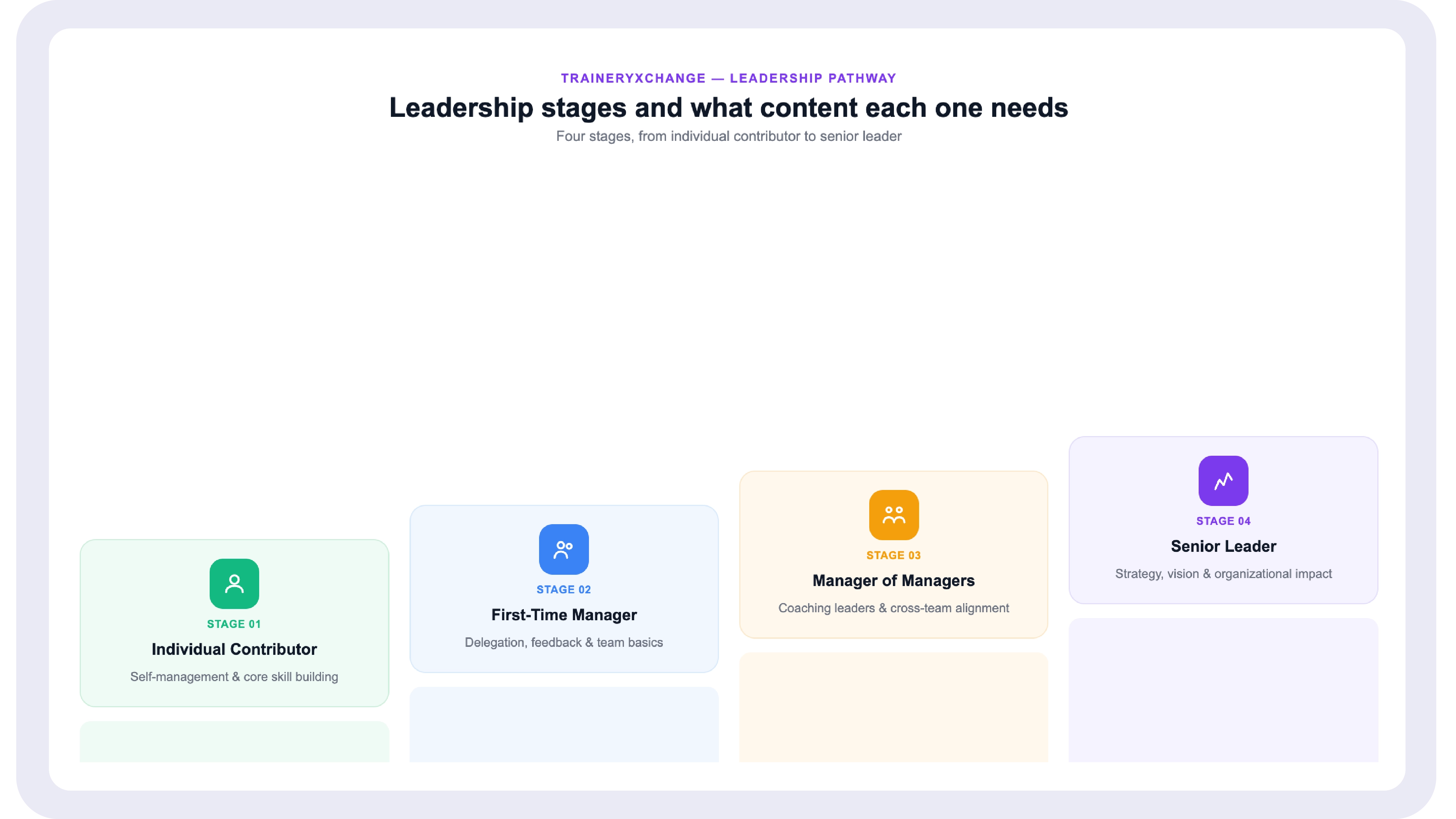
Leadership Stages and What Content Each One Actually Needs

Individual Contributor Preparing for Leadership

Emerging leaders need opportunities to influence outcomes before they formally manage people. Priorities may include self-awareness, clear communication, time and priority management, collaboration, problem-solving, meeting facilitation, and influence without authority.

Use projects that let participants practice leadership in context, such as leading a short improvement initiative, coordinating a cross-functional task, or facilitating a retrospective. Evaluate readiness through observed behavior and reflection, not course completion alone. Participation should not be presented as a promise of promotion.

First-Time Manager

The transition to people management changes what good performance looks like. New managers must shift from completing their own work to creating clarity, supporting performance, and developing others. Core topics often include setting expectations, delegation, one-on-one conversations, feedback, coaching, conflict management, workload planning, inclusion, and the organization's employment policies.

Sequence the learning around the first months in role. Provide tools managers can use immediately, such as an agenda for one-on-ones, a delegation planner, a feedback model, and escalation guidance. Pair self-paced learning with manager check-ins, practice, and peer discussion. Gallup's manager development guidance describes development as an ongoing process that builds habits and conversations, not a single training event.

The essential soft skills for managers provide a useful starting point, but the final learning path should reflect the organization's role expectations and employee population.

Manager of Managers

Managers of managers lead through other leaders. Their learning should emphasize coaching managers, calibrating performance expectations, allocating resources across teams, managing interdependencies, building leadership capacity, and communicating decisions across organizational levels.

Case discussions and action learning work well at this stage because the problems are less likely to have one correct answer. Participants can bring a real cross-team challenge, test an approach, and review results with peers or a facilitator. Learning should help them avoid taking over their managers' work while still providing direction and accountability.

Senior Leader

Senior leaders work at the level of organizational direction, alignment, and commitment. Priorities may include enterprise strategy, portfolio decisions, change leadership, culture, executive communication, stakeholder management, succession, and decision-making under uncertainty. CCL's research-based definition of leadership uses direction, alignment, and commitment as three central outcomes of the leadership process.

Development at this level is often more contextual than a standard course sequence can provide. Cohort work, executive coaching, simulations, strategic projects, and structured feedback can complement selected digital content. The executive sponsor should clarify which enterprise challenges the experience is intended to address.

Leadership Development Program Governance

Assign clear ownership before launch. The program owner should manage the curriculum, communications, enrollment rules, vendor relationships, data, and review cycle. An executive sponsor should connect the program to business priorities and help remove organizational barriers. Human resources, legal, information technology, procurement, accessibility, and privacy teams may need defined review roles depending on the content and delivery model.

Participants' managers are a critical part of the operating model. Ask them to discuss goals before the program, create opportunities for practice, and review application afterward. Give them concise guidance and enough notice to plan for the participant's workload.

Document version control, content approval, accessibility expectations, language needs, enrollment criteria, facilitator standards, data access, and escalation procedures. Governance should be proportionate to the program, but it should be explicit enough that the experience can be repeated consistently.

How to Measure Leadership Development

Use a measurement chain that starts with the intended outcome. CCL's leadership development evaluation guidance recommends clarifying what the program is expected to change, who cares about the outcome, and how the evidence will be used. ATD's measurement guidance similarly advises teams to look beyond attendance and satisfaction when the goal is workplace impact.

Participation indicators: Enrollment, attendance, completion, time to completion, and participation in discussions show reach and activity. They are useful operating measures, but they do not demonstrate behavior change.

Learning indicators: Knowledge checks, skill demonstrations, scenario responses, reflections, and confidence measures can show whether participants understood or practiced the material.

Behavior indicators: Manager observations, structured follow-ups, employee feedback, 360-degree assessments, work samples, and evidence of agreed leadership routines can show whether participants are applying the learning.

Organizational indicators: Depending on the program's purpose, teams may monitor internal mobility, readiness, retention, engagement, quality, safety, customer experience, or other business measures. These outcomes have many influences, so avoid attributing a change to training without an appropriate evaluation design.

Collect a baseline when practical and compare the same measure after participants have had time to apply the learning. A comparison group or phased rollout may strengthen the analysis, but it must be feasible and appropriate. Record limitations and alternative explanations alongside the results.

Common Implementation Mistakes to Avoid

Starting with a course list: Content cannot compensate for undefined business needs or vague role expectations. Complete the assessment and role mapping first.

Using one path for every leader: Shared principles can create consistency, but examples, practice, and responsibilities should match the leadership stage.

Treating development as a one-time event: Leadership behaviors require practice, feedback, reinforcement, and opportunities to apply them at work.

Leaving managers out: Participants may struggle to apply learning when their managers do not understand the program or make space for practice.

Measuring only completions: Completion is an operational metric. Add learning, behavior, and outcome measures that reflect the program's stated purpose.

Ignoring maintenance: Assign an owner and review cadence for sourced and custom content. Remove or revise material that no longer reflects current roles, policies, technology, or business priorities.

Conclusion

A practical leadership development program begins with business needs and observable leadership behaviors. From there, the organization can define stages, select a balanced curriculum, choose delivery methods, establish measures, and test the experience before expanding it.

The build-versus-buy decision should support that design. Source suitable foundational content, build the organization-specific material that only internal experts can provide, and connect both through practice and manager reinforcement. The result is a program that can be governed and improved as leadership needs change.

Plan Your Leadership Content Strategy

Discuss course discovery, content licensing, curation, and delivery options for a role-based leadership development program.

Book a Demo

Research and Professional Sources

Center for Creative Leadership, What Is Leadership? A Definition Based on Research

Center for Creative Leadership, How to Evaluate the Impact of Leadership Development

Center for Creative Leadership, Leadership Development Impact Framework

Gallup, Manager Development Strategy

Association for Talent Development, Measuring the Success of Leadership Development

Key Takeaways:‍

  • Begin with business needs and observable leadership behaviors before selecting courses or designing a curriculum.
  • Build role-specific paths because emerging leaders, first-time managers, managers of managers, and senior leaders face different responsibilities.
  • Blend sourced training for broadly applicable skills with custom material for company processes, expectations, and context.
  • Match delivery to the objective by combining digital content with practice, discussion, coaching, manager reinforcement, and workplace application.
  • Define measures before launch, pilot the experience, and improve it using evidence beyond completion and satisfaction.

Quick answer: Build a leadership development program by assessing business and leadership needs, defining leadership stages, selecting content for each stage, choosing delivery methods, setting measures before launch, and improving the program through scheduled reviews. Most organizations benefit from a blended content model: source training for broadly applicable leadership skills and create custom material for company-specific processes, expectations, and culture.

A leadership development program should connect learning to the work leaders are expected to perform. That connection is easy to lose when a team begins by purchasing courses or drafting a curriculum before it has defined the roles, behaviors, and business priorities the program should support.

The framework below gives learning and development (L&D) teams a practical sequence for moving from an initial needs assessment to a program that can be assigned, measured, and improved. It also explains how to make the build-versus-buy decision and how learning priorities change from emerging leader to senior leader.

Consider a hypothetical company that responds to weak engagement scores by buying a large leadership course library. Six months later, completion is high, but managers still avoid difficult feedback conversations because the program never defined or practiced that behavior. This planning example is not a client story. It illustrates why content selection should follow a diagnosis of the work leaders need to perform.

The Six-Step Leadership Development Framework

The Six-Step Leadership Development Framework

Step 1: Assess Business and Leadership Needs

Start with the outcomes the organization needs, not a generic list of leadership competencies. A useful assessment combines business priorities with evidence about current leadership performance. Review employee survey themes, performance data, succession plans, exit feedback, customer concerns, safety or quality trends, and recurring challenges raised by managers.

Then speak with the people who experience those challenges. Interviews, focus groups, manager surveys, and skip-level conversations can reveal where expectations are unclear or where leaders lack practice. A 360-degree assessment may help when the organization has the resources and safeguards to administer it well, but it is not the only option.

Translate each need into an observable behavior. “Improve communication” is too broad to design or measure. “Set clear priorities in weekly team meetings,” “give specific performance feedback,” or “explain the reason for a change” gives the program a practical target. The Association for Talent Development recommends connecting business measures with the behavior and learning intended to influence them. The Center for Creative Leadership likewise advises defining intended outcomes before selecting an evaluation approach.

Step 2: Define Leadership Stages and Role Expectations

Leadership is not one job. An employee preparing to lead peers needs a different learning path from a senior leader responsible for strategy across functions. Create a small number of stages that reflect how leadership work changes in your organization. Four common stages are emerging leader, first-time manager, manager of managers, and senior leader.

For each stage, document the audience, entry criteria, role expectations, priority behaviors, required learning, and expected application. Entry criteria might include a new appointment, nomination through succession planning, or demonstrated readiness for expanded responsibility. Clear criteria help reduce inconsistent enrollment and prevent the program from becoming a reward that is disconnected from role needs.

Keep the stage model understandable. If every job family has its own curriculum, administration can become difficult. Where possible, establish a shared leadership core and add targeted modules for functions, regions, or regulated responsibilities.

Step 3: Design the Curriculum and Choose Build, Buy, or Blend

Map each target behavior to a learning experience. Some needs are well suited to self-paced courses, while others require discussion, practice, coaching, or application on the job. A curriculum can combine short digital lessons, manager-led conversations, workshops, peer learning, simulations, job aids, coaching, and workplace assignments.

At this stage, decide which content to create internally and which to source. Broad topics such as feedback, delegation, communication, coaching, conflict resolution, and time management may be available from established publishers. Company values, internal decision rights, proprietary frameworks, promotion processes, and organization-specific case studies usually require internal context.

A content curation process can help L&D teams evaluate relevance, instructional quality, audience fit, accessibility, delivery format, and licensing before placing courses into a learning path. Content selection should follow the needs assessment rather than substitute for it.

Step 4: Select Delivery Methods and Platform Requirements

Choose the delivery approach after the learning design is clear. The platform should support the assignments, learner groups, completion data, reporting, and content formats the program actually requires. It should also fit the organization's identity management, privacy, accessibility, and procurement requirements.

If the organization already uses a learning management system (LMS), confirm how licensed content will be delivered and tracked. Depending on the course, provider, LMS, and configuration, options may include SCORM packages, xAPI, or a Learning Tools Interoperability (LTI) connection. TraineryXchange also presents TraineryLMS as a delivery option. Compatibility and data flow should be confirmed for the selected content and environment before launch.

Plan the human delivery system as carefully as the technology. Identify facilitators, coaches, program administrators, executive sponsors, and participants' managers. Provide discussion guides and application prompts so managers know how to reinforce learning without turning every course into another administrative task.

Step 5: Define Measures Before Launch

Define success before the first participant enrolls. Completion and satisfaction can show whether people reached and responded to the program, but they do not establish whether behavior changed. Add measures that reflect the program's stated outcomes.

For a feedback module, measures might include a knowledge check, a practice observation, participant confidence, employee feedback about conversation quality, and evidence that managers are holding the expected conversations. For a succession-focused program, measures might include readiness ratings, internal movement, or the quality of development plans. Business measures should be selected only when there is a plausible connection to the targeted behavior.

Establish the baseline, data owner, collection method, review date, and decision rule for each measure. This makes evaluation part of program design rather than a report assembled after the program ends.

Step 6: Pilot, Review, and Improve

Run a pilot with a representative group before a broader rollout. Include participants from different functions, locations, and experience levels when the program will serve a varied audience. Test the content, workload, communications, accessibility, technical workflow, manager support, and measurement process.

Collect evidence at planned intervals. Review where participants stop, which activities produce useful application, whether managers reinforce the program, and whether the measures are practical to collect. Revise the sequence, content, support materials, or delivery approach based on what the evidence shows.

Iteration should continue after launch. Set a formal review cadence and define who can approve content changes. A leadership program is a managed portfolio of learning experiences, not a static set of courses.

Build vs. Buy: The Decision Most Teams Underestimate

The choice is rarely all custom or all sourced. A blended approach can give the program organizational relevance without requiring the internal team to create every foundational lesson.

Factor Build Custom Content Source Existing Content
Context Can reflect internal language, processes, examples, and decision rights Often provides broadly applicable practices that must be checked for organizational fit
Internal resources Requires subject-matter input, instructional design, production, review, and maintenance Requires evaluation, licensing, curation, implementation, and vendor management
Control Offers direct control over scope, examples, branding, and revisions Scope and update decisions depend on the publisher and license terms
Best use Internal processes, proprietary frameworks, company expectations, and organization-specific scenarios Foundational skills such as communication, delegation, feedback, coaching, and conflict management
Key diligence Confirm ownership, review standards, accessibility, maintenance capacity, and version control Confirm quality, audience fit, accessibility, formats, licensing, update practices, and delivery compatibility

Build content when the organization itself is the source of truth. Source content when the learning objective is broadly applicable and a suitable course already exists. Blend the two when a sourced lesson needs an internal introduction, discussion guide, scenario, or workplace assignment to make it relevant.

Before making the decision, estimate the full effort on both sides. Custom development includes discovery, writing, design, review, production, accessibility, testing, and ongoing maintenance. Sourced content includes evaluation, contracting, curation, implementation, and vendor oversight. A build-versus-buy comparison can help teams document those trade-offs.

Explore Leadership Training Content

Browse leadership courses by topic and compare options against the stages, behaviors, and delivery requirements in the program plan.

Browse Leadership Courses

Leadership Stages and What Content Each One Actually Needs

Leadership Stages and What Content Each One Actually Needs

Individual Contributor Preparing for Leadership

Emerging leaders need opportunities to influence outcomes before they formally manage people. Priorities may include self-awareness, clear communication, time and priority management, collaboration, problem-solving, meeting facilitation, and influence without authority.

Use projects that let participants practice leadership in context, such as leading a short improvement initiative, coordinating a cross-functional task, or facilitating a retrospective. Evaluate readiness through observed behavior and reflection, not course completion alone. Participation should not be presented as a promise of promotion.

First-Time Manager

The transition to people management changes what good performance looks like. New managers must shift from completing their own work to creating clarity, supporting performance, and developing others. Core topics often include setting expectations, delegation, one-on-one conversations, feedback, coaching, conflict management, workload planning, inclusion, and the organization's employment policies.

Sequence the learning around the first months in role. Provide tools managers can use immediately, such as an agenda for one-on-ones, a delegation planner, a feedback model, and escalation guidance. Pair self-paced learning with manager check-ins, practice, and peer discussion. Gallup's manager development guidance describes development as an ongoing process that builds habits and conversations, not a single training event.

The essential soft skills for managers provide a useful starting point, but the final learning path should reflect the organization's role expectations and employee population.

Manager of Managers

Managers of managers lead through other leaders. Their learning should emphasize coaching managers, calibrating performance expectations, allocating resources across teams, managing interdependencies, building leadership capacity, and communicating decisions across organizational levels.

Case discussions and action learning work well at this stage because the problems are less likely to have one correct answer. Participants can bring a real cross-team challenge, test an approach, and review results with peers or a facilitator. Learning should help them avoid taking over their managers' work while still providing direction and accountability.

Senior Leader

Senior leaders work at the level of organizational direction, alignment, and commitment. Priorities may include enterprise strategy, portfolio decisions, change leadership, culture, executive communication, stakeholder management, succession, and decision-making under uncertainty. CCL's research-based definition of leadership uses direction, alignment, and commitment as three central outcomes of the leadership process.

Development at this level is often more contextual than a standard course sequence can provide. Cohort work, executive coaching, simulations, strategic projects, and structured feedback can complement selected digital content. The executive sponsor should clarify which enterprise challenges the experience is intended to address.

Leadership Development Program Governance

Assign clear ownership before launch. The program owner should manage the curriculum, communications, enrollment rules, vendor relationships, data, and review cycle. An executive sponsor should connect the program to business priorities and help remove organizational barriers. Human resources, legal, information technology, procurement, accessibility, and privacy teams may need defined review roles depending on the content and delivery model.

Participants' managers are a critical part of the operating model. Ask them to discuss goals before the program, create opportunities for practice, and review application afterward. Give them concise guidance and enough notice to plan for the participant's workload.

Document version control, content approval, accessibility expectations, language needs, enrollment criteria, facilitator standards, data access, and escalation procedures. Governance should be proportionate to the program, but it should be explicit enough that the experience can be repeated consistently.

How to Measure Leadership Development

Use a measurement chain that starts with the intended outcome. CCL's leadership development evaluation guidance recommends clarifying what the program is expected to change, who cares about the outcome, and how the evidence will be used. ATD's measurement guidance similarly advises teams to look beyond attendance and satisfaction when the goal is workplace impact.

Participation indicators: Enrollment, attendance, completion, time to completion, and participation in discussions show reach and activity. They are useful operating measures, but they do not demonstrate behavior change.

Learning indicators: Knowledge checks, skill demonstrations, scenario responses, reflections, and confidence measures can show whether participants understood or practiced the material.

Behavior indicators: Manager observations, structured follow-ups, employee feedback, 360-degree assessments, work samples, and evidence of agreed leadership routines can show whether participants are applying the learning.

Organizational indicators: Depending on the program's purpose, teams may monitor internal mobility, readiness, retention, engagement, quality, safety, customer experience, or other business measures. These outcomes have many influences, so avoid attributing a change to training without an appropriate evaluation design.

Collect a baseline when practical and compare the same measure after participants have had time to apply the learning. A comparison group or phased rollout may strengthen the analysis, but it must be feasible and appropriate. Record limitations and alternative explanations alongside the results.

Common Implementation Mistakes to Avoid

Starting with a course list: Content cannot compensate for undefined business needs or vague role expectations. Complete the assessment and role mapping first.

Using one path for every leader: Shared principles can create consistency, but examples, practice, and responsibilities should match the leadership stage.

Treating development as a one-time event: Leadership behaviors require practice, feedback, reinforcement, and opportunities to apply them at work.

Leaving managers out: Participants may struggle to apply learning when their managers do not understand the program or make space for practice.

Measuring only completions: Completion is an operational metric. Add learning, behavior, and outcome measures that reflect the program's stated purpose.

Ignoring maintenance: Assign an owner and review cadence for sourced and custom content. Remove or revise material that no longer reflects current roles, policies, technology, or business priorities.

Conclusion

A practical leadership development program begins with business needs and observable leadership behaviors. From there, the organization can define stages, select a balanced curriculum, choose delivery methods, establish measures, and test the experience before expanding it.

The build-versus-buy decision should support that design. Source suitable foundational content, build the organization-specific material that only internal experts can provide, and connect both through practice and manager reinforcement. The result is a program that can be governed and improved as leadership needs change.

Plan Your Leadership Content Strategy

Discuss course discovery, content licensing, curation, and delivery options for a role-based leadership development program.

Book a Demo

Research and Professional Sources

Center for Creative Leadership, What Is Leadership? A Definition Based on Research

Center for Creative Leadership, How to Evaluate the Impact of Leadership Development

Center for Creative Leadership, Leadership Development Impact Framework

Gallup, Manager Development Strategy

Association for Talent Development, Measuring the Success of Leadership Development
Frequently Asked Questions

What mistakes should organizations avoid when building leadership programs?
How long does it take to build a leadership development program?
How do you measure the success of a leadership development program?
Should leadership training content be built in-house or sourced externally?
What are the stages of a leadership development program?
How do you build a leadership development program?