
Harassment Training Requirements by State: 2026 Guide

Compare 2026 harassment training requirements for California, New York, Illinois, Connecticut, Delaware, Maine, and Washington.

Updated On:
July 3, 2026

Mahesh Kumar

Founder, TraineryHCM.com
Harassment Training Requirements by State: 2026 Guide

Table of Contents

Quick answer: No generally applicable federal harassment training mandate covers private employers, but several states require training for covered workplaces. California, New York, Illinois, Connecticut, Delaware, and Maine impose broad state requirements, while Washington applies an industry- and role-specific rule. Employer thresholds, training duration, timing, content, and recordkeeping obligations vary. Multi-state employers should therefore map each employee's work location before assigning training.

An HR team overseeing employees in several states faces more than one compliance obligation. Each work location may be subject to a different employer threshold, training cadence, content standard, and supervisor training requirement. Employers should assess remote employees based on where they work, not only where the company is headquartered.

This 2026 guide covers broad private-sector statewide mandates and Washington's isolated employee requirement. Local rules, public-sector obligations, industry-specific laws, contracts, and employer policies may impose additional requirements. Confirm the current rules for every work location before relying on a training assignment.

Consider a hypothetical employer with a California headquarters, remote employees in New York and Illinois, and a field employee covered by Washington's isolated-worker rule. One companywide course and renewal date may not address every applicable duration, content, timing, or role requirement. This is a planning example, not a client case, and it shows why assignments should begin with each employee's actual work location and duties.

Does Federal Law Require Harassment Training?

Federal employment discrimination laws prohibit unlawful workplace harassment, but they do not establish a generally applicable harassment training schedule for all private employers nationwide. The U.S. Equal Employment Opportunity Commission identifies regular, interactive training tailored to the audience and organization as a promising prevention practice. The EEOC also states that these practices are not, by themselves, federal legal requirements.

A training program should support a broader prevention system that includes accountable leadership, a clear policy, trusted reporting channels, prompt investigations, appropriate corrective action, and protection against retaliation. Training alone does not establish compliance or eliminate liability.

State Harassment Training Requirements for 2026

The table below summarizes the principal statewide private-employer mandates and Washington's narrower isolated employee law. Use it as a planning reference, not as a substitute for reviewing the cited laws and agency guidance.
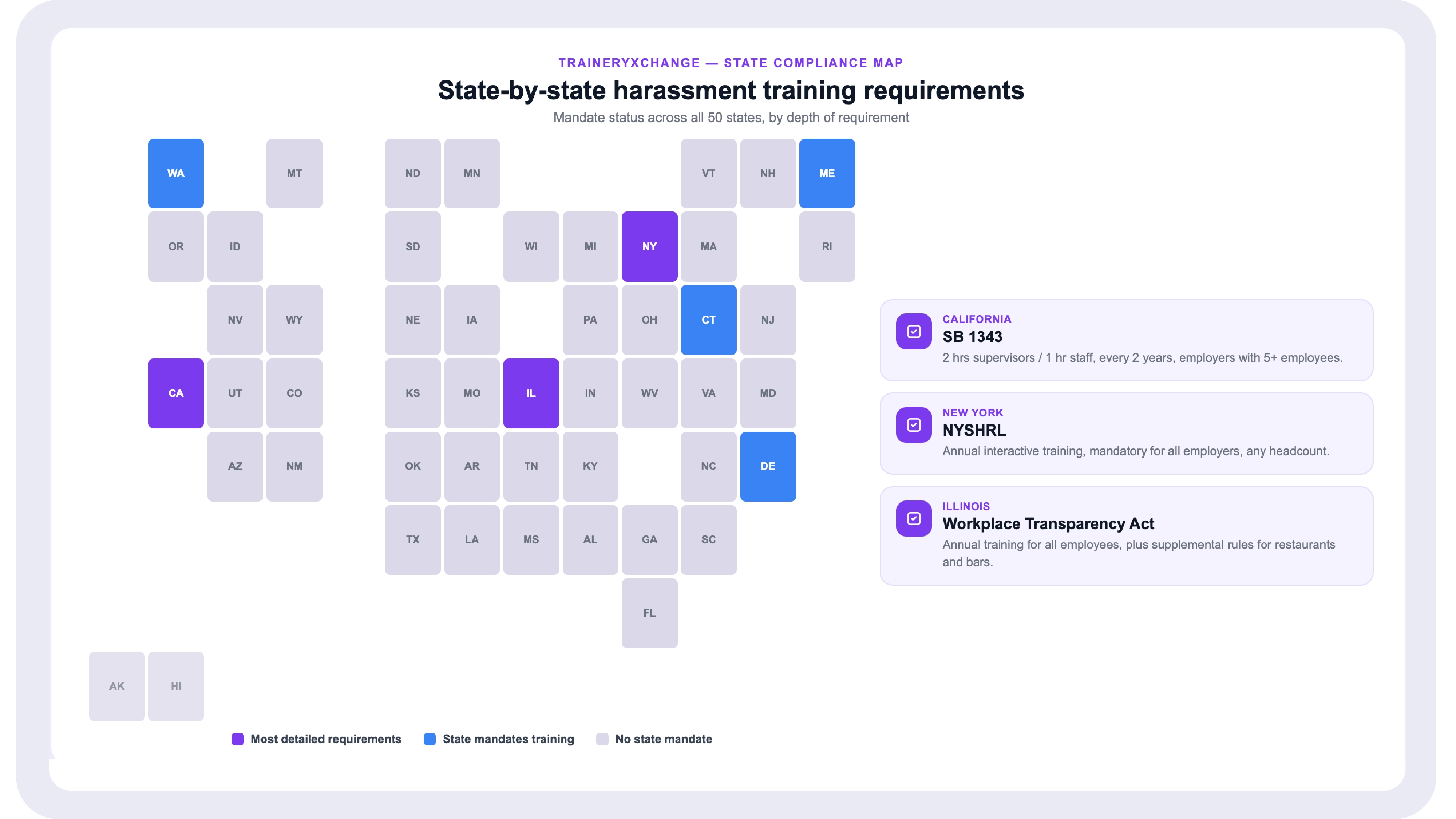
Color-coded map of the United States showing which states mandate workplace harassment training, with California, New York, and Illinois highlighted as having the most detailed requirements
State Covered employers and employees Minimum duration Timing
California Employers with five or more employees; supervisory and nonsupervisory employees Two hours for supervisors; one hour for nonsupervisory employees Every two years; generally within six months of hire or promotion, subject to special rules for certain temporary or seasonal employees
New York Every employer; all employees No fixed statewide hour minimum; training must be interactive and meet content standards Annually
Illinois Covered employers with employees working in Illinois; all employees No fixed statewide hour minimum in the general rule; required topics must be covered Once each calendar year
Connecticut Employers with three or more employees train all employees; smaller employers train supervisory employees Two hours New employees within six months; periodic supplemental training at least every ten years
Delaware Employers with fifty or more employees in Delaware; additional supervisor training applies No fixed hour minimum; interactive training is required New employees and supervisors within one year, then every two years, subject to statutory exclusions
Maine Employers with fifteen or more employees in the workplace; all new employees, with additional content for supervisors and managers No fixed hour minimum stated Within one year of employment; the cited statewide rule does not set a recurring cycle
Washington Hotels, motels, retail entities, security guard entities, and property services contractors that employ isolated employees; managers, supervisors, and isolated employees No fixed hour minimum in RCW 49.60.515 The statute requires training and documentation; confirm current agency guidance for assignment timing and refresher cadence

California Harassment Prevention Training

California mandates at least two hours of sexual harassment and abusive conduct prevention training for supervisors and at least one hour for nonsupervisory employees at businesses with five or more employees. The training must be interactive and repeated every two years. In general, employees must complete it within six months of hire or promotion, although shorter deadlines apply to certain temporary or seasonal employees.

California also specifies the required subject matter. The training must address practical examples, retaliation, available remedies, prevention of abusive conduct, and harassment based on gender identity, gender expression, and sexual orientation. Employers must retain the required training documentation for at least two years.

New York and Illinois Annual Requirements

New York mandates annual sexual harassment prevention training for every employer. The training must be interactive and cover the state's minimum subjects, including examples of unlawful conduct, available remedies, employee rights, and supervisor responsibilities. Employers must also maintain a written policy and complaint form that meet state standards.

Illinois follows an annual schedule for covered employers. The general training program must explain sexual harassment under Illinois law, provide examples, summarize relevant federal and state protections and remedies, and describe employer responsibilities. Restaurants and bars are subject to additional industry-specific training standards.

Side-by-side comparison graphic showing California, New York, and Illinois harassment training requirements: employer size threshold, required hours, and training frequency for each state

Explore Harassment Prevention Courses

Compare workplace harassment training options and evaluate which programs match employee roles and state-specific requirements.

Browse Harassment Courses

Connecticut, Delaware, Maine, and Washington

Connecticut

Connecticut employers with three or more employees must provide two hours of training to employees within six months of hire. Smaller employers still have training obligations for supervisory employees. The state also calls for periodic supplemental training at least every ten years. This provision addresses supplemental training; it is not a blanket directive to repeat the full two-hour program every ten years.

Delaware

By comparison, Delaware's training mandate applies to employers with fifty or more employees in the state. Covered employers must provide interactive training to new employees within one year and every two years thereafter. New supervisors must complete additional, role-specific training within one year of assuming the position and every two years thereafter. The statute contains exclusions, including one for employees who have not been continuously employed for at least six months.

Maine

Maine takes a different approach. Employers with fifteen or more employees in the workplace must provide new employees with sexual harassment education and training within one year of employment. Supervisors and managers need additional instruction on their responsibilities and appropriate corrective action. The cited statewide rule does not establish a recurring refresher schedule for existing employees.

Washington

Washington's rule is narrower than a general, all-industry mandate. RCW 49.60.515 covers hotels, motels, retail entities, security guard entities, and property services contractors that employ isolated employees. Covered employers must train managers, supervisors, and isolated employees on the prevention of sexual harassment, sexual assault, and discrimination; protections for employees who report violations; and responsibilities related to panic buttons. Employers must also document completion.

What Must Harassment Training Cover?

Define prohibited conduct and provide examples: Explain unlawful harassment and discrimination through practical, workplace-relevant scenarios rather than abstract legal language alone.

Explain reporting procedures and remedies: Show employees how to report concerns internally, where they may file external complaints, and how anti-retaliation protections operate.

Address supervisor responsibilities: When supervisor training applies, explain the duties to report, respond, escalate, prevent retaliation, and support prompt corrective action.

Cover state-specific subjects: Include topics identified by the applicable jurisdiction, such as prevention of abusive conduct in California or supplemental content for restaurants and bars in Illinois.

Provide required interactivity: When a state mandates interactive training, a passive video alone may not be sufficient. Questions, knowledge checks, scenarios, feedback, and timely access to answers can support the required interaction.

Supervisor and Employee Training Are Not Interchangeable

Some states distinguish training by role. California mandates a longer program for supervisors, while Delaware and Maine call for additional supervisor or manager content. The applicable legal definition may depend on an employee's authority and day-to-day responsibilities, not merely on a job title. Employers should document how they classify supervisors before assigning training.

A role-based training plan can help organizations separate employee, supervisor, and industry-specific tracks while maintaining program-level visibility.

Does Online Training Satisfy State Requirements?

Online harassment training may satisfy many state mandates when the program meets the applicable content, duration, trainer, and interactivity standards. California permits online sexual harassment prevention training in an interactive format. New York also permits online delivery, but a video alone is not interactive unless the employer adds a mechanism for questions, timely responses, or participant feedback that meets state standards.

Before purchasing a course, verify the covered state, employee role, training duration, required topics, interactivity design, language availability, completion record, and update process. Employers should evaluate a generic program against each applicable state's requirements rather than assume that one version is sufficient nationwide.

Recordkeeping and Documentation

Record employee-level completion data: Document the employee's name, completion date, course version, assigned training track, and any required score or acknowledgment.

Retain supporting training evidence: Save the certificate or attendance record, provider name, and a copy or detailed outline of the content delivered. California specifies a minimum two-year retention period for required training records.

Separate role-based records: Track supervisor, employee, and industry-specific assignments independently so the records show which training track each employee completed.

Use a training documentation checklist to evaluate whether records are complete and retrievable. In addition, review how the provider keeps compliance content current as laws and agency guidance change.

Build a Multi-State Harassment Training Program

1. Map work locations. Identify every state and locality where employees physically work, including remote work locations.

2. Identify the applicable rules. Record the employer thresholds, covered roles, training duration, content standards, timing, and documentation obligations for each location.

3. Establish separate training tracks. Assign different programs when employee, supervisor, industry, or locality requirements vary.

4. Create a renewal calendar. Track annual, biennial, onboarding, and supplemental training dates rather than force every jurisdiction into a single cadence.

5. Preserve supporting evidence. Store dated completion records with the corresponding course version in a system that supports retrieval for an audit, agency inquiry, or internal review.

Organizations managing several jurisdictions can use a corporate content marketplace to compare training programs and deploy selected content through an existing learning environment or a dedicated LMS.

Build a Multi-State Training Plan

Discuss course discovery, licensing, delivery options, and role-based harassment training for a distributed workforce.

Book a Demo

Official Legal and Agency Sources

U.S. Equal Employment Opportunity Commission, Promising Practices for Preventing Harassment

California Civil Rights Department, Sexual Harassment Prevention Training

New York State, Sexual Harassment Prevention Model Policy and Training

Illinois Department of Human Rights, Sexual Harassment Prevention Training FAQs

Connecticut Commission on Human Rights and Opportunities, Sexual Harassment Prevention Resources

Delaware Code, Title 19, Section 711A, Sexual Harassment Training

Maine Department of Labor, Sexual Harassment Education and Training

Washington State Legislature, RCW 49.60.515, Isolated Workers

Compliance note: This article provides general educational information and is not legal advice. Laws, agency guidance, local rules, and coverage thresholds may change. Confirm current requirements with the responsible agency or qualified counsel before assigning or relying on training.

Key Takeaways:‍

  • Harassment training requirements vary by state, work location, employer size, employee role, industry, timing, and content.
  • California, New York, Illinois, Connecticut, Delaware, and Maine have broad statewide requirements, while Washington applies a narrower isolated-worker rule.
  • Supervisor and employee training are not interchangeable when a law assigns different duration, content, or timing requirements.
  • Online training may satisfy a rule only when the course meets the applicable content, interaction, accessibility, and documentation standards.
  • Multi-state employers should map work locations, maintain separate training tracks, track the correct renewal cadence, and preserve course-version evidence.

Quick answer: No generally applicable federal harassment training mandate covers private employers, but several states require training for covered workplaces. California, New York, Illinois, Connecticut, Delaware, and Maine impose broad state requirements, while Washington applies an industry- and role-specific rule. Employer thresholds, training duration, timing, content, and recordkeeping obligations vary. Multi-state employers should therefore map each employee's work location before assigning training.

An HR team overseeing employees in several states faces more than one compliance obligation. Each work location may be subject to a different employer threshold, training cadence, content standard, and supervisor training requirement. Employers should assess remote employees based on where they work, not only where the company is headquartered.

This 2026 guide covers broad private-sector statewide mandates and Washington's isolated employee requirement. Local rules, public-sector obligations, industry-specific laws, contracts, and employer policies may impose additional requirements. Confirm the current rules for every work location before relying on a training assignment.

Consider a hypothetical employer with a California headquarters, remote employees in New York and Illinois, and a field employee covered by Washington's isolated-worker rule. One companywide course and renewal date may not address every applicable duration, content, timing, or role requirement. This is a planning example, not a client case, and it shows why assignments should begin with each employee's actual work location and duties.

Does Federal Law Require Harassment Training?

Federal employment discrimination laws prohibit unlawful workplace harassment, but they do not establish a generally applicable harassment training schedule for all private employers nationwide. The U.S. Equal Employment Opportunity Commission identifies regular, interactive training tailored to the audience and organization as a promising prevention practice. The EEOC also states that these practices are not, by themselves, federal legal requirements.

A training program should support a broader prevention system that includes accountable leadership, a clear policy, trusted reporting channels, prompt investigations, appropriate corrective action, and protection against retaliation. Training alone does not establish compliance or eliminate liability.

State Harassment Training Requirements for 2026

The table below summarizes the principal statewide private-employer mandates and Washington's narrower isolated employee law. Use it as a planning reference, not as a substitute for reviewing the cited laws and agency guidance.

Color-coded map of the United States showing which states mandate workplace harassment training, with California, New York, and Illinois highlighted as having the most detailed requirements
State Covered employers and employees Minimum duration Timing
California Employers with five or more employees; supervisory and nonsupervisory employees Two hours for supervisors; one hour for nonsupervisory employees Every two years; generally within six months of hire or promotion, subject to special rules for certain temporary or seasonal employees
New York Every employer; all employees No fixed statewide hour minimum; training must be interactive and meet content standards Annually
Illinois Covered employers with employees working in Illinois; all employees No fixed statewide hour minimum in the general rule; required topics must be covered Once each calendar year
Connecticut Employers with three or more employees train all employees; smaller employers train supervisory employees Two hours New employees within six months; periodic supplemental training at least every ten years
Delaware Employers with fifty or more employees in Delaware; additional supervisor training applies No fixed hour minimum; interactive training is required New employees and supervisors within one year, then every two years, subject to statutory exclusions
Maine Employers with fifteen or more employees in the workplace; all new employees, with additional content for supervisors and managers No fixed hour minimum stated Within one year of employment; the cited statewide rule does not set a recurring cycle
Washington Hotels, motels, retail entities, security guard entities, and property services contractors that employ isolated employees; managers, supervisors, and isolated employees No fixed hour minimum in RCW 49.60.515 The statute requires training and documentation; confirm current agency guidance for assignment timing and refresher cadence

California Harassment Prevention Training

California mandates at least two hours of sexual harassment and abusive conduct prevention training for supervisors and at least one hour for nonsupervisory employees at businesses with five or more employees. The training must be interactive and repeated every two years. In general, employees must complete it within six months of hire or promotion, although shorter deadlines apply to certain temporary or seasonal employees.

California also specifies the required subject matter. The training must address practical examples, retaliation, available remedies, prevention of abusive conduct, and harassment based on gender identity, gender expression, and sexual orientation. Employers must retain the required training documentation for at least two years.

New York and Illinois Annual Requirements

New York mandates annual sexual harassment prevention training for every employer. The training must be interactive and cover the state's minimum subjects, including examples of unlawful conduct, available remedies, employee rights, and supervisor responsibilities. Employers must also maintain a written policy and complaint form that meet state standards.

Illinois follows an annual schedule for covered employers. The general training program must explain sexual harassment under Illinois law, provide examples, summarize relevant federal and state protections and remedies, and describe employer responsibilities. Restaurants and bars are subject to additional industry-specific training standards.

Side-by-side comparison graphic showing California, New York, and Illinois harassment training requirements: employer size threshold, required hours, and training frequency for each state

Explore Harassment Prevention Courses

Compare workplace harassment training options and evaluate which programs match employee roles and state-specific requirements.

Browse Harassment Courses

Connecticut, Delaware, Maine, and Washington

Connecticut

Connecticut employers with three or more employees must provide two hours of training to employees within six months of hire. Smaller employers still have training obligations for supervisory employees. The state also calls for periodic supplemental training at least every ten years. This provision addresses supplemental training; it is not a blanket directive to repeat the full two-hour program every ten years.

Delaware

By comparison, Delaware's training mandate applies to employers with fifty or more employees in the state. Covered employers must provide interactive training to new employees within one year and every two years thereafter. New supervisors must complete additional, role-specific training within one year of assuming the position and every two years thereafter. The statute contains exclusions, including one for employees who have not been continuously employed for at least six months.

Maine

Maine takes a different approach. Employers with fifteen or more employees in the workplace must provide new employees with sexual harassment education and training within one year of employment. Supervisors and managers need additional instruction on their responsibilities and appropriate corrective action. The cited statewide rule does not establish a recurring refresher schedule for existing employees.

Washington

Washington's rule is narrower than a general, all-industry mandate. RCW 49.60.515 covers hotels, motels, retail entities, security guard entities, and property services contractors that employ isolated employees. Covered employers must train managers, supervisors, and isolated employees on the prevention of sexual harassment, sexual assault, and discrimination; protections for employees who report violations; and responsibilities related to panic buttons. Employers must also document completion.

What Must Harassment Training Cover?

Define prohibited conduct and provide examples: Explain unlawful harassment and discrimination through practical, workplace-relevant scenarios rather than abstract legal language alone.

Explain reporting procedures and remedies: Show employees how to report concerns internally, where they may file external complaints, and how anti-retaliation protections operate.

Address supervisor responsibilities: When supervisor training applies, explain the duties to report, respond, escalate, prevent retaliation, and support prompt corrective action.

Cover state-specific subjects: Include topics identified by the applicable jurisdiction, such as prevention of abusive conduct in California or supplemental content for restaurants and bars in Illinois.

Provide required interactivity: When a state mandates interactive training, a passive video alone may not be sufficient. Questions, knowledge checks, scenarios, feedback, and timely access to answers can support the required interaction.

Supervisor and Employee Training Are Not Interchangeable

Some states distinguish training by role. California mandates a longer program for supervisors, while Delaware and Maine call for additional supervisor or manager content. The applicable legal definition may depend on an employee's authority and day-to-day responsibilities, not merely on a job title. Employers should document how they classify supervisors before assigning training.

A role-based training plan can help organizations separate employee, supervisor, and industry-specific tracks while maintaining program-level visibility.

Does Online Training Satisfy State Requirements?

Online harassment training may satisfy many state mandates when the program meets the applicable content, duration, trainer, and interactivity standards. California permits online sexual harassment prevention training in an interactive format. New York also permits online delivery, but a video alone is not interactive unless the employer adds a mechanism for questions, timely responses, or participant feedback that meets state standards.

Before purchasing a course, verify the covered state, employee role, training duration, required topics, interactivity design, language availability, completion record, and update process. Employers should evaluate a generic program against each applicable state's requirements rather than assume that one version is sufficient nationwide.

Recordkeeping and Documentation

Record employee-level completion data: Document the employee's name, completion date, course version, assigned training track, and any required score or acknowledgment.

Retain supporting training evidence: Save the certificate or attendance record, provider name, and a copy or detailed outline of the content delivered. California specifies a minimum two-year retention period for required training records.

Separate role-based records: Track supervisor, employee, and industry-specific assignments independently so the records show which training track each employee completed.

Use a training documentation checklist to evaluate whether records are complete and retrievable. In addition, review how the provider keeps compliance content current as laws and agency guidance change.

Build a Multi-State Harassment Training Program

1. Map work locations. Identify every state and locality where employees physically work, including remote work locations.

2. Identify the applicable rules. Record the employer thresholds, covered roles, training duration, content standards, timing, and documentation obligations for each location.

3. Establish separate training tracks. Assign different programs when employee, supervisor, industry, or locality requirements vary.

4. Create a renewal calendar. Track annual, biennial, onboarding, and supplemental training dates rather than force every jurisdiction into a single cadence.

5. Preserve supporting evidence. Store dated completion records with the corresponding course version in a system that supports retrieval for an audit, agency inquiry, or internal review.

Organizations managing several jurisdictions can use a corporate content marketplace to compare training programs and deploy selected content through an existing learning environment or a dedicated LMS.

Build a Multi-State Training Plan

Discuss course discovery, licensing, delivery options, and role-based harassment training for a distributed workforce.

Book a Demo

Official Legal and Agency Sources

U.S. Equal Employment Opportunity Commission, Promising Practices for Preventing Harassment

California Civil Rights Department, Sexual Harassment Prevention Training

New York State, Sexual Harassment Prevention Model Policy and Training

Illinois Department of Human Rights, Sexual Harassment Prevention Training FAQs

Connecticut Commission on Human Rights and Opportunities, Sexual Harassment Prevention Resources

Delaware Code, Title 19, Section 711A, Sexual Harassment Training

Maine Department of Labor, Sexual Harassment Education and Training

Washington State Legislature, RCW 49.60.515, Isolated Workers
Compliance note: This article provides general educational information and is not legal advice. Laws, agency guidance, local rules, and coverage thresholds may change. Confirm current requirements with the responsible agency or qualified counsel before assigning or relying on training.

Frequently Asked Questions

How does supervisor harassment training differ from employee training?
What harassment training records should employers keep?
How often must harassment training be repeated?
Do small businesses have to provide harassment training?
What is California's harassment training requirement?
Does online harassment training satisfy state mandates?
Does federal law require harassment training?
Which states require annual harassment training?