

Training Marketplace vs In-House Content: Build or Buy Guide

Compare marketplace training with in-house development using an evidence-based build-or-buy framework for fit, cost, maintenance, compliance review, delivery, and ownership.

Updated On:
March 6, 2026

Mahesh Kumar

Founder, TraineryHCM.com

Table of Contents

Training Marketplace vs In-House Content: Build or Buy Guide

When a training need appears, L&D teams usually have three choices: build the content internally, license an existing course, or combine external content with organization-specific material. There is no universal winner. The right decision depends on how specific the requirement is, whether suitable content already exists, the evidence required, the delivery environment, and the ongoing cost of ownership.

This guide provides a practical build-or-buy framework without relying on generic course-cost benchmarks, guaranteed deployment times, or assumptions that marketplace content is automatically more accurate or effective.

Quick Comparison

FactorBuild In-HouseLicense Marketplace Content
Best fitProprietary systems, products, procedures, culture, local processesCommon professional skills and many broadly applicable training topics when suitable content exists
Time to deployDepends on scope, SME availability, production, review, and QACan be faster when suitable content, licensing, and delivery are already available
CostInternal labor, SME time, tools, production, review, LMS, maintenanceLicense, learner or usage fees, LMS or integration, administration, support
ControlHigh control over examples, branding, policy, workflow, and updatesDepends on publisher, license, customization rights, and delivery model
Compliance reviewOrganization owns legal and regulatory reviewPublisher processes may help, but buyer still needs to verify scope and suitability
UpdatesOrganization owns monitoring, revision, QA, and redistributionPublisher may issue revisions, but notification and customer actions depend on the delivery model

1. Start With Training Specificity

Build internally when the learner must understand information that an external publisher cannot know: company systems, equipment, products, policies, reporting channels, workflows, customers, or culture.

Marketplace content is more likely to fit when the objective is broadly transferable, such as communication, leadership fundamentals, common software skills, or a compliance topic for which an appropriate course exists. For regulated training, start with the governing requirement and verify the exact course rather than assuming a generic title satisfies it.

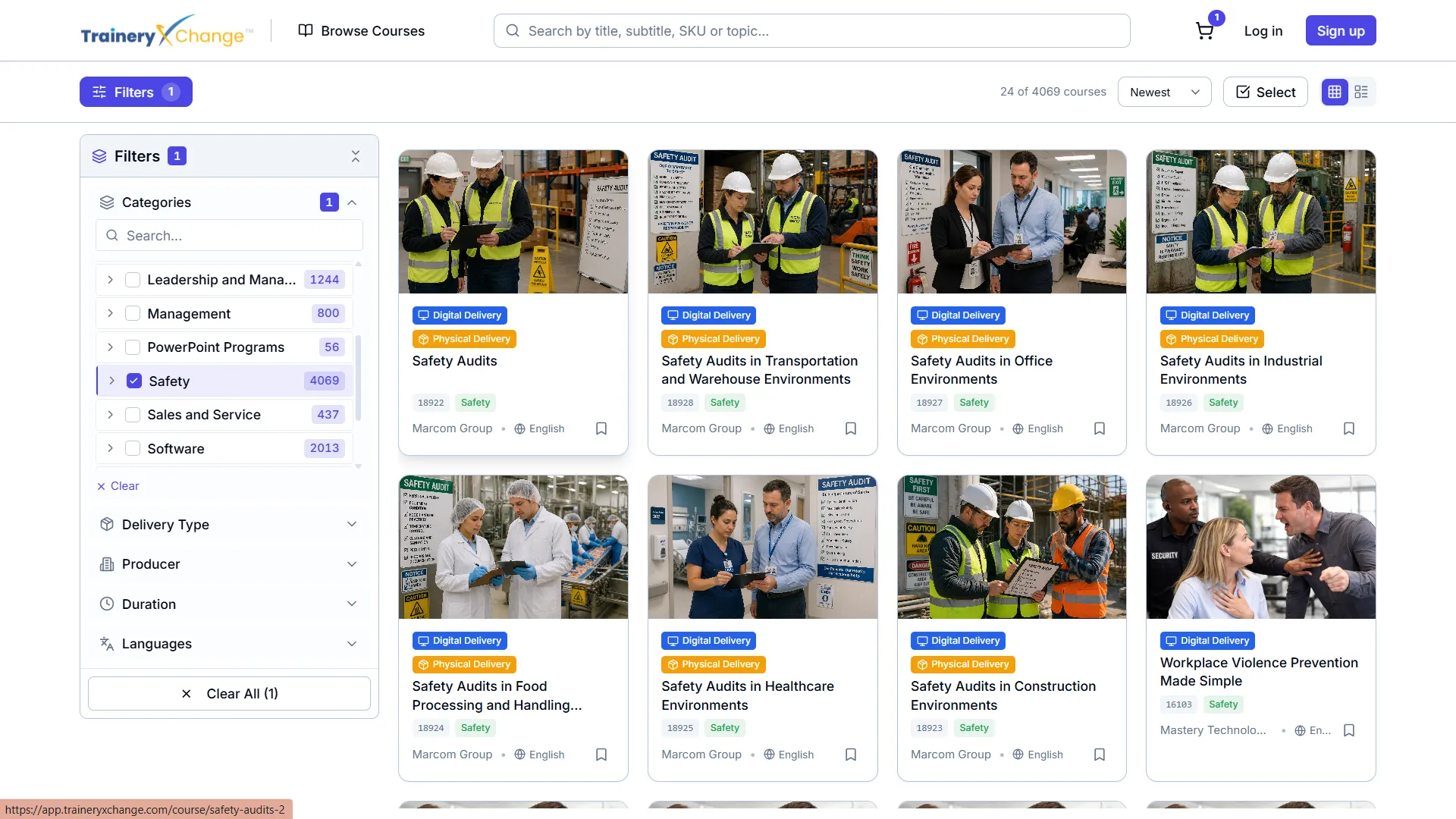
TraineryXchange provides access to 18,000+ training content options. Catalog breadth improves choice, but the selected course still needs to be evaluated for audience, jurisdiction, format, accessibility, licensing, and delivery requirements.

2. Compare Total Cost With Organization-Specific Inputs

Generic claims such as “an internal course costs $50,000” or “marketplace content costs $50 per course” are not reliable enough for a purchasing decision. Costs vary substantially by production scope, subject-matter expertise, legal review, media, accessibility, translation, authoring tools, LMS requirements, licensing model, learner count, and maintenance.

Build a simple total-cost model using actual inputs:

  • instructional-design and project-management hours
  • SME and stakeholder review hours
  • legal or compliance review where needed
  • authoring, media, accessibility, and translation costs
  • LMS, hosting, integration, and administration costs
  • external course licensing and learner or usage fees
  • expected revision and maintenance effort

For marketplace licensing, compare current vendor quotes and contract terms rather than assuming one pricing model. Our training licensing cost guide explains the variables to include.

3. Treat Deployment Speed as a Workflow Question

Existing content can reduce production time, but “same-day deployment” should not be assumed. A buyer may still need procurement, legal review, security review, licensing, LMS configuration, accessibility checks, technical testing, and internal approval.

Likewise, an internal course does not always require months. A short policy update may be produced quickly, while a complex simulation can take substantially longer. Estimate both options from the actual scope and approval path.

4. Do Not Outsource Compliance Accountability

Externally licensed compliance content can reduce internal authoring work, but a marketplace listing does not prove that a course is legally sufficient for every organization.

Before deployment, verify:

  • the governing requirement
  • covered jurisdiction and learner population
  • required duration, interaction, trainer, assessment, or practical elements where applicable
  • publisher review date and sources
  • organization-specific policies or procedures that must be added
  • records the organization must retain

Use the compliance training evidence checklist for a more detailed review framework.

5. Understand How Content Updates Actually Work

Neither internally built nor licensed content stays current by itself. Internal content requires an owner to monitor changes, review affected material, revise it, test it, and redistribute it. External content requires the buyer to understand the publisher’s monitoring and versioning process.

Hosted or dispatched delivery can simplify package replacement in some configurations, but it should not be described as guaranteeing automatic legal currency or zero administrator action. A publisher may update a hosted course while the customer still needs to review the change, communicate it, retest the experience, or reassign training.

Ask who monitors changes, what triggers review, how revisions are approved, how customers are notified, how previous completions are handled, and whether a new assignment or package is required. See how compliance course updates should be evaluated.

6. Compare Learning Quality at the Course Level

Do not assume externally produced content is more engaging than internal content, or that internal content has lower completion rates. Learning quality depends on objective alignment, instructional design, relevance, accessibility, practice, assessment, facilitation, and the learner environment.

Review sample content and evaluate whether the course helps learners perform the required task. Completion rate alone is not a reliable measure of learning effectiveness.

7. Confirm Technical Delivery Before Buying

Marketplace content may be delivered through SCORM packages, hosted launches, LTI, xAPI workflows, AICC, or other models depending on the provider and course. These approaches are not interchangeable.

Verify the selected course in the target LMS. Test launch, bookmarking, completion, score, reporting, mobile behavior, accessibility, and update handling. The third-party LMS content guide provides a rollout checklist.

When In-House Content Is Usually Stronger

  • company-specific onboarding and procedures
  • proprietary product or system training
  • site-specific safety procedures and equipment
  • internal policies, reporting channels, and escalation workflows
  • culture, values, and organization-specific leadership frameworks
  • sales processes and customer-specific enablement

When Marketplace Content May Be Stronger

  • a suitable course already exists and has been verified
  • the topic is broadly transferable across organizations
  • internal authoring capacity is constrained
  • multiple providers or formats need to be compared
  • the organization wants to expand topic coverage without building every course

A Hybrid Model Is Often the Practical Answer

Many organizations benefit from combining licensed and internal content. External courses can cover broadly applicable knowledge or skills, while internal modules add policies, systems, examples, manager expectations, reporting channels, or practical verification.

This avoids forcing a generic course to carry organization-specific information it was never designed to contain.

How to Evaluate a Training Marketplace

  1. Course fit: Can the buyer inspect the actual learning objectives, audience, format, and sample experience?
  2. Publisher evidence: Is subject-matter and review information available where relevant?
  3. Compliance scope: Can jurisdiction, role, and version information be verified for regulated content?
  4. Technical delivery: What formats and LMS workflows are available for the selected course?
  5. Accessibility and language: What course-level information is available?
  6. Update governance: How are revisions, retirements, and notifications handled?
  7. Licensing: What are the current price, usage rights, term, learner limits, and renewal conditions?

Our training marketplace quality checklist covers these questions in more detail.

Where TraineryXchange Fits

TraineryXchange provides access to 18,000+ training content options, along with TraineryLMS and supported delivery workflows for compatible existing learning environments. Exact course formats, licensing, accessibility, language availability, credentials, updates, reporting, and integrations depend on the selected content, publisher, systems, and configuration.

Explore the corporate training content marketplace or book a demo to compare content and delivery requirements for your organization.

Conclusion

The build-or-buy decision is not about proving that one sourcing model always wins. Compare the specificity of the requirement, total cost of ownership, internal capacity, compliance accountability, technical delivery, maintenance, and learner needs. Use marketplace content where it fits, build internally where context matters, and combine both when that produces the strongest program.
Key Takeaways:

  • Use marketplace content for common needs when a suitable course exists, but build organization-specific training when context is essential.
  • Compare total cost using your own labor, vendor quotes, licensing, LMS, review, and maintenance inputs rather than generic benchmark prices.
  • Verify compliance scope and update governance instead of assuming externally licensed content stays legally current automatically.
  • Confirm the exact course format, license, accessibility, language, and LMS delivery workflow before purchase.
  • A hybrid portfolio often works best: licensed content for repeatable topics and internal content for proprietary processes, systems, and culture.

Training Marketplace vs In-House Content: Build or Buy Guide

When a training need appears, L&D teams usually have three choices: build the content internally, license an existing course, or combine external content with organization-specific material. There is no universal winner. The right decision depends on how specific the requirement is, whether suitable content already exists, the evidence required, the delivery environment, and the ongoing cost of ownership.

This guide provides a practical build-or-buy framework without relying on generic course-cost benchmarks, guaranteed deployment times, or assumptions that marketplace content is automatically more accurate or effective.

Quick Comparison

FactorBuild In-HouseLicense Marketplace Content
Best fitProprietary systems, products, procedures, culture, local processesCommon professional skills and many broadly applicable training topics when suitable content exists
Time to deployDepends on scope, SME availability, production, review, and QACan be faster when suitable content, licensing, and delivery are already available
CostInternal labor, SME time, tools, production, review, LMS, maintenanceLicense, learner or usage fees, LMS or integration, administration, support
ControlHigh control over examples, branding, policy, workflow, and updatesDepends on publisher, license, customization rights, and delivery model
Compliance reviewOrganization owns legal and regulatory reviewPublisher processes may help, but buyer still needs to verify scope and suitability
UpdatesOrganization owns monitoring, revision, QA, and redistributionPublisher may issue revisions, but notification and customer actions depend on the delivery model

1. Start With Training Specificity

Build internally when the learner must understand information that an external publisher cannot know: company systems, equipment, products, policies, reporting channels, workflows, customers, or culture.

Marketplace content is more likely to fit when the objective is broadly transferable, such as communication, leadership fundamentals, common software skills, or a compliance topic for which an appropriate course exists. For regulated training, start with the governing requirement and verify the exact course rather than assuming a generic title satisfies it.

TraineryXchange provides access to 18,000+ training content options. Catalog breadth improves choice, but the selected course still needs to be evaluated for audience, jurisdiction, format, accessibility, licensing, and delivery requirements.

2. Compare Total Cost With Organization-Specific Inputs

Generic claims such as “an internal course costs $50,000” or “marketplace content costs $50 per course” are not reliable enough for a purchasing decision. Costs vary substantially by production scope, subject-matter expertise, legal review, media, accessibility, translation, authoring tools, LMS requirements, licensing model, learner count, and maintenance.

Build a simple total-cost model using actual inputs:

  • instructional-design and project-management hours
  • SME and stakeholder review hours
  • legal or compliance review where needed
  • authoring, media, accessibility, and translation costs
  • LMS, hosting, integration, and administration costs
  • external course licensing and learner or usage fees
  • expected revision and maintenance effort

For marketplace licensing, compare current vendor quotes and contract terms rather than assuming one pricing model. Our training licensing cost guide explains the variables to include.

3. Treat Deployment Speed as a Workflow Question

Existing content can reduce production time, but “same-day deployment” should not be assumed. A buyer may still need procurement, legal review, security review, licensing, LMS configuration, accessibility checks, technical testing, and internal approval.

Likewise, an internal course does not always require months. A short policy update may be produced quickly, while a complex simulation can take substantially longer. Estimate both options from the actual scope and approval path.

4. Do Not Outsource Compliance Accountability

Externally licensed compliance content can reduce internal authoring work, but a marketplace listing does not prove that a course is legally sufficient for every organization.

Before deployment, verify:

  • the governing requirement
  • covered jurisdiction and learner population
  • required duration, interaction, trainer, assessment, or practical elements where applicable
  • publisher review date and sources
  • organization-specific policies or procedures that must be added
  • records the organization must retain

Use the compliance training evidence checklist for a more detailed review framework.

5. Understand How Content Updates Actually Work

Neither internally built nor licensed content stays current by itself. Internal content requires an owner to monitor changes, review affected material, revise it, test it, and redistribute it. External content requires the buyer to understand the publisher’s monitoring and versioning process.

Hosted or dispatched delivery can simplify package replacement in some configurations, but it should not be described as guaranteeing automatic legal currency or zero administrator action. A publisher may update a hosted course while the customer still needs to review the change, communicate it, retest the experience, or reassign training.

Ask who monitors changes, what triggers review, how revisions are approved, how customers are notified, how previous completions are handled, and whether a new assignment or package is required. See how compliance course updates should be evaluated.

6. Compare Learning Quality at the Course Level

Do not assume externally produced content is more engaging than internal content, or that internal content has lower completion rates. Learning quality depends on objective alignment, instructional design, relevance, accessibility, practice, assessment, facilitation, and the learner environment.

Review sample content and evaluate whether the course helps learners perform the required task. Completion rate alone is not a reliable measure of learning effectiveness.

7. Confirm Technical Delivery Before Buying

Marketplace content may be delivered through SCORM packages, hosted launches, LTI, xAPI workflows, AICC, or other models depending on the provider and course. These approaches are not interchangeable.

Verify the selected course in the target LMS. Test launch, bookmarking, completion, score, reporting, mobile behavior, accessibility, and update handling. The third-party LMS content guide provides a rollout checklist.

When In-House Content Is Usually Stronger

  • company-specific onboarding and procedures
  • proprietary product or system training
  • site-specific safety procedures and equipment
  • internal policies, reporting channels, and escalation workflows
  • culture, values, and organization-specific leadership frameworks
  • sales processes and customer-specific enablement

When Marketplace Content May Be Stronger

  • a suitable course already exists and has been verified
  • the topic is broadly transferable across organizations
  • internal authoring capacity is constrained
  • multiple providers or formats need to be compared
  • the organization wants to expand topic coverage without building every course

A Hybrid Model Is Often the Practical Answer

Many organizations benefit from combining licensed and internal content. External courses can cover broadly applicable knowledge or skills, while internal modules add policies, systems, examples, manager expectations, reporting channels, or practical verification.

This avoids forcing a generic course to carry organization-specific information it was never designed to contain.

How to Evaluate a Training Marketplace

  1. Course fit: Can the buyer inspect the actual learning objectives, audience, format, and sample experience?
  2. Publisher evidence: Is subject-matter and review information available where relevant?
  3. Compliance scope: Can jurisdiction, role, and version information be verified for regulated content?
  4. Technical delivery: What formats and LMS workflows are available for the selected course?
  5. Accessibility and language: What course-level information is available?
  6. Update governance: How are revisions, retirements, and notifications handled?
  7. Licensing: What are the current price, usage rights, term, learner limits, and renewal conditions?

Our training marketplace quality checklist covers these questions in more detail.

Where TraineryXchange Fits

TraineryXchange provides access to 18,000+ training content options, along with TraineryLMS and supported delivery workflows for compatible existing learning environments. Exact course formats, licensing, accessibility, language availability, credentials, updates, reporting, and integrations depend on the selected content, publisher, systems, and configuration.

Explore the corporate training content marketplace or book a demo to compare content and delivery requirements for your organization.

Conclusion

The build-or-buy decision is not about proving that one sourcing model always wins. Compare the specificity of the requirement, total cost of ownership, internal capacity, compliance accountability, technical delivery, maintenance, and learner needs. Use marketplace content where it fits, build internally where context matters, and combine both when that produces the strongest program.
Frequently Asked Questions

Does TraineryXchange offer a free trial?
Can I use marketplace content alongside content I build internally?
How long does it take to deploy training content from a marketplace?
What types of training content are available on a marketplace?
What is a curated training marketplace?
How much cheaper is a training marketplace vs building in-house?
Is curated training content as good as custom-built content?