
How to Build an Employee Training Program From Scratch (No LMS Required)

A practical sequence for building a first training program with no platform, no budget line, and one person doing the work.

Updated On:
July 27, 2026

Mahesh Kumar

Founder, TraineryHCM.com
How to Build an Employee Training Program From Scratch (No LMS Required)

Table of Contents

Quick answer: Build an employee training program by starting with obligations rather than aspirations. Identify what training is legally required for your roles, then what the business actually needs, then everything else. Define the roles and what each must be able to do. Decide for each item whether to license existing content or build it internally, keeping in mind that only organization-specific material has to be built. Choose a delivery method proportionate to your size, which for a small organization may not require a learning platform at first. Set up record keeping before delivery begins, since retention obligations start with the first completion. Then run a small pilot, fix what breaks, and expand.

The task usually lands on one person. An HR generalist, an operations manager, or a business owner is told the company needs a training program, and there is no budget line, no learning platform, no existing content, and no one to delegate to.

The instinct is to start by looking at software or buying a course library. Both are premature. A program that starts with a tool tends to produce completion data about training nobody needed. Starting with obligations and roles produces something smaller, cheaper, and defensible.

This guide sets out a sequence that works at company sizes from about ten people upward, explains what you can defer, and covers the record keeping that most first programs get wrong. It assumes no existing infrastructure.

Step One: Separate Required From Wanted

Before designing anything, sort every candidate training item into three buckets. This single step prevents most of the wasted effort in a first program.

Legally or contractually required. Training mandated by regulation, by a customer contract, by an insurer, or by a license your business holds. These are non-negotiable and go first regardless of cost or enthusiasm.

Operationally necessary. Training without which the work cannot be done correctly. Onboarding to your systems, your processes, your products, your safety practices. This is where most of the actual business value sits.

Developmental. Training that improves capability over time but is not blocking anything today. Leadership skills, professional development, career growth. Valuable, and the first thing to defer if resources are tight.

The first bucket is the one people most often get wrong, usually by underestimating it. Requirements vary by industry, state, headcount, and the work performed. Safety obligations attach to specific hazards rather than to job titles. Harassment prevention training is mandated in some states and not others, with thresholds that change. Regulated sectors carry their own regimes entirely. Our overview of mandatory compliance training requirements by industry and state is a starting point, though the definitive answer for your organization needs confirmation against current regulation and, where the stakes justify it, legal review.

Write the list down with sources. For each required item, record what mandates it, which roles it applies to, how often it repeats, and what evidence must be kept. That document becomes the backbone of the program and the thing you hand to an auditor, an insurer, or your successor.

Step Two: Define Roles and What Each Must Do

Group people by what they actually do, not by department or reporting line. A department is an administrative unit. Training requirements follow the work.

For each role, write down the tasks that are frequent, consequential, or difficult, and the standard each must be performed to. Write these as observable behavior. "Understands the returns process" cannot be assessed. "Can process a return, issue a refund, and update inventory without supervision" can.

In a small organization this exercise usually produces four to eight roles and five to eight capabilities each, and it takes a few hours of conversation with the people who do the work. That is enough. The full method, including how to source task detail and set proficiency levels, is set out in our guides to running a training needs analysis and building a training gap matrix. If you want structured input from the team rather than assumptions, the question sets in our training needs assessment questionnaire guide can be run informally in a small company.

Once roles are defined, mapping training to them is mechanical. Every requirement, whether regulatory or operational, attaches to one or more roles, and that mapping is what stops you assigning everything to everyone. The reasoning behind that structure is covered in our role-based training guide.

Step Three: Decide What to Build and What to License

This decision determines most of your cost and timeline, and it usually splits more cleanly than people expect.

Content TypeBuild or LicenseWhy
Your systems, processes, and productsBuildNobody else has this information
Your policies and how to follow themBuildPolicy training is organization-specific by definition
Site-specific safety proceduresBuildTied to your equipment and layout
General regulatory and compliance topicsLicenseWidely available, expensive to build and maintain
Common safety subjectsLicenseStandardized content, regularly updated
Professional and managerial skillsLicenseGeneric by nature, high production cost to build
Software and technical skillsLicenseChanges constantly, maintenance burden is high

The maintenance burden is the factor most often overlooked. Building a compliance course is a one-time project. Keeping it accurate as regulation changes is a permanent commitment, and it is where internally built compliance content usually fails, quietly, two years after launch. The full cost comparison is set out in curated training marketplace versus building content in-house, and the economics specifically for smaller organizations are covered in the ROI of outsourced training content.

For the content you do build, resist the urge to produce polished video first. A written procedure with screenshots, a recorded walkthrough, or a structured checklist delivers most of the value at a fraction of the effort, and it is far easier to update when the process changes.

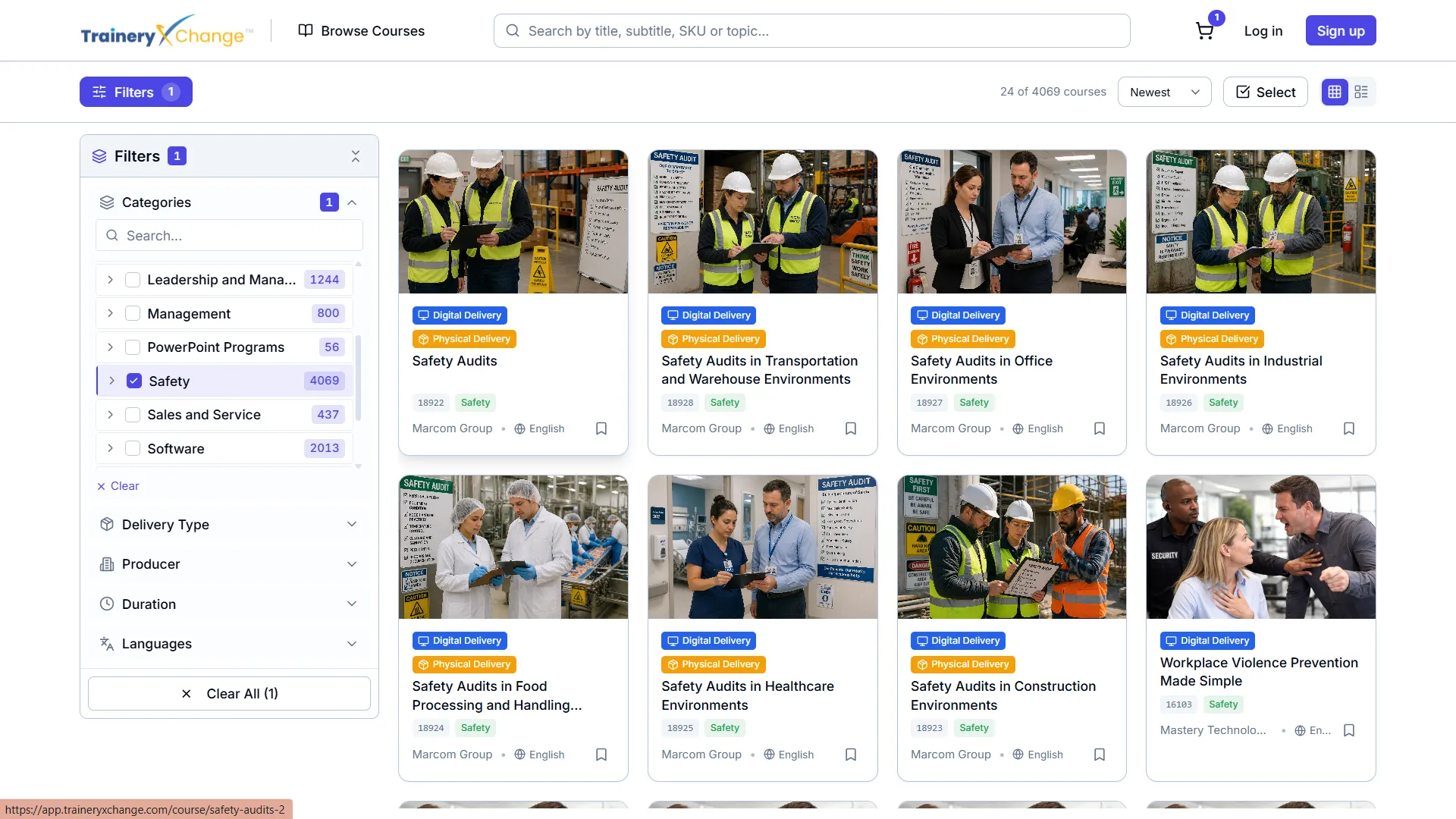
See What You Would Not Need to Build

Browse the live catalog against your list of required and operational training to identify which items already exist under license, so your build effort goes only to what is genuinely specific to your organization.

Browse the Course Catalog

Step Four: Choose Delivery Proportionate to Your Size

A learning platform is not the first purchase for most small organizations, and buying one before you have content or a defined program is a common early mistake.

ApproachWorks WhenBreaks Down When
In person, tracked on a spreadsheetVery small team, one site, few requirementsTurnover rises or requirements start recurring
Documents and videos in shared storageContent is stable, workforce is office basedYou need completion evidence or version control
Courses delivered through a learning platformRecurring requirements, multiple roles, records neededRarely; this is the durable answer for most
Content delivered into a platform you already haveAn LMS or HR system with learning features existsThe existing system cannot accept external content

The signal that you have outgrown spreadsheets is usually recurrence. One-off onboarding can be tracked manually. Requirements that expire per person on rolling dates cannot, because the tracking burden grows with headcount and nobody notices a missed renewal until something goes wrong.

If you already have an HR system, check whether it includes learning functionality before buying anything separate. If you do need a platform, organizations without one can use a native environment such as TraineryLMS, while organizations that already have a system can look at delivering licensed content into it instead. The options for a smaller organization are set out on our small business and startup training pages.

If a meaningful share of your workforce is on a shop floor, a route, or a shift pattern, the delivery decision changes considerably, since email-based assignment and desktop access do not reach those populations. Those constraints are covered in training deskless and shift-based employees.

Step Five: Set Up Record Keeping First

Records are the part of a first program that is most often added later, and adding them later means the early records do not exist.

Decide before your first delivery what a completion record will contain: the person's name and job title, the course or session title with its version or date, the requirement it satisfies, the date completed, the delivery method, and who delivered it. Adopt one format for everything.

Retention periods vary by the regulation that required the training, and some are long. A default policy of retaining records for the duration of employment plus a defined period, with longer statutory periods applied where they exist, is simpler to operate than tracking each rule separately. The detail is covered in our guide to how long to keep employee training records.

Two practical points for a small organization. Store records somewhere that will survive a staff change or a software change, and confirm you can export them. And keep the renewal date separate from the completion record, because those answer different questions and conflating them is how renewals get missed.

Step Six: Sequence the Rollout

Do not launch everything at once. A first program that tries to deliver twelve courses in a month produces resentment and low completion.

Start with required training for the highest-risk roles. This is the smallest set with the clearest justification, and completing it gives you something concrete to show leadership.

Move next to onboarding for the roles you hire most often. Onboarding delivers the most visible operational return in a small company because it shortens the period during which a new hire consumes a manager's time. Where you need content for common new-hire subjects, our guide to finding ready-made new employee training programs covers the sourcing options, and the delivery structure is set out on our employee onboarding page.

Then address the operational gaps that are causing visible problems, chosen by impact rather than by who complained loudest.

Developmental training comes last. It matters, particularly for retention, but it is the correct thing to defer while the required and operational layers are still incomplete. When you do reach it, the practical starting points are usually frontline leadership, covered in soft skills training for managers, and any capability shift the business is planning for, where the distinction between upskilling and reskilling changes both the content and the timeline.

Step Seven: Pilot Before You Scale

Run the first piece of the program with one team before rolling it out.

A pilot surfaces the practical failures that no amount of planning catches: content that assumes knowledge people do not have, a login process that does not work on a phone, a course length that does not fit into a shift, instructions that make sense to you and to nobody else.

Keep the pilot short and ask three questions afterward. Could you complete it without help? Was anything unclear or wrong? Can you now do the thing it was meant to teach? The third question is the one that matters, and it is the one most feedback forms omit.

Fix what the pilot revealed before expanding. A program that works badly at scale is much harder to correct than one that works badly for eight people.

Step Eight: Decide How You Will Know It Worked

Completion rate tells you an assignment was finished. It says nothing about whether anyone can do the job better.

For each training item, name one thing that should change and how you would notice. For onboarding, the time until a new hire works independently. For a safety requirement, incident or near-miss counts. For a process course, error or rework rates. For a customer-facing course, complaint or escalation volume.

Record the baseline before delivery. Without it, any post-training number is unanchored. In a small company these measures can be informal, but they need to be written down, because memory reconstructs the baseline favorably.

The structure for this is covered in measuring learning effectiveness beyond completion rates, with a starting metric set in the training KPI dashboard. Use a small subset of that rather than all of it.

What a First-Year Program Reasonably Looks Like

For an organization of roughly twenty-five to two hundred people with no existing infrastructure, a realistic first year covers a documented list of required training with sources, a role map with defined capabilities, a structured onboarding path for the two or three roles you hire most, licensed content covering general compliance and safety obligations, internally built material for your own systems and processes, a consistent completion record format with a written retention policy, and one or two measured outcomes.

That is a complete program. It does not include a skills taxonomy, a competency framework, a learning experience platform, or a development curriculum for every role. Those are appropriate later and are a common cause of stalled first attempts when pursued too early.

Common Mistakes in a First Program

Buying software first. The tool should follow the program, not define it.

Underestimating required training. The regulatory layer is usually larger than expected and carries the most consequence if missed.

Building content that already exists. Compliance and professional skills content is available under license and comes with a maintenance commitment you would otherwise carry yourself.

Assigning everything to everyone. It looks thorough, wastes time at scale, and dilutes the training that actually matters for each role.

Adding records later. Retention obligations begin at the first completion, not when you get organized.

Launching without a pilot. Problems that affect eight people are fixable. The same problems across two hundred people are a credibility loss.

No named owner. A program without one person accountable for renewals, content review, and records will drift within two quarters.

When to Ask for Budget

The strongest time to request funding is after the required-training list exists and before anything is purchased, because at that point you can state the obligation, the population, the consequence of not acting, and a costed comparison between building and licensing.

Present the licensed option against the internal build option including the ongoing maintenance cost, which is what makes the licensing case rather than the purchase price alone. Include what you are deliberately deferring, since that shows the request has been filtered. The submission structure is set out in getting budget approved for a training content platform, and the evaluation criteria once funding exists are covered in the training content marketplace buyer checklist.

The Order That Makes This Work

Building a training program from scratch is a sequencing problem more than a resourcing one. Start with what is required, then what the work demands, then what would be good to have. Define roles before content. License anything generic and build only what is specific to your organization. Choose delivery proportionate to your size rather than to your ambitions. Set up records before the first completion, not after. Pilot, fix, then expand.

Done in that order, a workable first program is achievable by one person in a few months without specialist tooling. Done in the reverse order, starting with a platform purchase and a content library, it tends to produce a lot of activity and very little that anyone can point to a year later.

Teams reviewing what is available under license can look at the corporate content marketplace and how content curation maps courses to defined roles, along with the delivery paths for organizations with and without an existing learning platform. Where compliance obligations are a significant part of the first program, the sequencing guidance in designing compliance learning paths is worth reading before you assign anything.

Talk Through Your First Program

Bring your list of required and operational training and discuss what could be covered by licensed content, how delivery would work with or without an existing platform, and what a realistic first-year sequence looks like.

Book a Demo

Reference Sources

On identifying which training obligations attach to specific hazards and roles: Occupational Safety and Health Administration, Training Requirements

On the record keeping that begins with your first completion: Occupational Safety and Health Administration, Recordkeeping

Key Takeaways:‍

  • Sort every training item into required, operationally necessary, and developmental before designing anything. The required layer is usually larger than expected.
  • Define roles and observable capabilities before selecting content. Mapping training to roles is what stops you assigning everything to everyone.
  • Build only what is specific to your organization. General compliance, safety, and professional content is available under license with maintenance included.
  • Do not buy a learning platform first. Choose delivery proportionate to your size, and let recurring requirements be the signal that spreadsheets have stopped working.
  • Set up the completion record format and retention policy before your first delivery, because retention obligations start at the first completion.

Quick answer: Build an employee training program by starting with obligations rather than aspirations. Identify what training is legally required for your roles, then what the business actually needs, then everything else. Define the roles and what each must be able to do. Decide for each item whether to license existing content or build it internally, keeping in mind that only organization-specific material has to be built. Choose a delivery method proportionate to your size, which for a small organization may not require a learning platform at first. Set up record keeping before delivery begins, since retention obligations start with the first completion. Then run a small pilot, fix what breaks, and expand.

The task usually lands on one person. An HR generalist, an operations manager, or a business owner is told the company needs a training program, and there is no budget line, no learning platform, no existing content, and no one to delegate to.

The instinct is to start by looking at software or buying a course library. Both are premature. A program that starts with a tool tends to produce completion data about training nobody needed. Starting with obligations and roles produces something smaller, cheaper, and defensible.

This guide sets out a sequence that works at company sizes from about ten people upward, explains what you can defer, and covers the record keeping that most first programs get wrong. It assumes no existing infrastructure.

Step One: Separate Required From Wanted

Before designing anything, sort every candidate training item into three buckets. This single step prevents most of the wasted effort in a first program.

Legally or contractually required. Training mandated by regulation, by a customer contract, by an insurer, or by a license your business holds. These are non-negotiable and go first regardless of cost or enthusiasm.

Operationally necessary. Training without which the work cannot be done correctly. Onboarding to your systems, your processes, your products, your safety practices. This is where most of the actual business value sits.

Developmental. Training that improves capability over time but is not blocking anything today. Leadership skills, professional development, career growth. Valuable, and the first thing to defer if resources are tight.

The first bucket is the one people most often get wrong, usually by underestimating it. Requirements vary by industry, state, headcount, and the work performed. Safety obligations attach to specific hazards rather than to job titles. Harassment prevention training is mandated in some states and not others, with thresholds that change. Regulated sectors carry their own regimes entirely. Our overview of mandatory compliance training requirements by industry and state is a starting point, though the definitive answer for your organization needs confirmation against current regulation and, where the stakes justify it, legal review.

Write the list down with sources. For each required item, record what mandates it, which roles it applies to, how often it repeats, and what evidence must be kept. That document becomes the backbone of the program and the thing you hand to an auditor, an insurer, or your successor.

Step Two: Define Roles and What Each Must Do

Group people by what they actually do, not by department or reporting line. A department is an administrative unit. Training requirements follow the work.

For each role, write down the tasks that are frequent, consequential, or difficult, and the standard each must be performed to. Write these as observable behavior. "Understands the returns process" cannot be assessed. "Can process a return, issue a refund, and update inventory without supervision" can.

In a small organization this exercise usually produces four to eight roles and five to eight capabilities each, and it takes a few hours of conversation with the people who do the work. That is enough. The full method, including how to source task detail and set proficiency levels, is set out in our guides to running a training needs analysis and building a training gap matrix. If you want structured input from the team rather than assumptions, the question sets in our training needs assessment questionnaire guide can be run informally in a small company.

Once roles are defined, mapping training to them is mechanical. Every requirement, whether regulatory or operational, attaches to one or more roles, and that mapping is what stops you assigning everything to everyone. The reasoning behind that structure is covered in our role-based training guide.

Step Three: Decide What to Build and What to License

This decision determines most of your cost and timeline, and it usually splits more cleanly than people expect.

Content TypeBuild or LicenseWhy
Your systems, processes, and productsBuildNobody else has this information
Your policies and how to follow themBuildPolicy training is organization-specific by definition
Site-specific safety proceduresBuildTied to your equipment and layout
General regulatory and compliance topicsLicenseWidely available, expensive to build and maintain
Common safety subjectsLicenseStandardized content, regularly updated
Professional and managerial skillsLicenseGeneric by nature, high production cost to build
Software and technical skillsLicenseChanges constantly, maintenance burden is high

The maintenance burden is the factor most often overlooked. Building a compliance course is a one-time project. Keeping it accurate as regulation changes is a permanent commitment, and it is where internally built compliance content usually fails, quietly, two years after launch. The full cost comparison is set out in curated training marketplace versus building content in-house, and the economics specifically for smaller organizations are covered in the ROI of outsourced training content.

For the content you do build, resist the urge to produce polished video first. A written procedure with screenshots, a recorded walkthrough, or a structured checklist delivers most of the value at a fraction of the effort, and it is far easier to update when the process changes.

See What You Would Not Need to Build

Browse the live catalog against your list of required and operational training to identify which items already exist under license, so your build effort goes only to what is genuinely specific to your organization.

Browse the Course Catalog

Step Four: Choose Delivery Proportionate to Your Size

A learning platform is not the first purchase for most small organizations, and buying one before you have content or a defined program is a common early mistake.

ApproachWorks WhenBreaks Down When
In person, tracked on a spreadsheetVery small team, one site, few requirementsTurnover rises or requirements start recurring
Documents and videos in shared storageContent is stable, workforce is office basedYou need completion evidence or version control
Courses delivered through a learning platformRecurring requirements, multiple roles, records neededRarely; this is the durable answer for most
Content delivered into a platform you already haveAn LMS or HR system with learning features existsThe existing system cannot accept external content

The signal that you have outgrown spreadsheets is usually recurrence. One-off onboarding can be tracked manually. Requirements that expire per person on rolling dates cannot, because the tracking burden grows with headcount and nobody notices a missed renewal until something goes wrong.

If you already have an HR system, check whether it includes learning functionality before buying anything separate. If you do need a platform, organizations without one can use a native environment such as TraineryLMS, while organizations that already have a system can look at delivering licensed content into it instead. The options for a smaller organization are set out on our small business and startup training pages.

If a meaningful share of your workforce is on a shop floor, a route, or a shift pattern, the delivery decision changes considerably, since email-based assignment and desktop access do not reach those populations. Those constraints are covered in training deskless and shift-based employees.

Step Five: Set Up Record Keeping First

Records are the part of a first program that is most often added later, and adding them later means the early records do not exist.

Decide before your first delivery what a completion record will contain: the person's name and job title, the course or session title with its version or date, the requirement it satisfies, the date completed, the delivery method, and who delivered it. Adopt one format for everything.

Retention periods vary by the regulation that required the training, and some are long. A default policy of retaining records for the duration of employment plus a defined period, with longer statutory periods applied where they exist, is simpler to operate than tracking each rule separately. The detail is covered in our guide to how long to keep employee training records.

Two practical points for a small organization. Store records somewhere that will survive a staff change or a software change, and confirm you can export them. And keep the renewal date separate from the completion record, because those answer different questions and conflating them is how renewals get missed.

Step Six: Sequence the Rollout

Do not launch everything at once. A first program that tries to deliver twelve courses in a month produces resentment and low completion.

Start with required training for the highest-risk roles. This is the smallest set with the clearest justification, and completing it gives you something concrete to show leadership.

Move next to onboarding for the roles you hire most often. Onboarding delivers the most visible operational return in a small company because it shortens the period during which a new hire consumes a manager's time. Where you need content for common new-hire subjects, our guide to finding ready-made new employee training programs covers the sourcing options, and the delivery structure is set out on our employee onboarding page.

Then address the operational gaps that are causing visible problems, chosen by impact rather than by who complained loudest.

Developmental training comes last. It matters, particularly for retention, but it is the correct thing to defer while the required and operational layers are still incomplete. When you do reach it, the practical starting points are usually frontline leadership, covered in soft skills training for managers, and any capability shift the business is planning for, where the distinction between upskilling and reskilling changes both the content and the timeline.

Step Seven: Pilot Before You Scale

Run the first piece of the program with one team before rolling it out.

A pilot surfaces the practical failures that no amount of planning catches: content that assumes knowledge people do not have, a login process that does not work on a phone, a course length that does not fit into a shift, instructions that make sense to you and to nobody else.

Keep the pilot short and ask three questions afterward. Could you complete it without help? Was anything unclear or wrong? Can you now do the thing it was meant to teach? The third question is the one that matters, and it is the one most feedback forms omit.

Fix what the pilot revealed before expanding. A program that works badly at scale is much harder to correct than one that works badly for eight people.

Step Eight: Decide How You Will Know It Worked

Completion rate tells you an assignment was finished. It says nothing about whether anyone can do the job better.

For each training item, name one thing that should change and how you would notice. For onboarding, the time until a new hire works independently. For a safety requirement, incident or near-miss counts. For a process course, error or rework rates. For a customer-facing course, complaint or escalation volume.

Record the baseline before delivery. Without it, any post-training number is unanchored. In a small company these measures can be informal, but they need to be written down, because memory reconstructs the baseline favorably.

The structure for this is covered in measuring learning effectiveness beyond completion rates, with a starting metric set in the training KPI dashboard. Use a small subset of that rather than all of it.

What a First-Year Program Reasonably Looks Like

For an organization of roughly twenty-five to two hundred people with no existing infrastructure, a realistic first year covers a documented list of required training with sources, a role map with defined capabilities, a structured onboarding path for the two or three roles you hire most, licensed content covering general compliance and safety obligations, internally built material for your own systems and processes, a consistent completion record format with a written retention policy, and one or two measured outcomes.

That is a complete program. It does not include a skills taxonomy, a competency framework, a learning experience platform, or a development curriculum for every role. Those are appropriate later and are a common cause of stalled first attempts when pursued too early.

Common Mistakes in a First Program

Buying software first. The tool should follow the program, not define it.

Underestimating required training. The regulatory layer is usually larger than expected and carries the most consequence if missed.

Building content that already exists. Compliance and professional skills content is available under license and comes with a maintenance commitment you would otherwise carry yourself.

Assigning everything to everyone. It looks thorough, wastes time at scale, and dilutes the training that actually matters for each role.

Adding records later. Retention obligations begin at the first completion, not when you get organized.

Launching without a pilot. Problems that affect eight people are fixable. The same problems across two hundred people are a credibility loss.

No named owner. A program without one person accountable for renewals, content review, and records will drift within two quarters.

When to Ask for Budget

The strongest time to request funding is after the required-training list exists and before anything is purchased, because at that point you can state the obligation, the population, the consequence of not acting, and a costed comparison between building and licensing.

Present the licensed option against the internal build option including the ongoing maintenance cost, which is what makes the licensing case rather than the purchase price alone. Include what you are deliberately deferring, since that shows the request has been filtered. The submission structure is set out in getting budget approved for a training content platform, and the evaluation criteria once funding exists are covered in the training content marketplace buyer checklist.

The Order That Makes This Work

Building a training program from scratch is a sequencing problem more than a resourcing one. Start with what is required, then what the work demands, then what would be good to have. Define roles before content. License anything generic and build only what is specific to your organization. Choose delivery proportionate to your size rather than to your ambitions. Set up records before the first completion, not after. Pilot, fix, then expand.

Done in that order, a workable first program is achievable by one person in a few months without specialist tooling. Done in the reverse order, starting with a platform purchase and a content library, it tends to produce a lot of activity and very little that anyone can point to a year later.

Teams reviewing what is available under license can look at the corporate content marketplace and how content curation maps courses to defined roles, along with the delivery paths for organizations with and without an existing learning platform. Where compliance obligations are a significant part of the first program, the sequencing guidance in designing compliance learning paths is worth reading before you assign anything.

Talk Through Your First Program

Bring your list of required and operational training and discuss what could be covered by licensed content, how delivery would work with or without an existing platform, and what a realistic first-year sequence looks like.

Book a Demo

Reference Sources

On identifying which training obligations attach to specific hazards and roles: Occupational Safety and Health Administration, Training Requirements

On the record keeping that begins with your first completion: Occupational Safety and Health Administration, Recordkeeping
Frequently Asked Questions

When should I set up training records?
What can one person realistically build in the first year?
Should I build training content or license it?
Do I need an LMS to run an employee training program?
Where should I start when building a training program from scratch?