

%201.svg)
Quick answer: Audit a training content library by pulling four data sets before renewal: what you are contractually committed to, what was actually assigned, what was actually completed, and what each item costs. Compare them. Every course falls into one of five categories: actively used and required, actively used but not required, licensed but never assigned, assigned but never completed, or duplicated across vendors. Start the audit ninety days before renewal, because most agreements carry a notice period and losing that window removes your negotiating position entirely. The output is a keep, cut, consolidate, or renegotiate decision for every line, supported by usage evidence.
Content libraries accumulate. A compliance requirement adds one vendor, a leadership initiative adds another, a department buys its own subscription, and an acquisition brings a third. Three years later nobody can say with confidence what the organization is paying for, who is using it, or whether the same subject is licensed twice.
Renewal is the moment that becomes visible, and usually too late. The invoice arrives, the deadline is close, and the safe decision is to renew as-is because there is no evidence to support anything else.
An audit changes that. It replaces an assumption with usage data and gives you a defensible position at the table. This guide covers what to pull, how to classify what you find, how to identify licenses nobody is using, and how to sequence the work so the findings land before the notice period closes.
Start Ninety Days Out, Not Thirty
The timing matters more than the analysis, because most content agreements carry an automatic renewal clause with a notice period attached.
Notice periods commonly run from thirty to ninety days before the term ends, though the specific figure varies by agreement and should be read from your own contract rather than assumed. Miss the window and the agreement renews on its existing terms, regardless of what your audit found. That single clause removes more negotiating leverage than any other feature of these contracts.
Work backward from the renewal date. Allow two to three weeks to gather data, two weeks to analyze it, two weeks for stakeholder review, and then the notice period itself. Ninety days is a realistic minimum for a library of any size, and a hundred and twenty is better if multiple vendors renew in the same quarter.
Before anything else, build a simple register of every content agreement with its renewal date, notice period, term length, and auto-renewal terms. Most organizations doing this for the first time discover at least one agreement they had forgotten and at least one notice period they have already missed.
Pull Four Data Sets
The audit is a comparison exercise. You need four things, and the gaps between them are the findings.
| Data Set | Source | What to Capture | Common Problem |
|---|---|---|---|
| Contractual commitment | Agreements and purchase orders | Titles, seat or user counts, term, renewal and notice dates, price | Agreements held by different departments |
| Assignment activity | LMS or platform reporting | Which courses were assigned, to whom, when | Assignment and enrollment counted differently |
| Completion activity | LMS or platform reporting | Starts, completions, and time period | Completion definitions differ between systems |
| Cost allocation | Finance | Actual spend by vendor and cost center | Spend recorded under general software categories |
Use a full twelve-month window rather than a quarter. Compliance content is cyclical, and a quarterly view will make an annually assigned course look unused.
Where reporting is fragmented across an LMS, an HR system, and a content provider's own dashboard, reconciliation is the hard part. Numbers rarely match exactly, and chasing perfect agreement wastes time. Establish which system is authoritative for each measure and note the discrepancy rather than trying to eliminate it. Reducing that fragmentation is a separate project, and the case for it is set out in LMS and HRIS integration.
Classify Every Line Item
Once the data is assembled, sort every licensed course or content package into one of five categories. The category determines the decision.
| Category | How to Identify It | Default Decision | What to Verify First |
|---|---|---|---|
| Used and required | Regular assignment, satisfies an obligation | Keep | Content currency and update cadence |
| Used but not required | Regular assignment, no obligation attached | Keep if it maps to a real capability gap | Whether it maps to anything documented |
| Licensed, never assigned | Zero assignments in twelve months | Cut | Whether it is held deliberately as reserve |
| Assigned, rarely completed | High assignment, low completion | Investigate before cutting | Whether the barrier is content or delivery |
| Duplicated | Same subject licensed from two vendors | Consolidate | Which version is actually better |
The fourth category is the one most often mishandled. A course with low completion may be poor content, but it may equally be a delivery problem: too long for the population, inaccessible to people without corporate email, or technically broken. Cutting a course that failed for access reasons and replacing it with another that fails the same way solves nothing. The diagnostic questions are covered in training deskless and shift-based employees and, where completions are simply not recording, in why a SCORM course shows incomplete.
Find the Licenses Nobody Is Using
Unused capacity is usually the largest single finding, and it takes several forms.
Seats assigned to people who left. Where licensing is per named user and deprovisioning is manual, departed employees continue to consume seats. Compare the active user list against the current HR roster rather than against last year's headcount.
Seats held for a population that never launched. A department planned a rollout, licenses were purchased, priorities changed, and the licenses were never reallocated.
Catalog breadth nobody browses. Where a subscription grants access to a wide catalog, measure how much of it is actually reached. Broad access has value as optionality, but that value should be a deliberate decision rather than an assumption.
Duplicate subject coverage. The same compliance or professional subject licensed from two vendors because two departments bought independently.
Overlapping platform features. Content licensed separately that is also included in a platform subscription already held.
Quantify each in both seats and spend. A finding expressed as a number of unused seats is interesting; the same finding expressed as annual cost is actionable. Whether this analysis is straightforward or painful depends heavily on your licensing model, and the mechanics of each are covered in per-seat versus per-course licensing and consumption-based versus subscription licensing.
Compare Your Current Coverage Against What Is Available
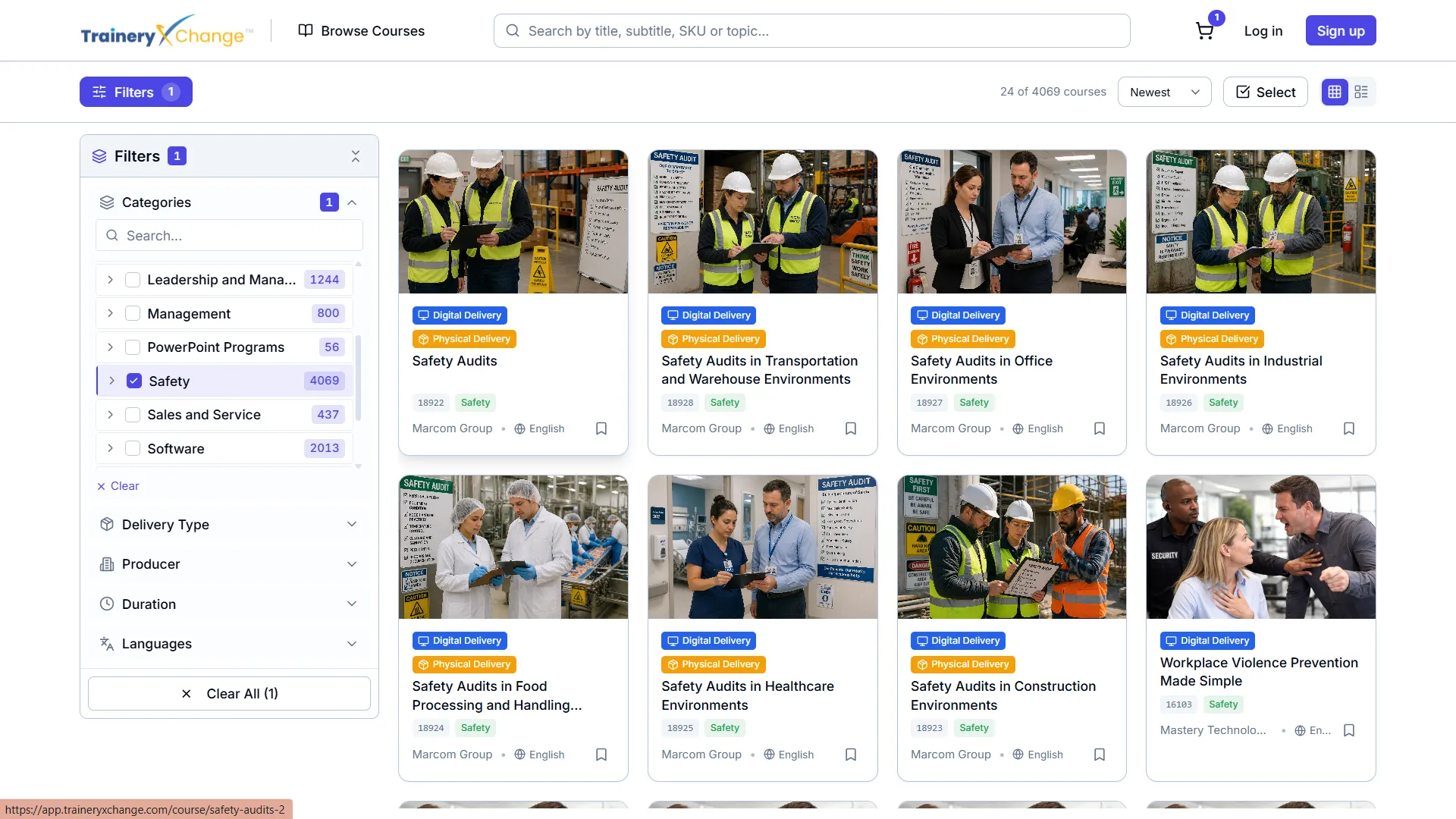
Browse the live catalog against your audit findings to see where duplicated subjects could be consolidated and which gaps in your current library are already covered under license.
Check Content Currency, Not Just Usage
Usage tells you whether people opened something. It does not tell you whether what they opened was accurate.
For every compliance, safety, and regulatory course, record when it was last updated and what triggered that update. Content referencing superseded regulation is worse than no content, because it produces a completion record against inaccurate instruction and creates a false sense of coverage.
Ask each provider directly how frequently material is reviewed, what triggers an update, how customers are notified, and whether updates are included in the license or charged separately. Those questions belong in the renewal conversation, and the detail is covered in how compliance courses stay current and how often compliance training content gets updated.
Where content supports a regulatory obligation, currency is not a quality preference. It is the difference between a defensible record and an evidence gap, which is the reasoning set out in what makes a compliance course legally defensible.
Confirm What Happens to Your Records
This is the question most often missed in a renewal audit, and it has consequences that outlast the agreement.
Establish for each vendor what happens to completion records if you do not renew. Can historical data be exported, in what format, and for what period? Does access to records end with the subscription? Are records held in your LMS or in the provider's system?
The answer matters because retention obligations attach to the training regardless of your commercial relationship, and several run for years beyond employment. If a vendor holds the only copy of records you are required to retain, that is a risk to resolve before renewal rather than after termination. The applicable periods are set out in how long to keep employee training records.
Export your records before making any termination decision, not after. Once notice is served, cooperation tends to become slower.
Map Coverage Against Actual Requirements
Usage data tells you what people did. It does not tell you whether it was the right thing.
Take your list of regulatory obligations and your documented capability gaps, and check each against the library. Two findings usually emerge. The first is content covering subjects nobody requires, purchased for a reason that no longer applies. The second is a requirement with no content behind it at all, which is the more serious of the two.
Where a capability framework or gap matrix already exists, this mapping is quick. Where it does not, the audit is a reasonable moment to build one, using the method in training gap analysis and, for a full review, training needs analysis. The obligation side should be checked against mandatory compliance training requirements.
Build the Renewal Position
The audit output is a document, not a spreadsheet. It should state a decision for every line and the evidence behind it.
Group findings into four actions. Renew as-is where usage justifies the cost and content is current. Renegotiate where usage is materially below the licensed volume, since utilization data is the strongest argument available for reducing committed seats or adjusting the model. Consolidate where duplicated subjects sit across vendors. Terminate where a line has no usage and no requirement behind it.
Quantify the total in annual spend, and separate the confirmed savings from the contingent ones so nobody presents a negotiation hope as a delivered result.
Bring the utilization data to the conversation rather than describing it. A vendor discussion in which you can state actual assignment and completion volumes against licensed capacity proceeds differently from one in which you ask for a discount. Where the outcome points toward reducing vendor count, sequence the transition before serving notice on anything, and where it points toward changing provider, migrating between content providers covers what that involves.
Make the Next Audit Easier
The first audit is difficult because nothing was set up to support it. The second does not have to be.
Maintain the agreement register with renewal and notice dates, and set calendar reminders at the notice date minus ninety days rather than at the renewal date. Tag every licensed course with the requirement or capability it supports, so coverage mapping becomes a filter rather than a project. Establish a quarterly utilization review rather than an annual scramble, even if it is only a single report. Route all content purchases through one approval point to prevent new shadow subscriptions.
The reporting that supports this is worth specifying before your next purchase rather than after. What you need is assignment and completion by course, by population, and by period, exportable without a support request. Our guidance on reporting that matters and course performance metrics covers what to ask for, and the evaluation criteria belong in the training content marketplace buyer checklist.
What the Audit Usually Reveals
Patterns recur across organizations doing this for the first time.
Spend is higher than expected once departmental subscriptions are included. Utilization is concentrated in a small share of the catalog. At least one subject is licensed twice. At least one agreement auto-renewed without review. Compliance content is current while professional development content is several years old. And the largest single cost is usually seats rather than content, meaning the licensing model deserves as much attention as the catalog itself.
None of that is a failure of management. It is the predictable result of buying content over several years without a review mechanism, which is why the register and the quarterly check matter more than any single audit.
What You Should Have Before the Renewal Meeting
A content library audit is a comparison between what you committed to, what was assigned, what was completed, and what it cost. The gaps between those four data sets are the findings, and every line ends with a keep, cut, consolidate, or renegotiate decision supported by evidence.
Start ninety days out, because the notice period rather than the renewal date is the real deadline. Pull a full twelve months of data. Classify every item. Quantify unused capacity in spend rather than seats. Check content currency alongside usage. Confirm what happens to your completion records before you terminate anything. And map coverage against actual obligations, since the most serious finding is usually a requirement with no content behind it rather than a course nobody used.
Teams reviewing alternatives after an audit can compare options in the corporate content marketplace, review the structures available for training content licensing, and see how content curation maps a catalog to defined roles. The broader cost comparison against building internally is set out in the ROI of outsourced training content.
Review Your Audit Findings Before You Renew
Walk through your utilization data, duplicated subjects, and coverage gaps, and discuss what a consolidated licensing structure would look like across the roles and populations you actually need to reach.
Reference Source
On the record retention obligations referenced above: Occupational Safety and Health Administration, Recordkeeping




%5B1%5D.svg)
